




















Search
Science and Tech

Look out at a distant object, and you're not seeing it as it is today. It's size, brightness, and actual distance are all different.

Symmetrical objects are less complex than non-symmetrical ones. Perhaps evolution acts as an algorithm with a bias toward simplicity.

It was supposed to have a 5.5-10 year lifetime, and take 6 months to calibrate. It's performing better than anyone anticipated.

Israel looks to deploy its “Iron Beam” air-defense system within the year.

The effects are even worse for women.

Disulfiram is an FDA-approved drug for the treatment of chronic alcoholism. It might also serve as anti-anxiety medication.

Fish are surprisingly good in numbers tests — a skill that sometimes makes the difference between life and death.

Two types of leaves for two different drastic weather conditions.

People believe that slow and deliberative thinking is inherently superior to fast and intuitive thinking. The truth is more complicated.
John Templeton Foundation

Independent of cultural background, people seem to share a sense of what makes certain color combinations aesthetically pleasing.
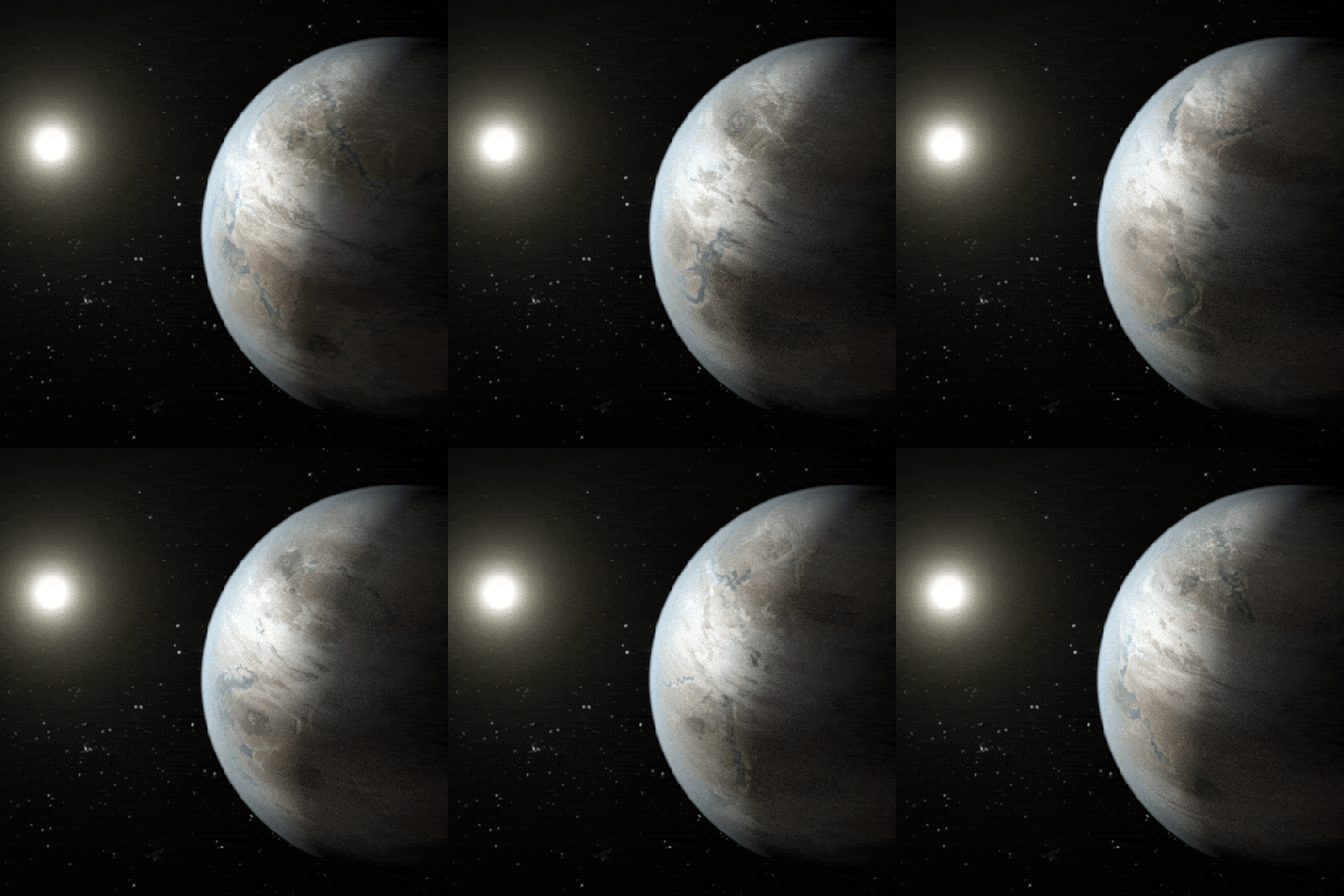
If there are human-sized creatures walking around on other planets, would we be able to view them directly?

Research shows that octopuses are sentient, emotional creatures.

There are pros and cons to sending interstellar messages to aliens that may or may not exist.

Every timekeeping device works via a version of a pendulum — even the atomic clocks that are accurate to nanoseconds.

Two types of nanotechnology, metalenses and metamaterials, could soon make Harry Potter's invisibility cloak a reality.

Singularities frustrate our understanding. But behind every singularity in physics hides a secret door to a new understanding of the world.

Morbid fatality statistics on digital highway signs seem to distract drivers, thus increasing the number of car crashes.

It didn't look like anything I'd seen before, but I'd be a great fool to consider "aliens" as a reasonable possibility.

Today, we could use Big Data to radically reform democracy. Tomorrow, we could build nanofabricators and usher in an era of abundance. Is society ready?

Nanofabricators could quickly synthesize whatever we need, molecule by molecule.

Volcanic activity caused the end-Triassic mass extinction 200 million years ago. The dinosaurs survived and rose to dominance.

We take for granted that time is real. But what if it's only an illusion, and a relative illusion at that? Does time even exist?

The ability is tied to mental health, consciousness, and memory in humans.

Spin, spin, spin — fire! The startup’s radical system could make satellite launches cheaper and cleaner.

“We didn’t build anything face-ish into our network [but] managed to segregate themselves without being given a face-specific nudge.”

Shoving platelet-rich plasma up your nose might restore your sense of smell after COVID. But whether it actually works still needs to be sniffed out.

Ancient helium-3 from the dawn of time leaks from the Earth, offering clues to our planet’s formation. A key question is where it leaks from.

AI-generated photos, also known as synthetic media, are being used to create fake experts and journalists to spread disinformation.

You've spent almost a decade gaining extremely specialized skills. But that's ok; your value is greater than you realize.

After mammoth investments and two decades of anti-aging research, what do immortality proponents have to show for it?