




















Search
Science and Tech

25 years ago, our concordance picture of cosmology, also known as ΛCDM, came into focus. 25 years later, are we about to break that model?

In around 7 billion years, we expect the Sun to run out of fuel, dying in a planetary nebula/white dwarf combination. Is that for certain?

Exoplanets can exist anywhere around their parent stars, even so close that they evaporate or disintegrate. Even the rocky ones.

It's difficult to project a sphere onto a flat, two-dimensional surface. All maps of the Earth have flaws; the same is true for the cosmos.

A look inside Mindstate Design Labs' effort to design drugs that reliably produce specific states of mind.

Welcome to The Nightcrawler — a weekly newsletter from Eric Markowitz covering tech, innovation, and long-term thinking.

22mins
"Quantum mechanics and quantum entanglement are becoming very real. We're beginning to be able to access this tremendously complicated configuration space to do useful things."

The Kalam cosmological argument asserts that everything that exists must have a cause, and the "first" cause must be God. Is that valid?

Americans have gone through three historic junctures like what we're witnessing today — and they happen on an uncanny 80-year cycle.

0m
"We're at a very critical point in human history where things are about to change dramatically. One of the beauties of these AI tools is you now can just be anything that you dreamt of being."

We understand many things about our Universe, and our home within it, extremely well. The number of stars in the Milky Way isn't among them.

Common knowledge says the maximum size of a PDF is as big as 40% of Germany — but that’s a gross underestimate.

The Multiverse isn't just a staple of science fiction; there's real-life science behind it, too. Here are 10 facts to expand your mind.

How the cult hit sci-fi show imagines a “techno-realist” future.

The first in a series of short stories by the Hugo- and Nebula-winning author that inspired the cult hit "Pantheon."

Large, massive, rotating galaxies like the Milky Way are common today. So how could one form a mere ~2 billion years after the Big Bang?

1hr 33mins
"Many astronomers are really driven by the search for Earth twins because I think deep down the natural endpoint of this whole goal of looking for planets is to answer the question, are we alone?"

Over a century after we first unlocked the secrets of the quantum universe, people find it more puzzling than ever. Can we make sense of it?

Science writer Matt Ridley joins us to discuss how “Darwin’s strangest idea” makes us all a bit feather-brained (in a good way).

For centuries, even after we knew the Sun was a star like any other, we still didn't know what it was made of. Cecilia Payne changed that.

The latest from Peter Leyden's "The Great Progression: 2025 to 2050", an essay series published by Freethink.

OpenAI has become a household name in artificial intelligence — but back in 2018 things looked very rocky. Here’s what happened.

Even from a single pixel, multiwavelength data taken over time can reveal clouds, icecaps, oceans, continents, and even signs of life.

Someday, we'll look back and see a young galaxy forming stars for the first time. JADES-GS-z14-0, the farthest ever, isn't early enough.

Einstein's general relativity has reigned supreme as our theory of gravity for over a century. Could we reduce it back down to Newton's law?

A fresh view of intelligence — spanning living systems from bacteria to human civilization — challenges the idea that it’s merely problem-solving.

In his new book, the popular science writer tells the story of how scientists discovered the “gaseous ocean” we all swim in — and the trillions of invisible life forms we share it with.

Our scientific instruments are constantly improving, revealing nature's workings as never before. Without them, we'll remain in the dark.
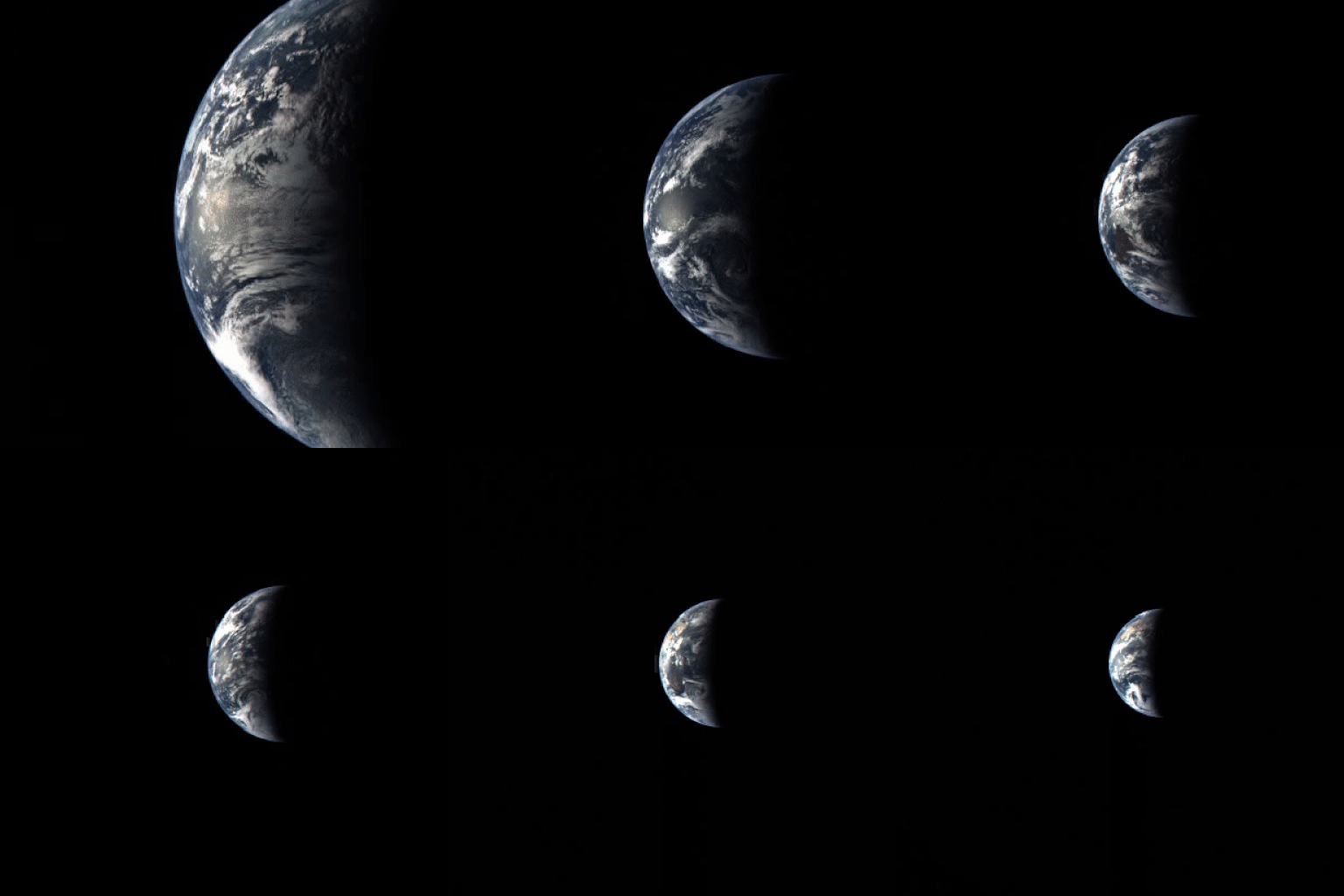
All scientific theories are limited in scope, power, and application, being mere approximations of reality. That's why consensus is vital.

When we see spiral galaxies, some are face-on, others are edge-on, but most are tipped at an angle. But which side is closest to us?