




















Search
Science and Tech

Of the millions of substances people encounter daily, health researchers have focused on only a few hundred. Those in the emerging field of exposomics want to change that.

Welcome to The Nightcrawler — a weekly newsletter from Eric Markowitz covering tech, innovation, and long-term thinking.

The last naked-eye Milky Way supernova happened way back in 1604. With today's detectors, the next one could solve the dark matter mystery.

How did life on Earth begin? Is there life on other worlds? An answer to either question will reflect heavily on the other.

A member of a species that kills trees, this mushroom is not the first to be called the Humongous Fungus — and perhaps not the last.

13mins
What can you do to support your health during menopause? “If exercise were a drug, that would be the one thing that we would be giving to everybody.”
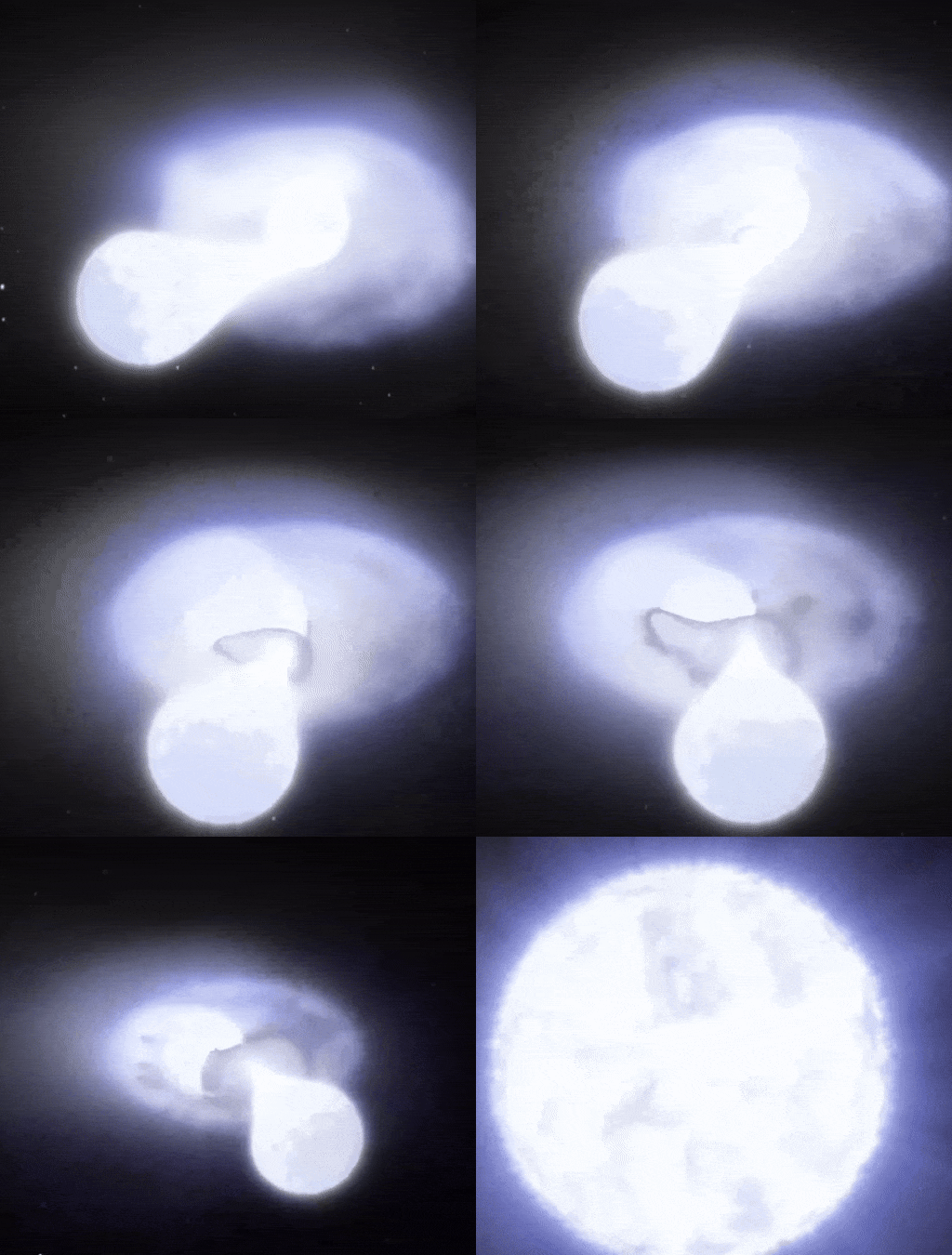
Since 1930, type Ia supernovae have been thought to arise from white dwarfs exceeding the Chandrasekhar mass limit. Here's why that's wrong.

The cat-and-mouse game between China and the world’s semiconductor companies is already having enormous consequences.

The race to find dark matter could grow more complex with high-energy neutrino interference.

In astronomy, a star's initial mass determines its ultimate outcome in life. Unless, that is, a stellar companion alters the deal.

The color of the shirt you're wearing right now depends on many factors, from your eye shape to what language you speak.

A prolonged strike could cost the economy between $500 million to $4.5 billion per day.

Black holes are the most massive individual objects, spanning up to a light-day across. So how do they make jets that affect the cosmic web?

Scientists have created a magnificent portrait of every connection among neurons in a fruit fly’s brain.

Humans, when we consider space travel, recognize the need for gravity. Without our planet, is artificial or antigravity even possible?

Welcome to The Nightcrawler — a weekly newsletter from Eric Markowitz covering tech, innovation, and long-term thinking.

All the stars, stellar corpses, planets, and other large, massive objects take on spherical or spheroidal shapes. Why is that universal?

In the international competition, people with physical disabilities put state-of-the-art devices to the test as they race to complete the tasks of everyday life.

Can laboratories become more humane, or is it time to end animal research altogether?

11mins
“What happens if you incorporate an AI? It's now a legal person, and it can make decisions by itself. So you start having legal persons in the U.S., which are not human, and in many ways are more intelligent than us.”

A crowdsourced "final exam" for AI promises to test LLMs like never before. Here's how the idea, and its implementation, dooms us to fail.

Why hasn’t matter fallen apart over billions of years? The mystery might start with protons.

The 5th brightest star in our night sky is young, blue, and apparently devoid of massive planets. New JWST observations deepen the mystery.

The successful tactics of big-name leaders — including Bob Iger, Mary Barra, and Satya Nadella — reveal key approaches to innovation.

Hang on to something — or ride the wave — because three big tech trends are about to converge.

Reusable rockets, moon landers, civilian astronauts, and more.

4mins
“Part of what's happening now in the world is tension between organic animals and an inorganic digital system which is increasingly controlling and shaping the entire world.”

One of the 20th century's most famous, influential, and successful physicists is lauded the world over. But Feynman is no hero to me.

MIT Scientist Jason Soderblom describes how the NASA mission will study the geology and composition of the surface of Jupiter’s water-rich moon and assess its astrobiological potential.

Here's the dark side of first contact.