




















Search
Science

Watching for changes in the Red Planet’s orbit over time could be new way to detect passing dark matter.

Almost all of the stars, planets, and interesting physics happens in the inner portions of galaxies. Is that conventional wisdom all wrong?

These startups, space agencies, and aerospace giants are building humanity's next off-world homes.

A recent experiment challenges the leading dark matter theory and hints at new directions for uncovering one of the Universe's biggest mysteries.

By focusing on the role of human experience, we may uncover new insights on the fundamental structure of reality.
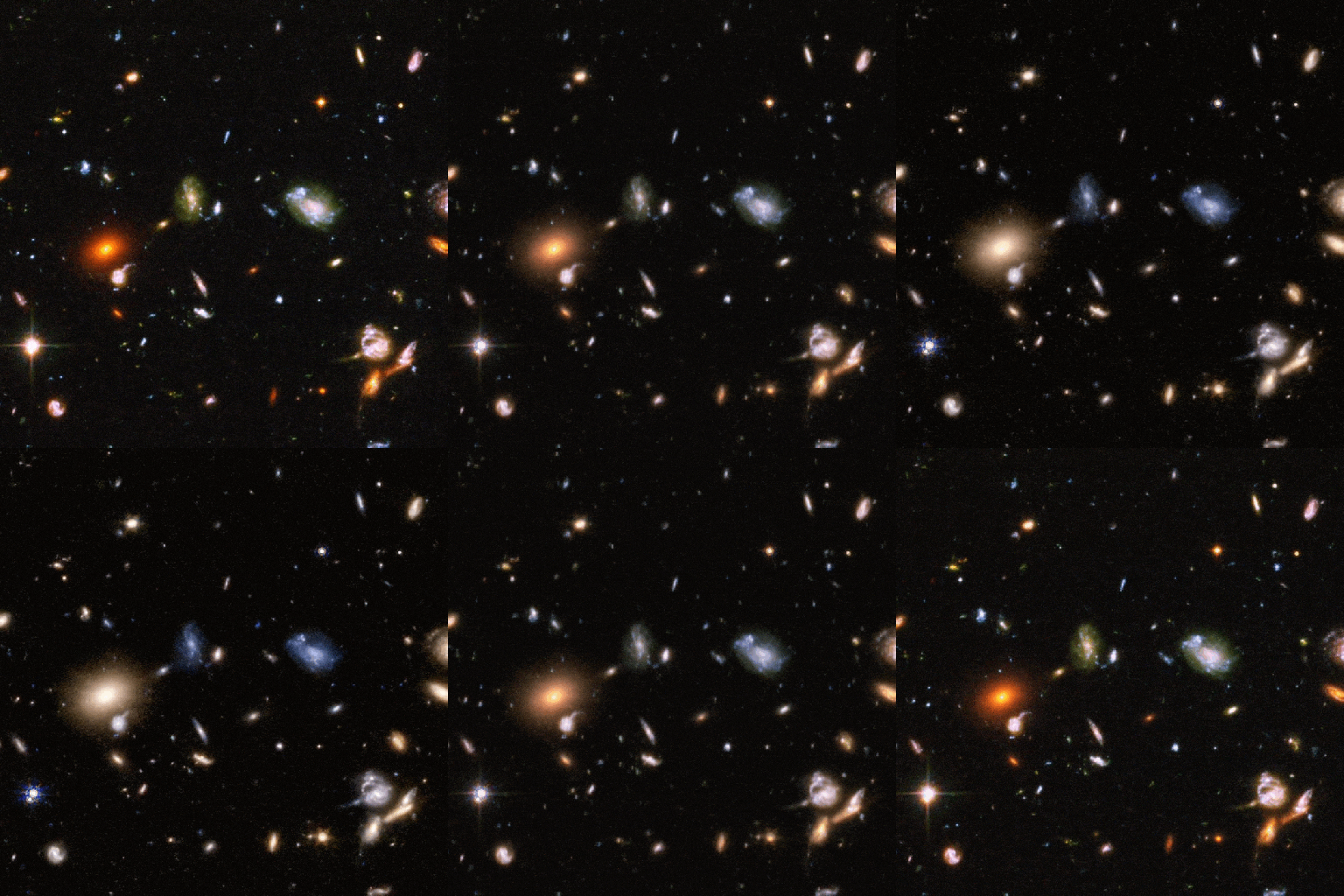
The "little red dots" were touted as being too massive, too early, for cosmology to explain. With new knowledge, everything adds up.

So far, Earth is the only planet that we're certain possesses active life processes. Here's what we shouldn't assume about life elsewhere.

No matter how good our measurement devices get, certain quantum properties always possess an inherent uncertainty. Can we figure out why?

Many contrarians dispute that cosmic inflation occurred. The evidence says otherwise.

The original principle of relativity, proposed by Galileo way back in the early 1600s, remains true in its unchanged form even today.

Often viewed as a purely theoretical, calculational tool only, direct observation of the Lamb Shift proved their very real existence.

The true story of the shot that "reverberated through England" when science collided head-on with religion.

Gravitational waves carry enormous amounts of energy, but spread out quickly once they leave the source. Could they ever create black holes?

On June 20, 2024, the summer solstice occurs at its earliest moment since 1796: when George Washington was President of the USA. Here's why.

There are many theories of gravity out there, and many interpretations of wide binary star data. What have we really learned from it all?

An interview with Lisa Kaltenegger, the founding director of the Carl Sagan Institute, about the modern quest to answer an age-old question: "Are we alone in the cosmos?"

There are so many problems, all across planet Earth, that harm and threaten humanity. Why invest in researching the Universe?

The "first cause" problem may forever remain unsolved, as it doesn’t fit with the way we do science.

Even if you aren't in the path of totality, you can still use the solar eclipse to measure how long it takes the Moon to orbit Earth.

The least exciting of all eclipses, a penumbral lunar eclipse, foreshadows the spectacular show that April 8th's total eclipse will bring.

Ground-based facilities enable the greatest scientific production in all of astronomy. The NSF needs to be ambitious, and it's now or never.

After listening to the same playlist, people from the United Kingdom, the United States, and China reported feeling nearly identical bodily sensations.

For now, our Solar System's eight planets are all safe, and relatively stable. Billions of years from now, everything will be different.

The $21.5-billion project could involve tunneling hundreds of feet under Lake Geneva.

The Uros of Lake Titicaca live on floating islands made from reeds. How did they get there?

Beyond the planets, stars, and Milky Way lie ultra-distant objects: galaxies and quasars. Here's how far back we've seen throughout history.

New DNA analyses raise questions over the theory that Christopher Columbus and his men brought syphilis to Europe.

If our Milky Way were located in the Virgo cluster instead of the Local Group, chances are we'd already be a "red and dead" galaxy.

Skilled hunters adapted to the changing landscape and left tantalizing clues to who they were.

Each time you fold a piece of paper, you double the paper's thickness. It doesn't take all that long to even reach the Moon.