




















Search
Science

In the Saudi Arabian desert, the Al Naslaa rock formation looks completely unnatural. Its perfectly vertical split remains a mystery.

At the Great Lakes Shipwreck Historical Society in Michigan, retrieving sunken vessels is the order of the day. Here’s how they do it.

Most people have a distorted view of what being a scientist is like. Scientists need to make a greater effort to challenge stereotypes.

To understand the edges of our universe, we’ll need to explore the edges of our own philosophies.
John Templeton Foundation

From a desert oasis to the Rocky Mountains, being filled with awe makes me a better scientist.

We cannot deduce laws about a higher level of complexity by starting with a lower level of complexity. Here, reductionism meets a brick wall.

There's a limit to how large planets can be, and it's only about double the radius of Jupiter. At least, so far.

An ancient continent called Balkanatolia rose and fell in the area in and around what is now the eastern Mediterranean.

Scientists captured it on footage 1.5 miles below the surface.

With 1550 distinct type Ia supernovae measured across ~10 billion years of cosmic time, the Pantheon+ data set reveals our Universe.

In general, 5G is not a threat to human health or activities, but there are some legitimate questions about interference with airplane instruments.

Just 12 million light-years away, the galaxies Messier 81 and 82 offer a nearby preview of the Milky Way-Andromeda merger.

2mins
James Gleick, the author of biographies of Isaac Newton and Richard Feynman, discusses what they and other geniuses have in common.
John Templeton Foundation

Particle physics needs a new collider to supersede the Large Hadron Collider. Muons, not electrons or protons, might hold the key.

Centuries ago, the plague forced people into quarantine for years. Isaac Newton and Galileo used the time to revolutionize the world.

Setting resolutions for the new year means you think the future is up to you — but is it?

The boiling new world, which zips around its star at ultraclose range, is among the lightest exoplanets found to date.

∆G = ∆H - T∆S is one of the most abstract formulas in science, but it is also one of the most important. Without it, life cannot exist.

We should all pause to appreciate the awe-inspiring beauty of the Universe.

Even some philosophers don’t think highly of philosophy, but we need it now more than ever.

Why are the rest masses of fundamental particles related like this? When it comes to the nature of matter in the Universe, the Standard Model describes the known elementary particles perfectly […]

We’ve already observed three cases where it’s happened. When you look at an object in space, it’s pretty easy to tell if it’s a star or a planet. Stars are […]

Hidden variables aren’t ruled out, but they can’t get rid of quantum weirdness. Ever since the discovery of the bizarre behavior of quantum systems, we’ve been forced to reckon with […]

Three of our dimensions are spatial and one is temporal, but could there be more? From any point in space, you are free to move in any direction you choose. No […]

Even addition has to play by different rules for black holes. How do you add 28 and 47 together? This simple math question helps us highlight the many different ways that […]
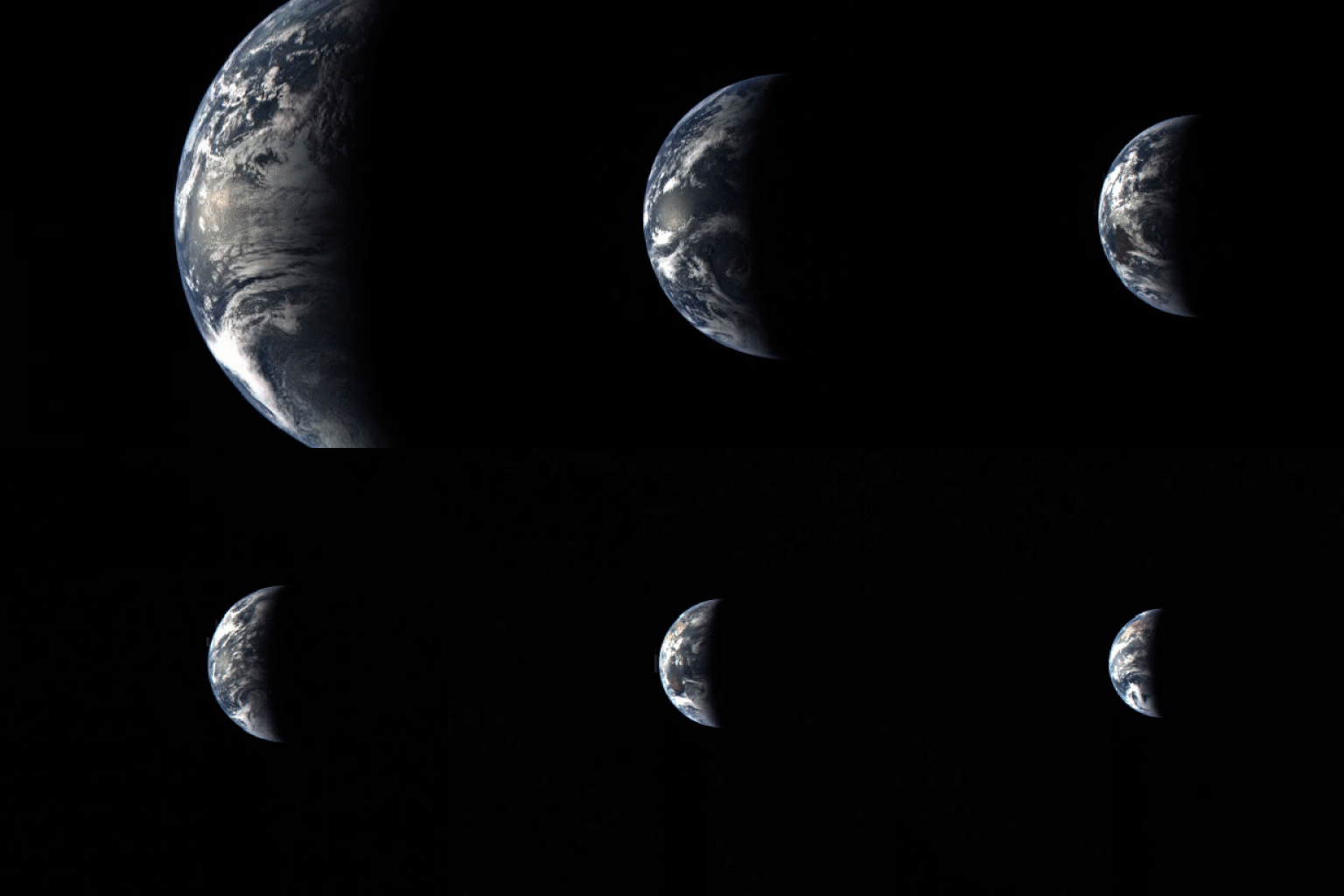
Science can teach us so much about our planet, but something more must compel us to take care of it. If you want to understand our planet, the best way to […]

We’ve almost got the entire story. James Webb will put the last piece into place. In all of science, there are really only two ways that something can be “known” to […]

Is a proton fundamentally more ‘quarky’ or ‘gluey’ in nature? One question that every curious child winds up asking at some point or other is, “what are things made of?” Every […]

Our views from the red planet’s surface are more spectacular than ever. Ever since the earliest spaceflight, humanity has reached for Mars. This photo composite shows Meande Ring, a river on […]

The Crab Nebula goes back to 1054, opening a window into our cosmic past. On July 4, 1054, Chinese astronomers recorded a “guest star” in the Taurus constellation. A ‘guest star’ […]