




















Search
Scientific Advancement

Not everyone accepts the scientific consensus; some even make careers out of challenging it. But only a select few do it the right way.

US science is worth fighting for, but so are the science projects and scientists denied opportunities. Here are 4 paths all worth exploring.

Dark matter, dark energy, and the Big Bang are all part of a solid scientific foundation. Here's why popular media often claims otherwise.

Stellar streams are faint trails of stars that appear to "stream" out of galaxies. A new one, escaping galaxy M61, may point to many others.

Physicist Daniel Whiteson challenges the notion that all intelligent species would eventually uncover the same laws of nature. Do you agree?

“We can build AI scientists that are better than we are… these systems can be superhuman,” says the FutureHouse co-founder.

With the discovery of Porphyrion, we've now seen black hole jets spanning 24 million light-years: the scale of the cosmic web.

DUNE is designed to detect the Universe's most antisocial particle: the neutrino.

The world needs a moral defense of progress based in humanism and agency.

If the electromagnetic and weak forces unify to make the electroweak force, maybe, at higher energies, something even grander happens?

Ground-based facilities enable the greatest scientific production in all of astronomy. The NSF needs to be ambitious, and it's now or never.

If nature were perfectly deterministic, atoms would almost instantly all collapse. Here's how Heisenberg uncertainty saves the atom.

Named "Supernova H0pe," it shows how JWST plus gravitational lensing can be used to solve the greatest puzzle facing astronomy today.

What are supermassive black holes, how common are they, and how do they grow up throughout cosmic history? Listen and find out!

NASA has finally chosen which flagship mission, like Hubble and JWST, will launch in ~2040. Detecting alien life is now a reachable goal.

Laser-guided lightning systems could someday offer much greater protection than lightning rods.

Hubble revolutionized astronomy more than once. Here's what we can expect from the James Webb Space Telescope.

The idea of gravitational redshift crossed Einstein's mind years before General Relativity was complete. Here's why it had to be there.

Scientists have discovered enzymes from several plastic-eating bacteria. So, why are our oceans still full of plastic pollution?

Science doesn't fit neatly into ideology.
John Templeton Foundation

Atomic clocks keep time accurately to within 1 second every 33 billion years. Nuclear clocks could blow them all away.

It started with a 22-year-old woman, named in papers only as Mrs McK.

Thou shalt not conclude “aliens” from insufficient data. When it comes to what’s out there in this Universe, perhaps the only thing that’s greater than our cosmic ignorance is the […]

Over the past 30 years, we’ve revolutionized what we know about the Universe. But we couldn’t have done it without these lessons. On April 24, 1990, the Hubble Space Telescope rocketed […]

We’ve never found eight stars bound together in the same stable system. But nature might make it so. The Universe that we have is often more wondrous and bizarre than even […]

And how cutting just $1 billion per year in funding from NASA’s budget would be a catastrophe for science. When you think of the great cosmic beyond and what we know […]

After Kepler but before James Webb, TESS is preparing astronomers for the coming exoplanet revolution. There are always new discoveries and achievements occurring in science, and certain fields have experienced […]

The Solar System’s outermost, undisputed planet wasn’t discovered until the 19th century. Here’s how you can easily find it yourself this December. There’s no greater scientific thrill than discovering something […]
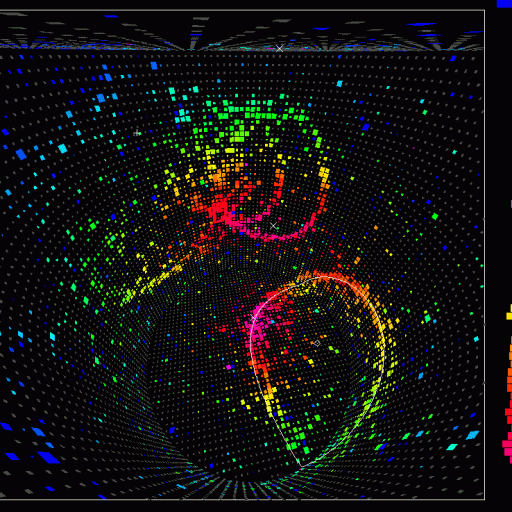
Before there were gravitational waves, multi-messenger astronomy got its start with the neutrino. Sometimes, the best-designed experiments fail. The effect you’re looking for might not even occur, meaning that a […]

The ELT, at 39 meters in diameter, will dwarf everything that’s ever come before. “There are so many people who are arguing or fighting over issues which don’t have much relevance. […]