




















Search
Scientific Evidence

What if the first search for life beyond Earth actually succeeded?

Just because a paper passes peer review doesn't mean that what's written, or what the author asserts, is true. Here's why it still matters.

It's the origin of our entire observable Universe, but it's still not the very beginning of everything.

Einstein is credited with saying, "If the facts don't fit the theory, change the facts." What he actually said has a very different meaning.

In the search for life in the Universe, the ultimate goal is to find an inhabited planet beyond Earth. How will we know when we've made it?

The CMB has long been considered the Big Bang's "smoking gun" evidence. But after what JWST saw, might it come from early galaxies instead?

Is the Universe's expansion rate 67 km/s/Mpc, 73 km/s/Mpc, or somewhere in between? The Hubble tension is real and not so easy to resolve.

The most famous Hubble images show glittering stars and galaxies amidst the black backdrop of space. But more was captured than we realized.

DESI, by mapping galaxies, has claimed they see evidence for dark energy evolving by getting weaker. But that's only one interpretation.
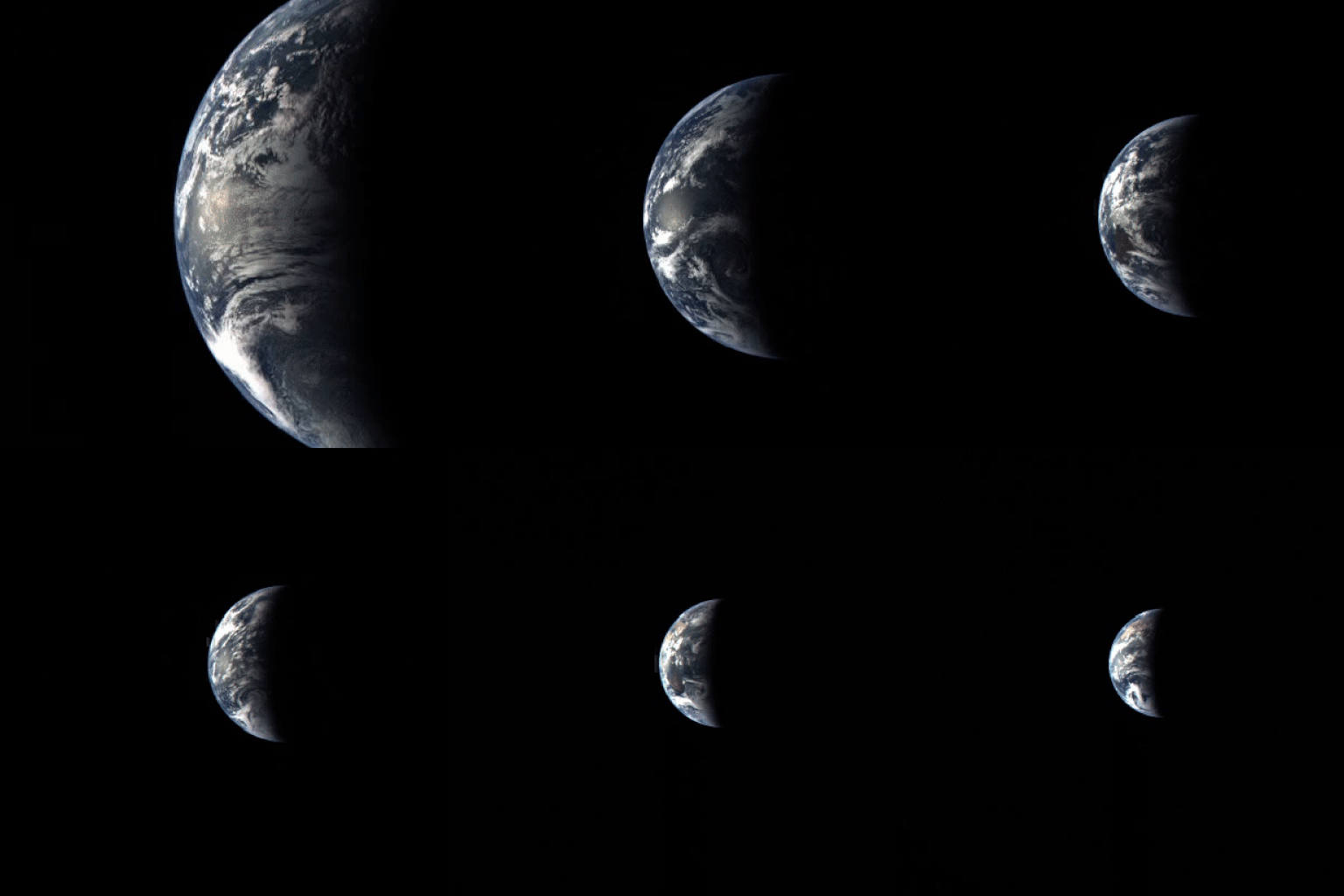
All scientific theories are limited in scope, power, and application, being mere approximations of reality. That's why consensus is vital.

A new bill introduced into the US Senate claims to make us safer. Instead, it would destroy all virology research, and for no real cause.

Since the mid-1960s, the CMB has been identified with the Big Bang's leftover glow. Could any alternative explanations still work?

Do we actually live in a deterministic Universe, despite quantum physics? An alternative, non-spooky interpretation has now been ruled out.
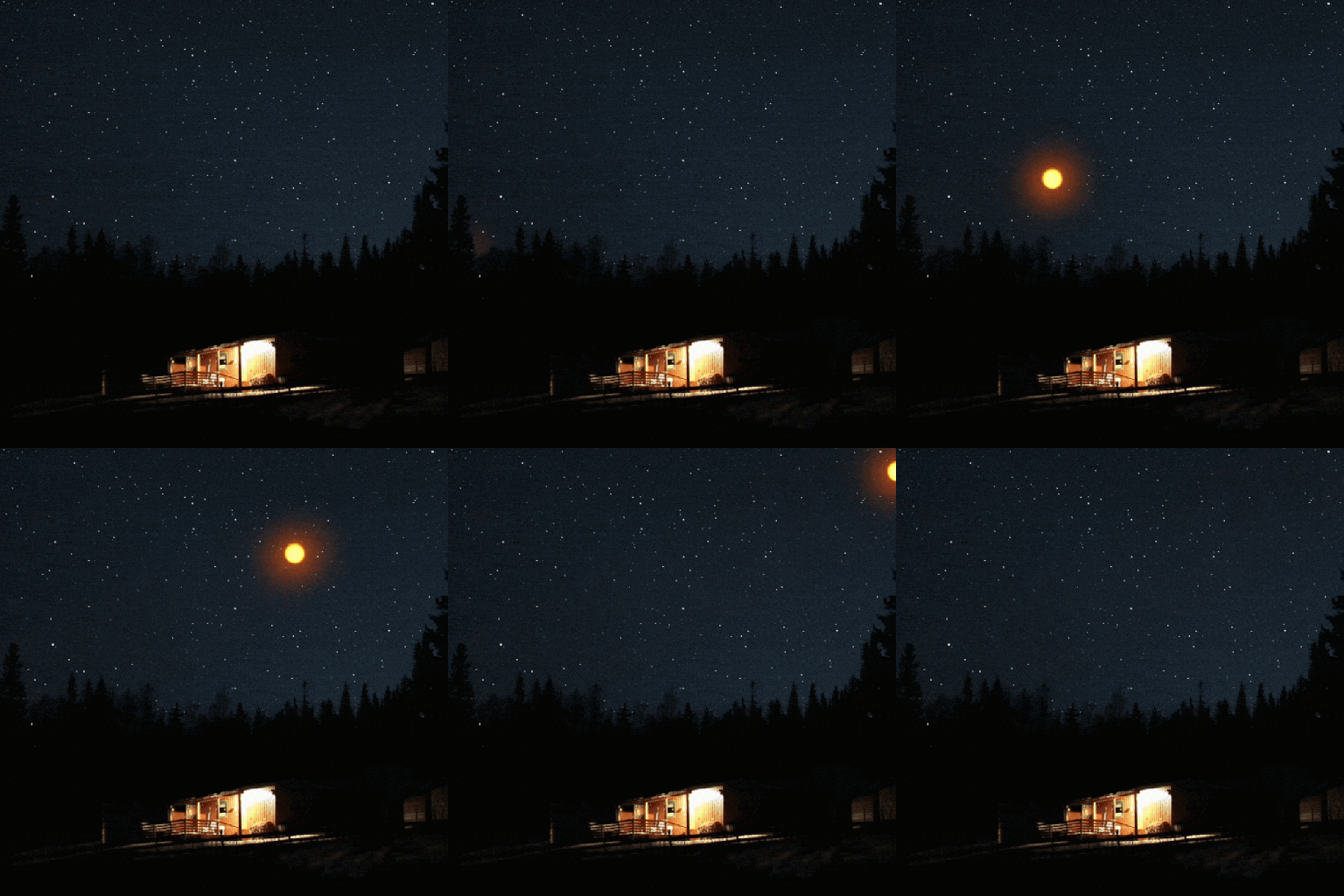
Although a great many unidentified sights have been seen in the skies, none have conclusively demonstrated the presence of aliens. So far.

Inflation, dark matter, and string theory are all proposed extensions to the prior consensus picture. But what does the evidence say?

Scientific surprises, driven by experiment, are often how science advances. But more often than not, they’re just bad science.

SARS-CoV-2 first emerged in humans in 2019. Despite much noise generated by lab leak proponents, the evidence indicates a natural origin.

Poor research can be worse than no research at all.

Harvard astronomer Avi Loeb claimed to track down and find alien spherules on the ocean bottom. Here's the sober truth.

Finding alien technology on the seafloor would be truly incredible. This extraordinary claim, however, is debunked by the actual evidence.

Some fascinating observations of K2-18b have come along with horrendous, speculative communications. There's no evidence for oceans or life.

When the average person has a "theory," they're just guessing. But for a scientist, a theory is the pinnacle of what we can achieve.

The first observational evidence showing the Universe is expanding is 100 years old now: in 2023. Here's the story of its 100th anniversary.

Is LK-99 truly a room temperature superconductor? These 4 tests, none of which have yet been passed, will separate fact from fiction.

An army of replicators belonging to national laboratories, research universities, and amateur garages is rushing to replicate ambient superconductivity in LK-99.

"I am not sick at all but everyone around me becomes sick."

A Harvard astronomer went to the bottom of the ocean, claiming he recovered alien technology. But what does the science actually indicate?

The truth is out there, but it's probably not in the latest whistleblower's report.

And why you, a non-expert, should absolutely not consider "explaining what you know" to an actual expert in the field.

You can’t spot a liar just by looking — but psychologists are zeroing in on methods that might actually work.