




















Search
Scientific Method

Fears of celestial collisions — and calculations of their likelihood — go back to the very origins of modern science itself.

The CMB gives us critical information about our cosmic past. But it doesn't give us everything, and galaxy mapping can fill in a key gap.

If we wish to tackle the very real problems society faces, we require expert-level knowledge. Valuing it starts earlier than we realize.

With a flurry of threats to scientists, science funding, and health policy, the USA now faces a crisis reminiscent of Soviet-era Lysenkoism.

It's the ultimate game of cosmic "cover up," as the dimming occurs when a circumbinary disk from a nearby star passes in front of T Tauri North.

A proton is the only stable example of a particle composed of three quarks. But inside the proton, gluons, not quarks, dominate.

Despite no experimental evidence showing that gravitons exist, they remain a respectable concept in the world of professional physicists.

Our Universe isn't just expanding, the expansion is accelerating. Instead of dark energy, could a "lumpy" Universe be at fault?

“We can build AI scientists that are better than we are… these systems can be superhuman,” says the FutureHouse co-founder.

Recent controversies bode ill for the effort to detect life on other planets by analyzing the gases in their atmospheres.

Astronomer Adam Frank asks: With so many extraordinary claims, why can't anybody produce the proof?

The race to find dark matter could grow more complex with high-energy neutrino interference.

The 5th brightest star in our night sky is young, blue, and apparently devoid of massive planets. New JWST observations deepen the mystery.

Beyond stars, galaxies, and gravity, studying the fundamental workings of nature reveals widely applicable lessons for learners everywhere.

An in-depth interview with astronomer Kelsey Johnson, whose new book, Into the Unknown, explores what remains unknown about the Universe.

Are breakthroughs really a matter of chance, or are they simply waiting to be uncovered by the right person at the right time?

Despite many ultra-distant galaxy candidates found with JWST, we still haven't seen anything from the Universe's first 250 million years.

CERN scientists achieved record-breaking accuracy in mapping the mass of a key particle in the Standard Model.

Do we actually live in a deterministic Universe, despite quantum physics? An alternative, non-spooky interpretation has now been ruled out.

A recent experiment challenges the leading dark matter theory and hints at new directions for uncovering one of the Universe's biggest mysteries.
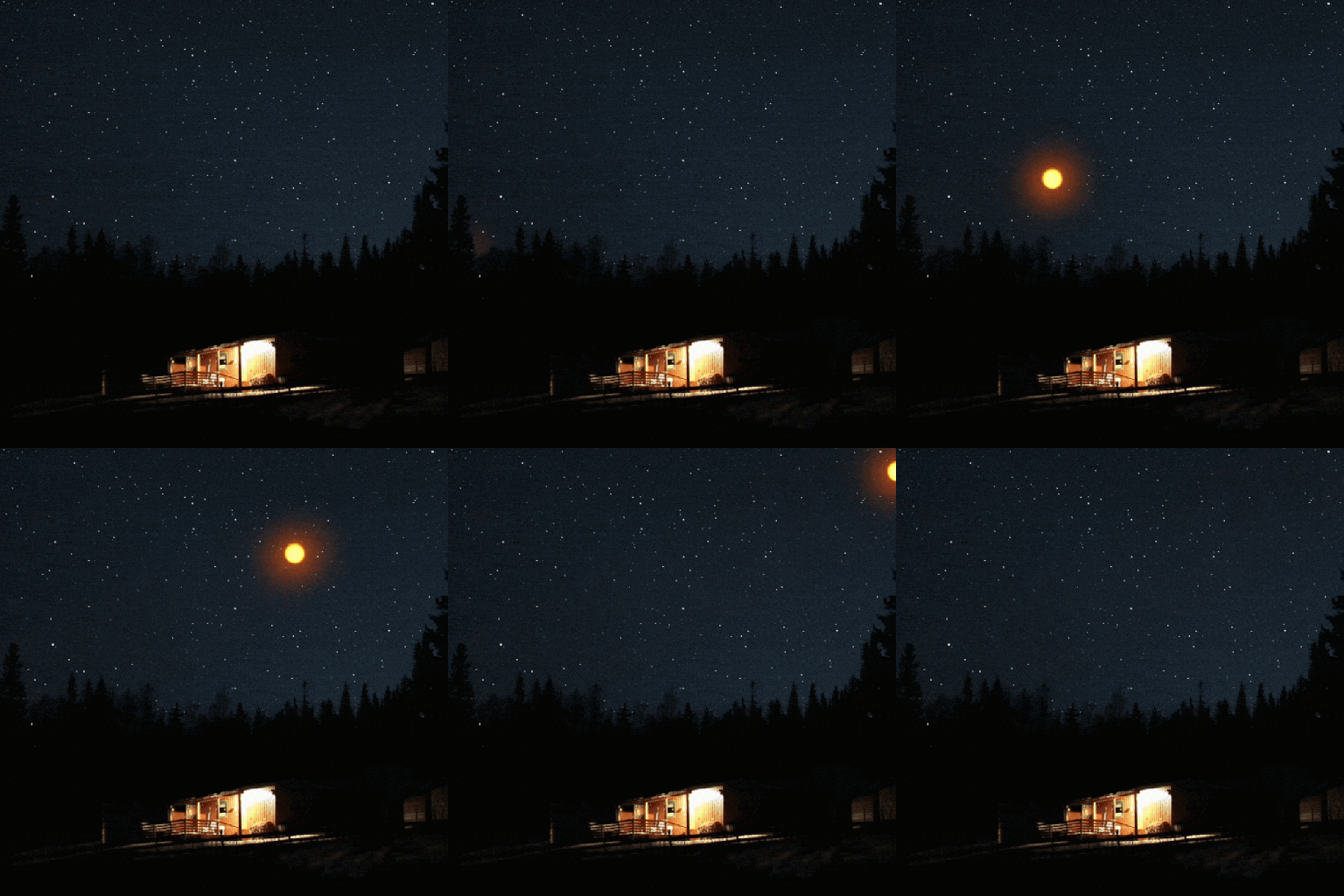
Although a great many unidentified sights have been seen in the skies, none have conclusively demonstrated the presence of aliens. So far.

Taught in every introductory physics class for centuries, the parabola is only an imperfect approximation for the true path of a projectile.

Inflation, dark matter, and string theory are all proposed extensions to the prior consensus picture. But what does the evidence say?

Scientific surprises, driven by experiment, are often how science advances. But more often than not, they’re just bad science.
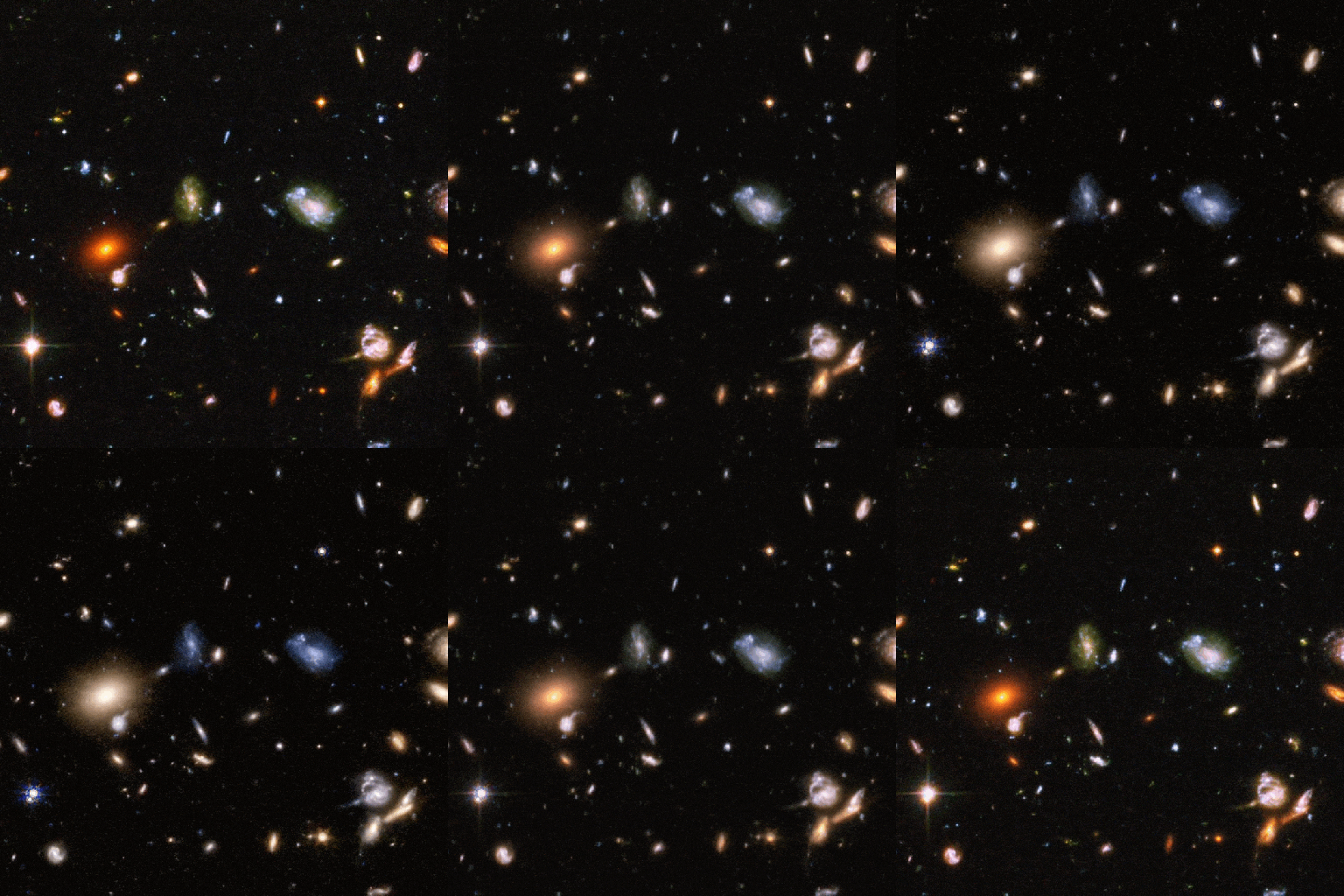
The "little red dots" were touted as being too massive, too early, for cosmology to explain. With new knowledge, everything adds up.

Researchers at the Brookhaven National Laboratory recently created the heaviest exotic antimatter hypernucleus ever observed.

The big question isn't whether the Universe is expanding at 67 or 73 km/s/Mpc. It's why different methods yield such different answers.
From inside our Solar System, zodiacal light prevents us from seeing true darkness. From billions of miles away, New Horizons finally can.

We know of stellar mass and supermassive black holes, but intermediate mass ones have long proved elusive. Until now.

There are many things that separate science from ideology, politics, philosophy, or religion. Follow these 10 commandments to get it right.