




















Search
Scientific Revolutions

Not everyone accepts the scientific consensus; some even make careers out of challenging it. But only a select few do it the right way.

Even the most brilliant mind in history couldn't have achieved all he did without significant help from the minds of others.

Our view of the world, the Universe, and ourselves can change with just one glimpse of what's out there. It's happened many times before.

Many view the development of fringe, alternative theories as a useless waste of time. But when they can be tested, it shows what reality is.

In this excerpt from "The Great Math War," Jason Socrates Bardi explores how Georg Cantor revolutionized mathematics and reshaped how our finite minds conceived of the infinite.

Dark matter, dark energy, and the Big Bang are all part of a solid scientific foundation. Here's why popular media often claims otherwise.

Scientists are notoriously resistant to new ideas. Are they falling prey to groupthink? Or are our current theories just that successful?

Proposed over 2000 years ago by Democritus, the word atom literally means uncuttable. Revived in 1803, today's "atoms" can indeed be split.

Since even before Einstein, physicists have sought a theory of everything to explain the Universe. Can positive geometry lead us there?

Realizing that matter and energy are quantized is important, but quantum particles aren't the full story; quantum fields are needed, too.

The CMB has long been considered the Big Bang's "smoking gun" evidence. But after what JWST saw, might it come from early galaxies instead?

A paradigm should be elastic enough to accommodate new data and broad enough to explain the world. For Rupert Sheldrake, ours does neither.

"I was stunned. Here in front of me was the original apparatus through which a new vision of the world was slowly and painfully brought to light."

Our classical intuition is no good in a quantum Universe. To make sense of it, we need to learn, and apply, an entirely novel set of rules.

One of the 20th century's most famous, influential, and successful physicists is lauded the world over. But Feynman is no hero to me.
Many mavericks look to Einstein as a unique figure, whose lone genius revolutionized the Universe. The big problem? It isn't true.

Are breakthroughs really a matter of chance, or are they simply waiting to be uncovered by the right person at the right time?

It's deceptively tricky to distinguish living systems from non-living systems. Physics may be key to solving the problem.

The Michelson-Morley experiment of 1887, despite expectations, revealed a null result: no effect. The implications were revolutionary.
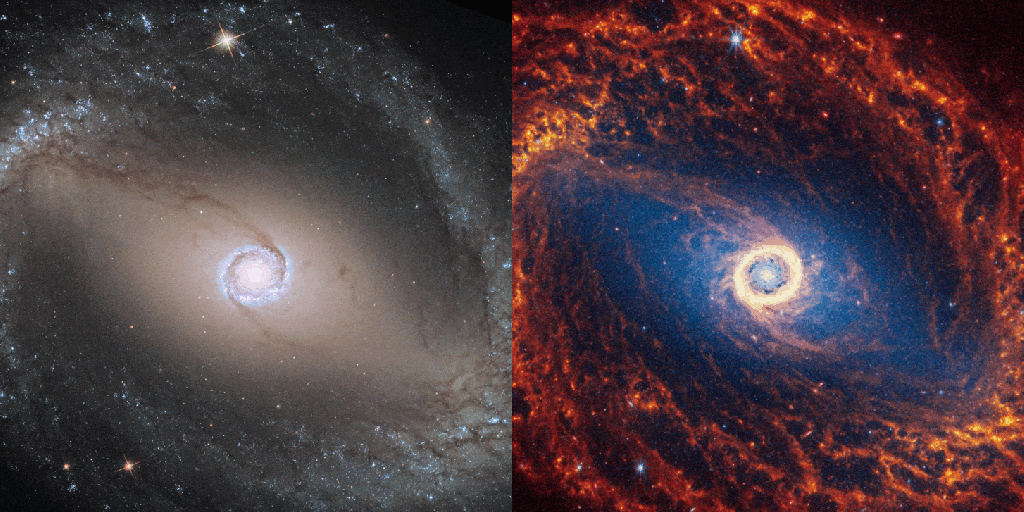
In July of 2022, the first science images from JWST were unveiled. Two years later, it's changed our view of the Universe.

A longstanding mismatch between theory and experiment motivated an exquisite muon measurement. At last, a theoretical solution has arrived.

The structure of our Solar System has been known for centuries. When we finally started finding exoplanets, they surprised everyone.

Some think the reason fundamental scientific revolutions are so rare is because of groupthink. It's not; it's hard to mess with success.

Physicists just can't leave an incomplete theory alone; they try to repair it. When nature is kind, it can lead to a major breakthrough.

Everything acts like a wave while it propagates, but behaves like a particle whenever it interacts. The origins of this duality go way back.

In 1924, Edwin Hubble found proof that the Milky Way isn't the only galaxy in the Universe.

With the invention of the leap year, the Julian calendar was used worldwide for over 1500 years. Over time, it led only to catastrophe.

In pre-War Cambridge, students had to ace an interview with Ludwig Wittgenstein to attend his lectures — Alan Turing passed that test, and went on to create one of his own.

The combined intellectual heft of multiple “big thinkers” delivered arguably the most successful scientific theory in history.

From unexplained tracks in a balloon-borne experiment to cosmic rays on Earth, the unstable muon was particle physics' biggest surprise.