




















Search
Scientific Revolutions

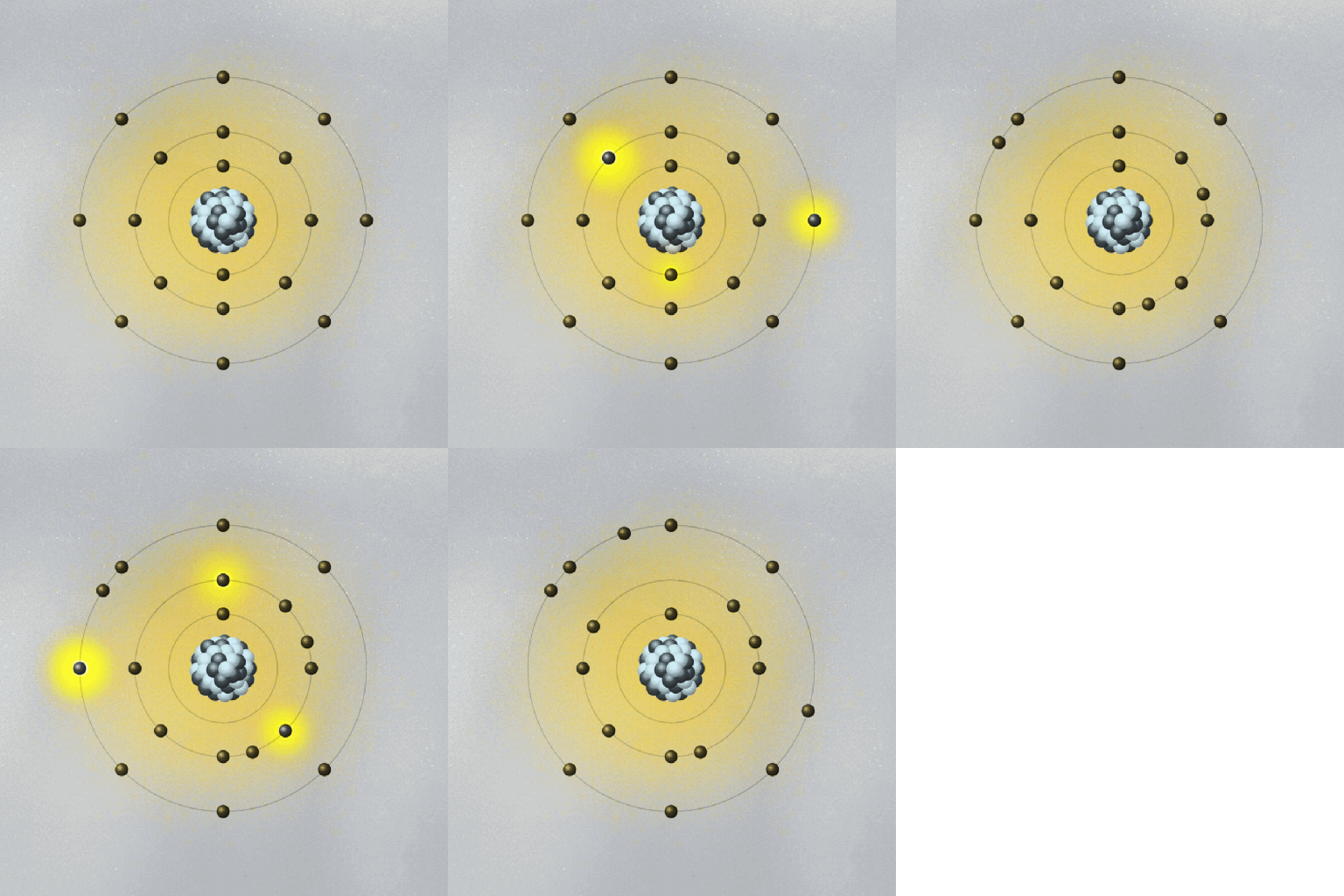
If nature were perfectly deterministic, atoms would almost instantly all collapse. Here's how Heisenberg uncertainty saves the atom.

There are a few clues that the Universe isn't completely adding up. Even so, the standard model of cosmology holds up stronger than ever.

The first observational evidence showing the Universe is expanding is 100 years old now: in 2023. Here's the story of its 100th anniversary.

There may be unknown particles lurking inside the quantum foam.

Alchemy had its golden age in the 17th century, when it counted Isaac Newton and Robert Boyle among its adherents.
John Templeton Foundation

Michael Faraday's 1834 law of induction was the key experiment behind the eventual discovery of relativity. Einstein admitted it himself.

It may be time for a cosmological paradigm shift.

For many years, some cosmologists embraced the idea of an eternal, steady state universe. But science triumphed over philosophical prejudice.

Leading a scientific revolution is easy: you just have to succeed where the current theory fails while equaling its successes. Good luck!

Many galaxies really are ultra-distant, but some are just intrinsically red or dusty. Only with spectroscopy can JWST tell which is which.

How scientists found out that we live in a cosmic aquarium.

Generations ago, cosmologists asserted that the Universe might not just be the same in all directions, but at all times. But is that true?

Far from practicing witchcraft, the experimentation of medieval alchemists helped bring about the Scientific Revolution.

To Einstein, nature had to be rational. But quantum physics showed us that there was not always a way to make it so.

Einstein tried to disprove quantum mechanics. Instead, a weird concept called entanglement showed that Einstein was wrong.

Quantum superposition challenges our notions of what is real.
Light carries with it the secrets of reality in ways we cannot completely understand.
Like Dua Lipa, he had to create new rules.

The quantum world is one in which rules that are completely foreign to our everyday experience dictate bizarre behavior.

Before we discovered gravitational waves, multi-messenger astronomy got its start with light and particles arriving from the same event.

When people pick the greatest scientist of all-time, Newton and Einstein always come up. Perhaps they should name Johannes Kepler, instead.

The idea of gravitational redshift crossed Einstein's mind years before General Relativity was complete. Here's why it had to be there.

In all of science, no figures have changed the world more than Einstein and Newton. Will anyone ever be as revolutionary again?

On July 12, 2022, JWST will release its first science images. Here are 5 ways the telescope's findings could change science forever.


Atomic clocks keep time accurately to within 1 second every 33 billion years. Nuclear clocks could blow them all away.

By toppling medieval Europe’s mightiest political power, the Protestant Reformation ushered in a new age of freedom, religious and otherwise.

Einstein's theories of relativity faced fierce opposition. One critic claimed he was attempting to subvert the scientific method.

Even without the greatest individual scientist of all, every one of his great scientific advances would still have occurred. Eventually.

Society-changing ideas form through a three-stage process, argues author Michael Bhaskar.