




















Search
Solar System Science

The James Webb Space Telescope viewed Neptune, our Solar System's final planet, for the first time. Here's what we saw, and what it means.

No planet enters retrograde more frequently than Mercury, which does so 3-4 times each year. Here’s the scientific explanation for why.

Do you think you know the Solar System? Here's a fact about each planet that might surprise you when you see it!

We've only seen Uranus up close once: from Voyager 2, back in 1986. The next time we do it, its features will look entirely different.

In all of human history, only 5 spacecraft have had the right trajectory to exit the Solar System. Will they ever catch Voyager 1?
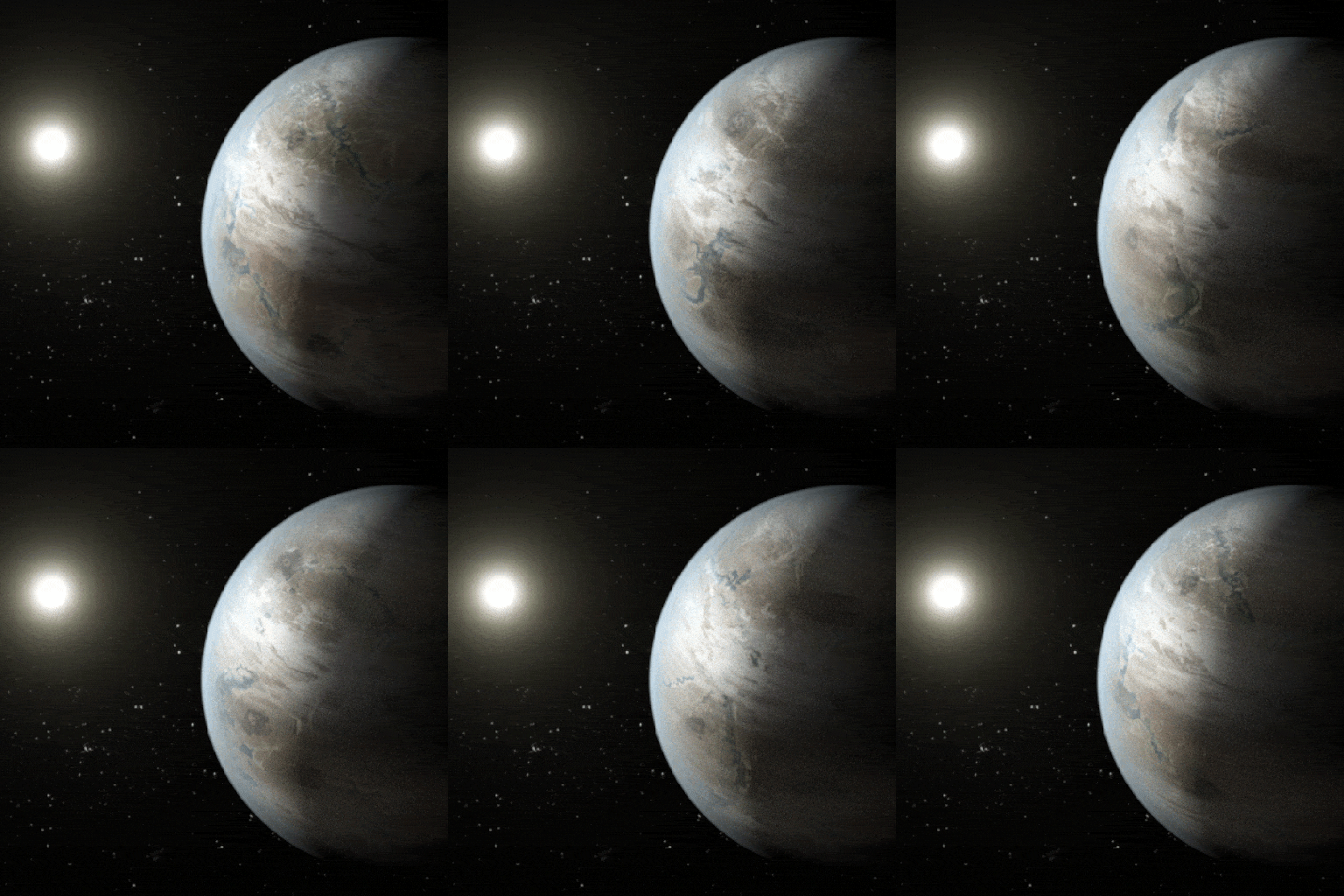
If there are human-sized creatures walking around on other planets, would we be able to view them directly?

Pluto failed to meet the definition of a planet, but some astronomers think there might be a legitimate Planet 9 out there.

The recently discovered Oort cloud comet, Bernardinelli–Bernstein, has the largest known nucleus: 119 km. Here's what it could do to Earth.

The European Space Agency’s Solar Orbiter recently captured images that could help scientists better under the mysterious physics of our Sun.

In 1990, we only knew of the planets in our own Solar System. Today, the exoplanet count is more than 5000. Here's what we've learned.

In the night sky for March of 2022, only stars and the Moon, not planets, will greet you. The real show, however, arrives just before dawn.

There's a limit to how large planets can be, and it's only about double the radius of Jupiter. At least, so far.

Despite being the closest planet to the Sun, Mercury "only" reaches 800 °F at its hottest. Venus is always hotter, even at night.
In 1990, we only knew of the ones in our Solar System. Today, we know of thousands, and that's just the tip of the iceberg.

How can you "touch the Sun" if you've always been inside the solar corona, yet will never reach the Sun's photosphere?

Our Solar System's outer reaches, and what's in them, was predicted long before the first Oort Cloud object was ever discovered.
The stars, planets, and many moons are extremely round. Why don't they take other shapes?

We once thought the Moon was completely airless, but it turns out it has an atmosphere, after all. Even wilder: It has a tail of its own.
Based on the atoms that they're made out of, the innermost planet should always be the densest. Here's why Earth beats Mercury, hands down.

The largest moon in our Solar System, often overlooked, is a water-rich world. Does that mean life? Here on Earth, life took hold very early on in our planet’s history, and […]

And why, even at its faintest, it always outshines every other star and planet. If you’ve been looking to the west after sunset recently, you may have noticed that there’s one […]

Planets are either rocky, like Earth, or gas-rich, like Neptune, with no in-between. What are the different types of planets that exist in the Universe? If all you could see […]

While Mars is known as a frozen, red planet today, it has all the evidence we could ask for of a watery past, lasting for approximately the first 1.5 billion […]

The definitive answer requires better, unbiased data. Despite all the advances that have occurred in human history, one extraordinary puzzle still remains right in our own backyard: we aren’t sure how […]

And what can it teach us about our Solar System’s earliest days? In many ways, astronomy is unique among the sciences. In every other field, you have the ability to design […]
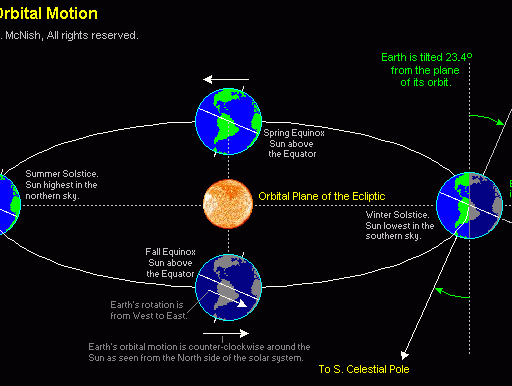
If we’re migrating slowly away, is our speed changing, too? Every year, planet Earth completes one revolution around the Sun while spinning on its axis. On a year-to-year basis, our […]

Don’t wait until Christmas to gift a telescope this year. All throughout the year, two bright lights have stood out in the post-sunset skies. Earlier this year, on March 31, 2020, […]

Halley’s comet only visits every ~76 years, but its meteors arrive twice each year. The most famous comet of all — Halley’s comet — returns to our inner Solar System every ~76 years. Halley’s comet […]

At its biggest for the next 15 years, it’s still much smaller than the Moon. On October 6, 2020, Mars makes its closest approach to Earth until 2035. Earth orbits in […]

In 2006, the IAU demoted Pluto. Here’s what we know today. In 2006, the last planet in our Solar System suffered an unforgettable insult, as Pluto — known for generations as our ninth […]