




















Search
Space Exploration

What happens when scientists "write what they know"? Some amazing science fiction stories.

In this preview from "The Saucerian," author Gabriel Mckee explains how the combination of fantastical stories and obscure bureaucracy launched the “space age of the imagination.”

In all the known Universe, Earth is the only planet known to have native life. What should guide us in expanding humanity beyond our world?

After drastic cuts to the NIH, the FDA, the NSF, and the DOE, NASA science faces down its smallest budget ever. All of society will suffer.

Exoplanets can exist anywhere around their parent stars, even so close that they evaporate or disintegrate. Even the rocky ones.

We understand many things about our Universe, and our home within it, extremely well. The number of stars in the Milky Way isn't among them.

For centuries, even after we knew the Sun was a star like any other, we still didn't know what it was made of. Cecilia Payne changed that.

Even from a single pixel, multiwavelength data taken over time can reveal clouds, icecaps, oceans, continents, and even signs of life.

Our scientific instruments are constantly improving, revealing nature's workings as never before. Without them, we'll remain in the dark.

When we see spiral galaxies, some are face-on, others are edge-on, but most are tipped at an angle. But which side is closest to us?

The tiniest galaxies of all are the most susceptible to violence by their larger, bullying siblings. That's why we need them in isolation.

Barnard's star, the closest singlet star system to ours, has long been a target for planet-hunters. We've finally confirmed it: they exist!

Back in 1970, Sister Mary Jucunda wrote NASA, decrying large investments in science. A former Nazi's legendary response is still relevant.

Astronomers see spiral and elliptical nebulae nearly everywhere, except by the Milky Way's plane. We didn't know why until the 20th century.

The full extent of the Andromeda galaxy, the nearest large galaxy to our own, has been entirely imaged with Hubble's exquisite cameras.

Dark matter doesn't absorb or emit light, but it gravitates. Instead of something exotic and novel, could it just be dark, normal matter?

Asteroid 2024 YR4, which could devastate a city's worth of humans, has gone from 1.2% to 2.3% to 2.6% to 3.1% chances of impact. Here's why.

At extremely close distances to their stars, even rocky planets can be completely disintegrated. We've just caught our first one in action.

Ring galaxies are rare, but we think we know how they form. A new, early-stage version, the Bullseye galaxy, provides a new testing ground.

Here in our Solar System, terrestrial bodies get moons from gravitational capture or collisions. The Pluto-Charon system? It was both.

Only 5% of the Universe is made of normal "stuff" like we are. Could there be dark matter or dark energy life, or even aliens, out there?
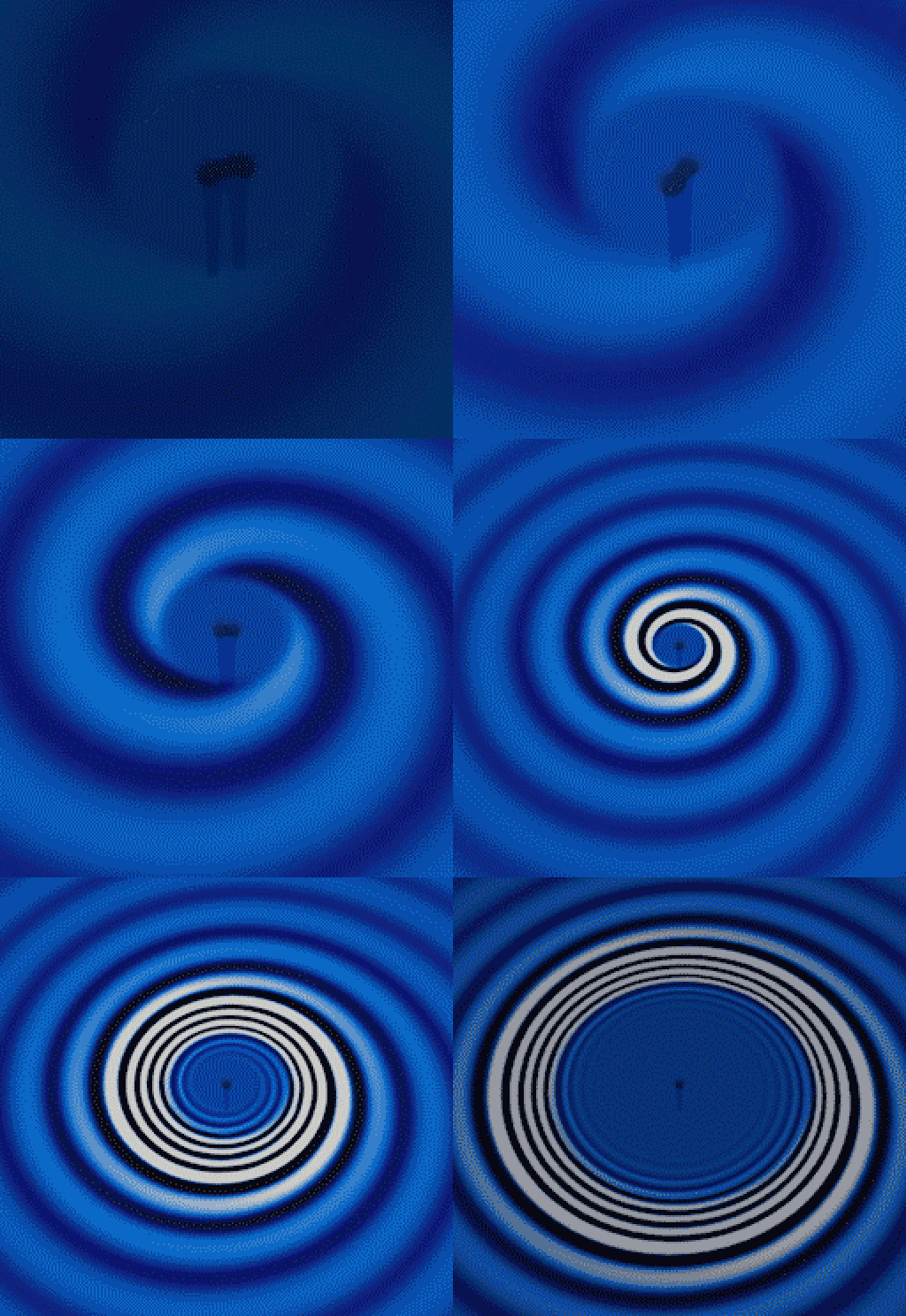
The ultimate multi-messenger astronomy event would have gravitational waves, particles, and light arriving all at once. Did that just occur?

A young, nearby, massive star, whose protoplanetary disk appears perfectly edge-on, was just viewed by JWST, with staggering implications.

A new SETI study shows how far the field of technosignatures has come.

If we wish to tackle the very real problems society faces, we require expert-level knowledge. Valuing it starts earlier than we realize.

Our Moon is full of craters, basins, and ancient lava flows. But two large lunar Grand Canyons have the same origin: a single, giant impact.

Life may have arisen far earlier — and more rapidly — than previously thought.

From LIGO, there weren't enough neutron star-neutron star mergers to account for our heavy elements. With a JWST surprise, maybe they can.

It's the ultimate game of cosmic "cover up," as the dimming occurs when a circumbinary disk from a nearby star passes in front of T Tauri North.

Scientists just viewed one of the tiniest, most isolated, lowest-mass galaxies ever found with JWST. Despite all odds, it's still growing.