




















Search
Space Exploration

New telescopes, radio dishes, and gravitational wave detectors are needed for next-generation science. Will the USA lead the way?

The Ring Nebula, a bright, circular planetary nebula, is created by a dying Sun-like star. After centuries, we finally know its true shape.

Motility was suggested as a promising "biosignature" as early as the 1960s, but the technology was insufficient — until now.

The discovery of ultra-bright, ultra-distant galaxies was JWST's first big surprise. They didn't "break the Universe," and now we know why.

Seven years ago, an outburst in a distant galaxy brightened and faded away. Afterward, a new supermassive black hole jet emerged, but how?

We see objects whose light only arrives just now. But we see them as they were in the past: when that now-arriving light was first emitted.

Featuring SpaceX's "Mechazilla," a first-of-its-kind spacewalk, and more.

A recent measurement has simultaneously settled an ongoing scientific debate while puzzling scientists.

On larger and larger scales, many of the same structures we see at small ones repeat themselves. Do we live in a fractal Universe?

Experts answer 10 big questions about the nightmare scenario that could send us back to the pre-Space Age.

Earth is actively broadcasting and actively searching for intelligent civilizations. But could our technology even detect ourselves?

Did the Milky Way form by slowly accreting matter or by devouring its neighboring galaxies? At last, we're uncovering our own history.

Our galactic home in the cosmos — the Milky Way — is only one of trillions of galaxies within our Universe. Is one of them truly our "twin?"

When three wise men gifted baby Jesus with gold, frankincense, and myrrh, they had no idea one was made from colliding neutron stars.

Sixty years ago, the Soviet Union was way ahead of the USA in the space race. Then one critical event changed everything.

The problem for galactic-scale civilizations comes down to two numbers.

From a hot, dense, uniform state in its earliest moments, our entire known Universe arose. These unavoidable steps made it all possible.

It was barely a century ago that we thought the Milky Way encompassed the entirety of the Universe. Now? We're not even a special galaxy.

Even with just a momentary view of our galaxy right now, the data we collect enables us to reconstruct so much of our past history.

The Sombrero is the closest bright, massive, edge-on galaxy to us. JWST's new image, taken with MIRI, finally shows what's under its hat.

In November 1974, astronomers used the radio telescope at Puerto Rico’s Arecibo Observatory to send a hello to the universe.

Recent controversies bode ill for the effort to detect life on other planets by analyzing the gases in their atmospheres.

Astronomer Adam Frank asks: With so many extraordinary claims, why can't anybody produce the proof?
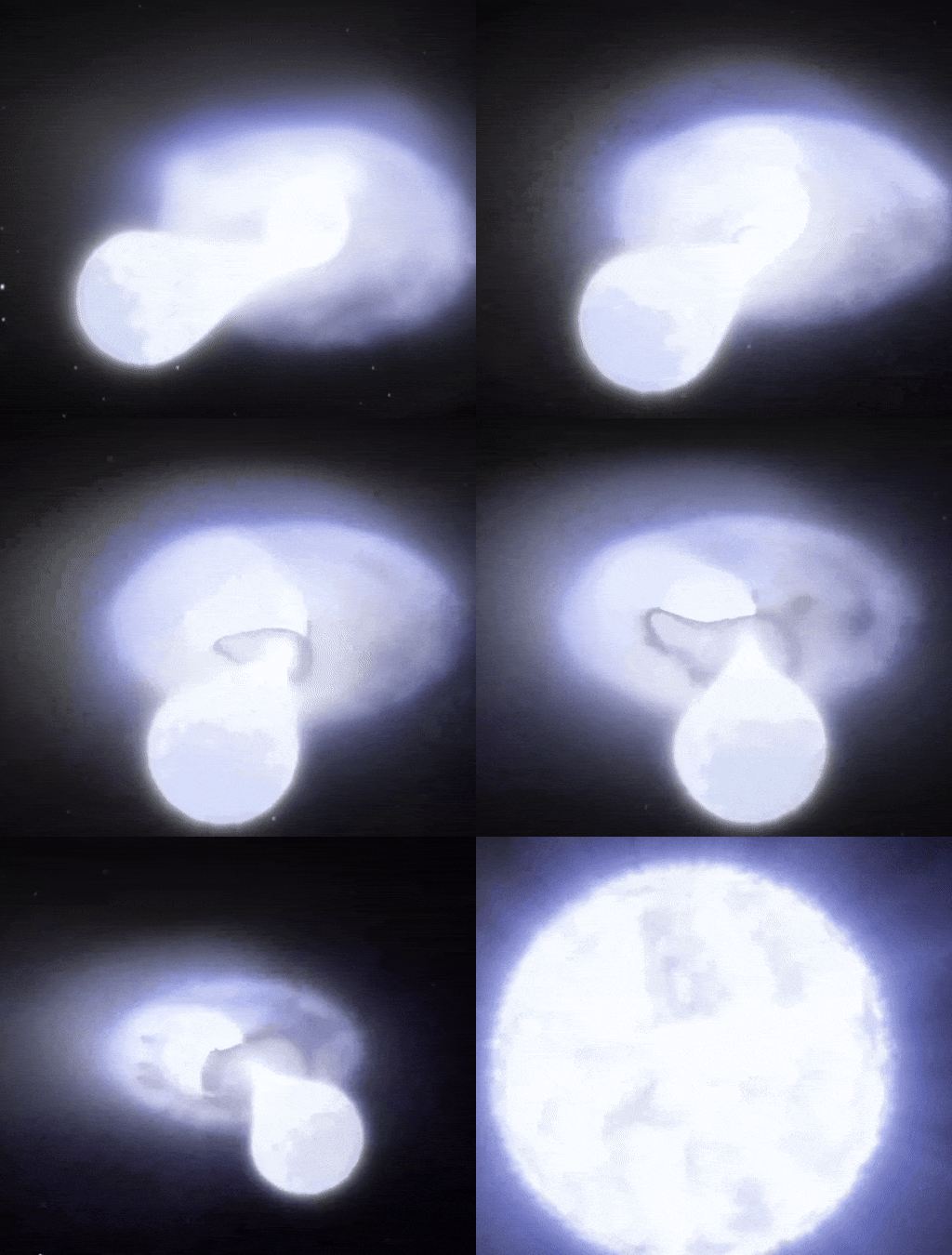
Since 1930, type Ia supernovae have been thought to arise from white dwarfs exceeding the Chandrasekhar mass limit. Here's why that's wrong.

Reusable rockets, moon landers, civilian astronauts, and more.

MIT Scientist Jason Soderblom describes how the NASA mission will study the geology and composition of the surface of Jupiter’s water-rich moon and assess its astrobiological potential.

Here's the dark side of first contact.

NASA's space telescopes and observatories bring humanity unrivaled science images and scientific discoveries. Here's what should be next.

In the year 1181, a "guest star" was recorded in the constellation of Cassiopeia. Its modern supernova remnant is weirder than we imagined.

Beyond stars, galaxies, and gravity, studying the fundamental workings of nature reveals widely applicable lessons for learners everywhere.