




















Search
Space Exploration

More than two years after JWST began science operations, our Universe now looks very different. Here are its biggest science contributions.

What are dark matter and dark energy? The large-scale structure of the cosmos encodes them both, with ESA's Euclid mission leading the way.

Could life be widespread throughout the cosmos, in the subsurface oceans of ice-covered worlds? NASA's Europa Clipper mission investigates.

Caption:“At this time in Mars’ history, we think CO2 is everywhere, in every nook and cranny, and water percolating through the rocks is full of CO2 too,” Joshua Murray says.

National Geographic's first James Webb Space Telescope book shows us the cosmos like never before.

The earliest Milky Way-like galaxy, REBELS-25, was spotted rotating about its axis. It's only 700 million years old: 5% of our present age.

Dinosaurs and other beasts were once thought to be the “undisputed masters” of Venus.

Physicists recently created Coordinated Lunar Time, a time zone for our Moon.

Comet A3, also known as Comet Tsuchinshan-ATLAS, has sprung to life since 2024's last equinox. Here's how to catch the show for yourself.

Scientists might be looking for Martian life in the wrong place.

In theory, dark matter is cold, collisionless, and only interacts via gravity. What we see in ultra-diffuse galaxies indicates otherwise.

The Parker Solar Probe is about to undergo its seventh encounter with Venus on its journey toward the Sun. Here's how fast it'll go.

Just 460 light-years away, the closest newborn protostars are forming in the Taurus molecular cloud. Here are JWST's astonishing insights.

It would get rid of our hazardous, radioactive, and pollutive waste for good, but physics tells us it's a losing strategy for elimination.

These startups, space agencies, and aerospace giants are building humanity's next off-world homes.

The existence of another watery world in the outer solar system may offer clues to how such seas form — and hope for another spot to search for life.

Galactic activity doesn't just arrive when supermassive black holes feast on matter. Before, during, and after all create fascinating signs.
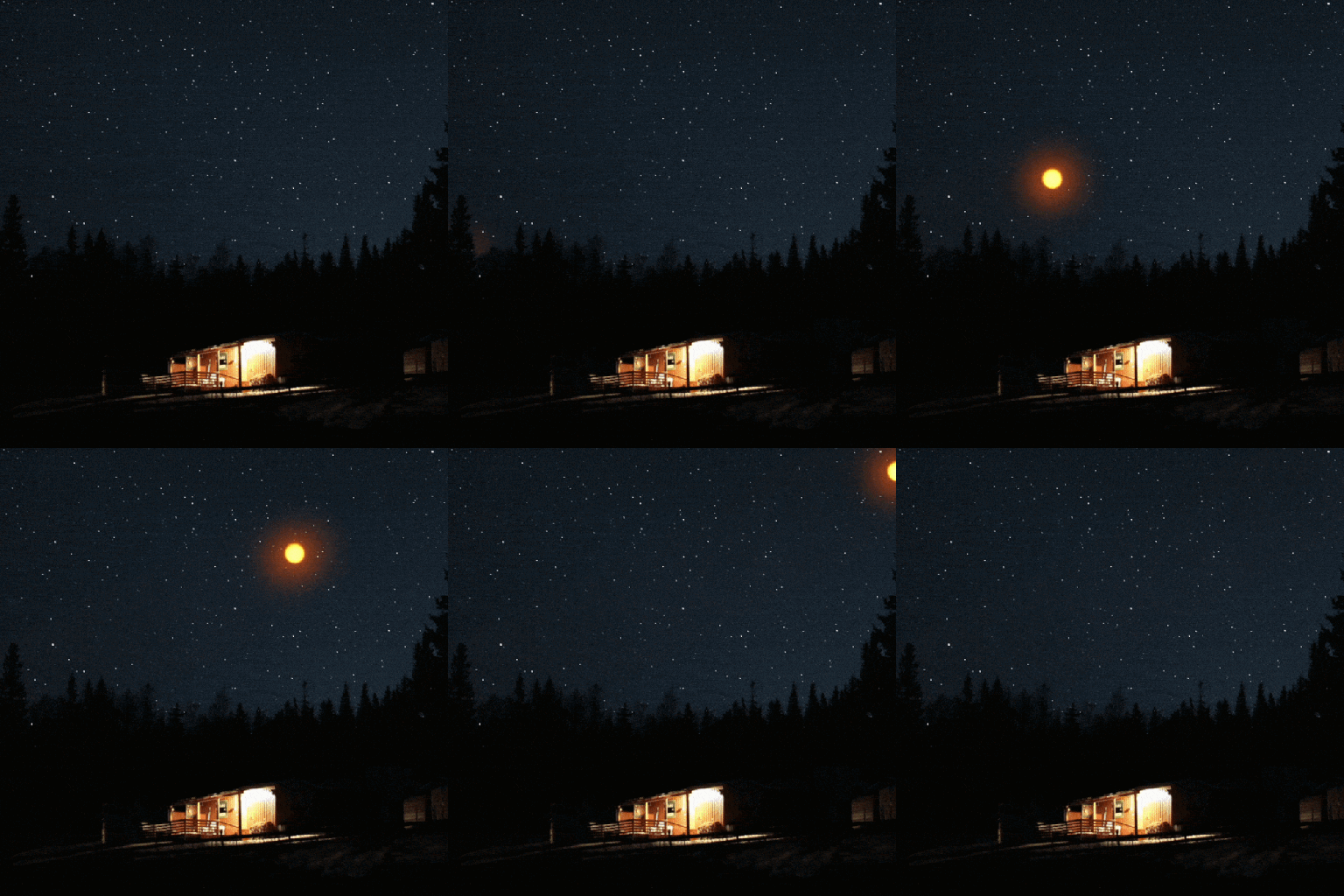
Although a great many unidentified sights have been seen in the skies, none have conclusively demonstrated the presence of aliens. So far.

Finding life beyond our Solar System requires understanding its host planet.

"When you feel the isolation setting in at times, you have to reframe your mindset."
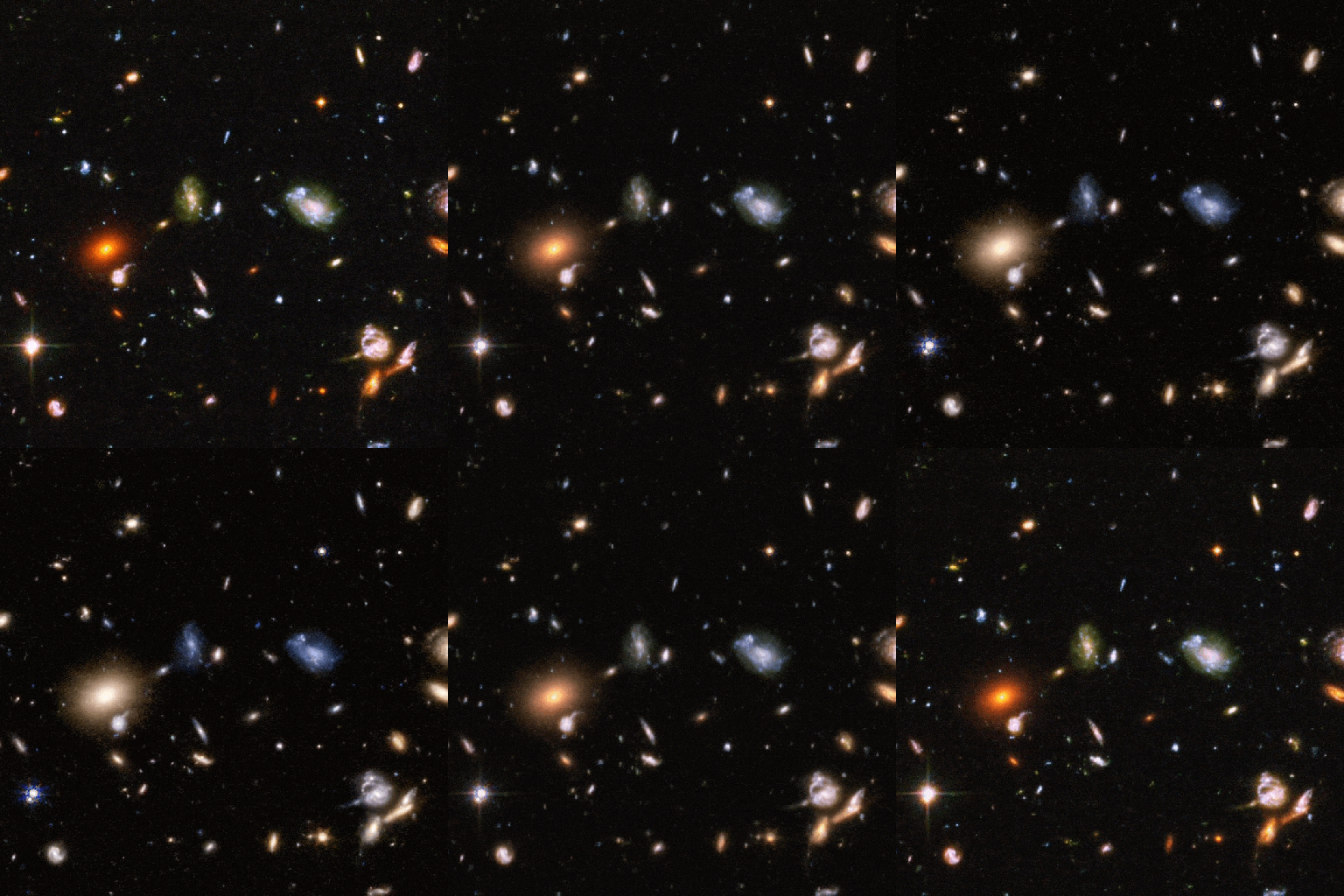
The "little red dots" were touted as being too massive, too early, for cosmology to explain. With new knowledge, everything adds up.

Here on Earth, we commonly use terms like weight (in pounds) and mass (in kilograms) as though they're interchangeable. They're not.

In "Life As No One Knows It," Sara Imari Walker explains why the key distinction between life and other kinds of "things" is how life uses information.


No matter how good our measurement devices get, certain quantum properties always possess an inherent uncertainty. Can we figure out why?

Life arose on Earth early on, eventually giving rise to us: intelligent and technologically advanced. "First contact" still remains elusive.

We need more data centers for AI. Developers are getting creative about where to build them.

The recent discovery of a large cave on the Moon highlights the importance of caves not just for future space explorers but astrobiology as well.

Most stars in the Universe are located in big, massive, Milky Way-like galaxies. But most galaxies aren't like ours at all.

The largest particle accelerator and collider ever built is the Large Hadron Collider at CERN. Why not go much, much bigger?