




















Search
Space Exploration

For centuries, Newton's inverse square law of gravity worked beautifully, but no one knew why. Here's how Einstein finally explained it.

From size to mass to density and more, each world in our Solar System is unique. When we compare them, the results are truly shocking.

Peaking on the night of August 11/12, up to 100 bright meteors per hour will be visible. Here's how to make the most of it.

Earth, the only rocky planet with a large, massive satellite, is greatly affected by the Moon. Destroying it would cause 7 major changes.

Straddling the bounds of science and religion, Newton wondered who set the planets in motion. Astrophysics reveals the answer.

How do normal matter and dark matter separate by so much when galaxy clusters collide? Astronomers find the surprising, unexpected answer.
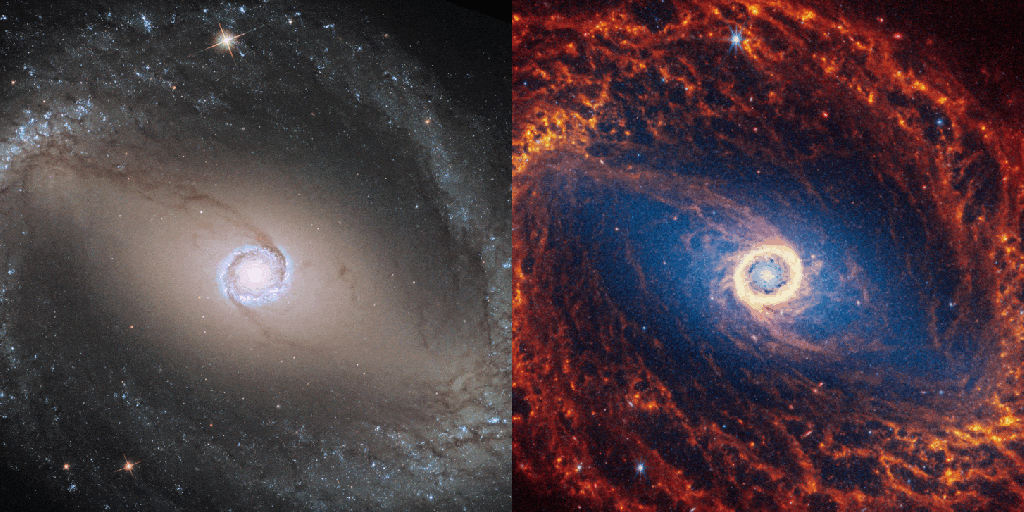
In July of 2022, the first science images from JWST were unveiled. Two years later, it's changed our view of the Universe.
From inside our Solar System, zodiacal light prevents us from seeing true darkness. From billions of miles away, New Horizons finally can.

The Extremely Large Telescope (ELT) will have a light-collecting power 10 times greater than today's best telescope.

For its 2-year science anniversary, JWST has revealed unprecedented details in "the Penguin and the Egg." Here are the surprises inside.

As the Sun ages, it loses mass, causing Earth to spiral outward in its orbit. Will that cool the Earth down, or will other effects win out?

Comparing Elon Musk's Mars rocket to NASA's new ride.

The structure of our Solar System has been known for centuries. When we finally started finding exoplanets, they surprised everyone.

The last infant stars are finishing their formation inside these pillars of gas. The evaporation of those columns is almost complete.

Sure, there's less daylight during winter than summer, as your hemisphere is tilted away from the Sun. But darkness goes deeper than that.

This research team is working out how to detect extraterrestrial cells in the liquid water ocean hidden beneath Enceladus’s icy crust.
From the coldest planets to spacecraft that have exited the Solar System, these little-known facts stump even many professional astronomers.

Newborn stars are surrounded only by a featureless disk. Debris disks persist for hundreds of millions of years. So when do planets form?

In December 1968, human beings made their first-ever journey to the Moon aboard Apollo 8. Their most important discovery? Planet Earth.

Out beyond Neptune are some fascinating bodies left over from our Solar System's formation. Could one of them truly be spectacular?

To know how to protect its astronauts, NASA needs to first understand the threat.

From forming bound states to normal scattering, many possibilities abound for matter-antimatter interactions. So why do they annihilate?

A new all-time record! JWST's discovery of JADES-GS-z14-0 pushes the earliest galaxy ever seen to just 290 million years after the Big Bang.

Ancient currents seemed to move in concert with a 2.4 million-year dance between the Red Planet and Earth.

The threats Mars astronauts face — and how NASA is working to solve them.

In ~7 billion years, our Sun will run out of fuel and die. So will every star, eventually. Here are the different fates they'll encounter.

In 2023, data from the James Webb Space Telescope soured hopes that TRAPPIST-1 c had an atmosphere. That disappointment might have been premature.

The mutual distance between well-separated galaxies increases with time as the Universe expands. What else expands, and what doesn't?

The number of planets that could support life may be far greater than previously thought, a recent discovery suggests.

The most iconic, longest-lived space telescope of all, NASA's Hubble, is experiencing orbital decay as the solar cycle peaks. Here's why.