




















Search
Space Missions

Compared to Earth, Mars is small, cold, dry, and lifeless. But 3.4 billion years ago, a killer asteroid caused a Martian megatsunami.

It is humanity's biggest step yet into the Solar System.

Thanks to a couple of rovers, we know Mars was once blue.

The largest hazardous asteroid found in the last 8 years showcases a little-known class of planet-killers. And we're woefully unprepared.

The DART mission tested whether it's possible to deflect an asteroid by crashing something into it.


This technological feat changes our cosmic history.

Sooner or later, Earth is going to be hit by a large enough space object to cause significant damage to humanity. Stopping them isn't easy.

The James Webb Space Telescope viewed Neptune, our Solar System's final planet, for the first time. Here's what we saw, and what it means.

Venus Life Finder could launch as early as 2023.

With a telescope at just the right distance from the Sun, we could use its gravity to enhance and magnify a potentially inhabited planet.

"You develop an instant global consciousness, a people orientation, an intense dissatisfaction with the state of the world, and a compulsion to do something about it."

The surface of asteroid Bennu is more like a plastic ball pit than the Moon.

Take a peek at the pre-release images used to calibrate and commission JWST's coldest instrument, now ready for full science operations.
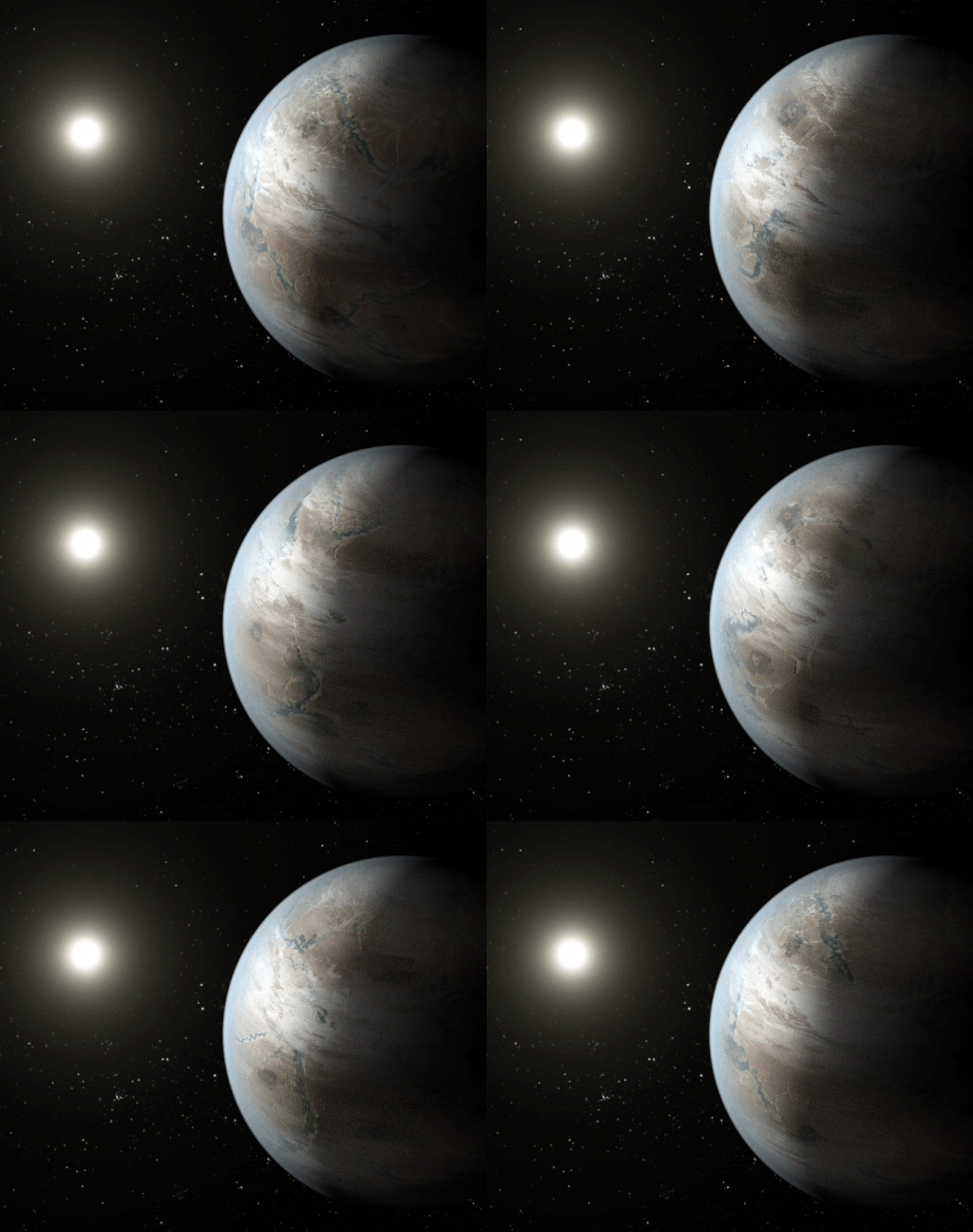
There are billions of potentially inhabited planets in the Milky Way alone. Here's how NASA will at last discover and measure them.

Do you think you know the Solar System? Here's a fact about each planet that might surprise you when you see it!

In all of human history, only 5 spacecraft have had the right trajectory to exit the Solar System. Will they ever catch Voyager 1?

Data from the Zhurong rover suggests the Red Planet was wet more recently than we thought.

For a thousand light-years in all directions, there's a "bubble" that the Sun sits at the center of. Here's the story behind it.

Most potentially hazardous asteroids remain unidentified. NEO surveyor could change that, but only if it's funded, and soon.

Pluto failed to meet the definition of a planet, but some astronomers think there might be a legitimate Planet 9 out there.

Multiple lines of evidence — physical, chemical, and biological — must converge for scientists to conclude that alien life has been found.

Knowing that technology would advance in the future, NASA put some moon rock samples into storage without opening them. Now, they have.

Nearly 200 orbital launches are scheduled for 2022.

65 million years ago, an asteroid strike caused the 5th great mass extinction. Could we save Earth, today, from a similar event?

The massive craft could carry 100 humans to Mars and revolutionize space exploration.

On December 19 1972, astronauts Eugene Cernan, Harrison Schmitt and Ronald Evans splashed down safely in the Pacific Ocean, ending the Apollo 17 lunar mission. They were the last people to travel […]

Space missions in 2022 will include massive rockets and asteroid collisions. This is also the year space tourism starts to hit its stride.

A levitating vehicle might someday explore the moon, asteroids, and other airless planetary surfaces.