




















Search
Space Science

Human beings have now traveled farther from Earth than ever before with Artemis II's flyby of the lunar far side. Here's how it happened.
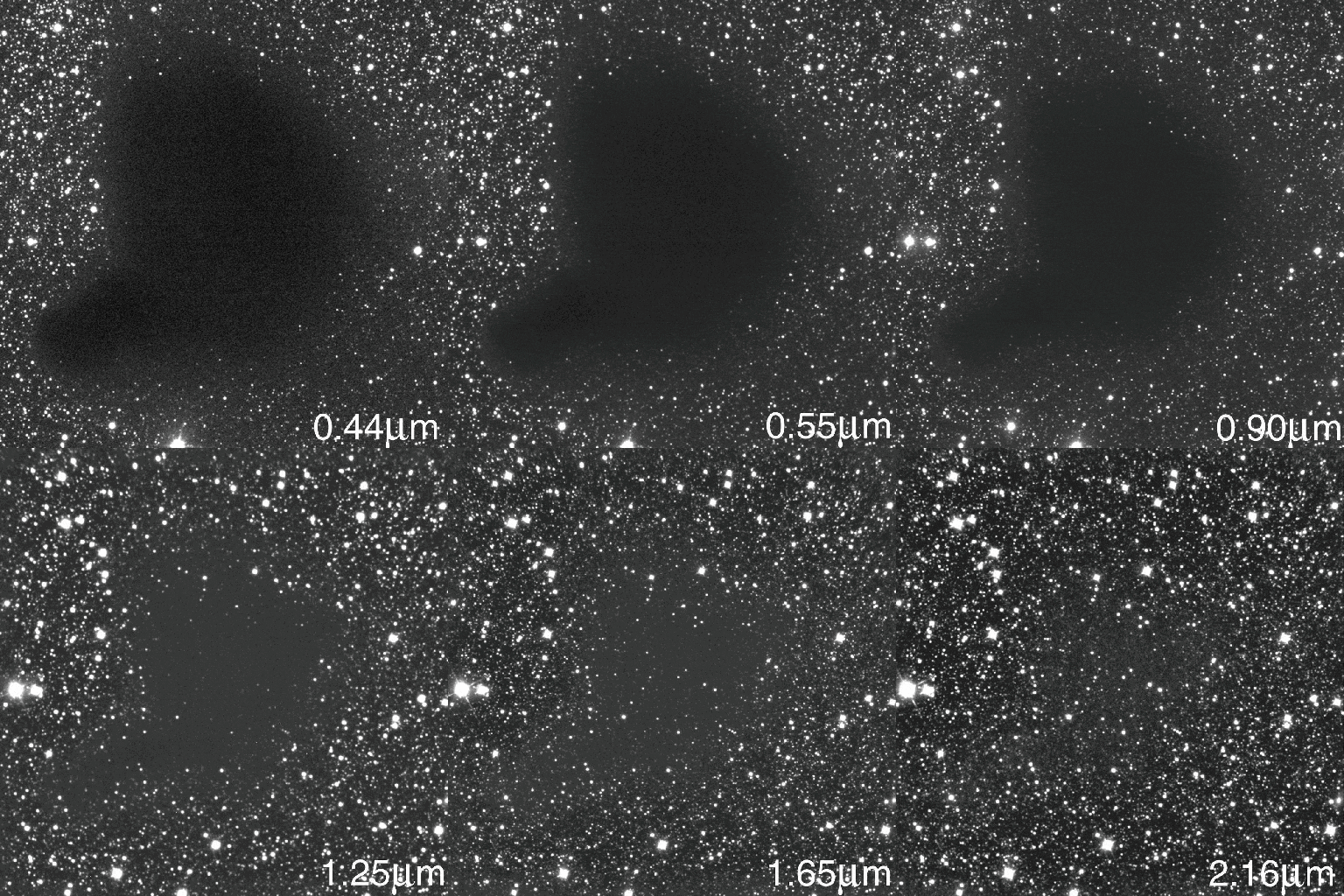
The image you're seeing isn't a hole in the Universe, and the cosmic voids that do exist aren't hole-like at all.

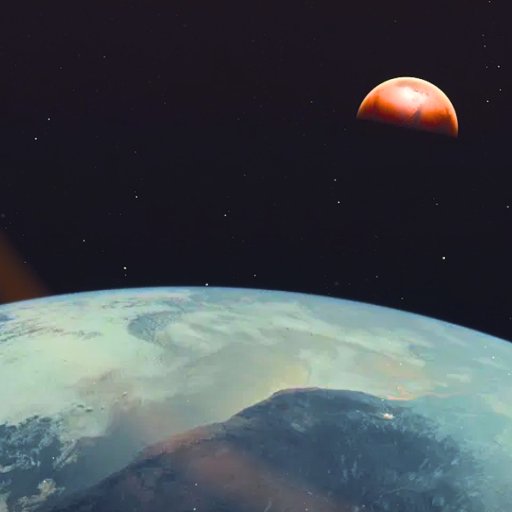
Science fiction romanticized Mars as a place of adventure and future settlement; science tells a very different story.

The unanswered questions about sex, love, and pregnancy in space could shape the future of humanity more than we think.
7mins
30 years ago, we didn’t know other stars had planets orbiting them. Now, we may be on the verge of finding Earth’s Twin. Sara Seager explains.

US science is worth fighting for, but so are the science projects and scientists denied opportunities. Here are 4 paths all worth exploring.

It takes a wide variety of processes in the Universe to make all the elements that populate space today. We're still discovering new ones!

We first measured G, the gravitational constant, back in the 18th century. As the least well-known fundamental constant, can it be improved?

What if the first search for life beyond Earth actually succeeded?

The first world beyond Earth for human habitability should be the Moon, not Mars. This is why we should terraform our lunar neighbor first.

24mins
“Deep down the natural endpoint of this whole goal of looking for planets is to answer the question: are we alone?”

As October begins, thousands of longtime NASA employees are leaving the agency. 4000+ will exit by January 9, 2026, changing NASA forever.

Organic compounds can form through simple chemistry alone — making the search for true biosignatures trickier than it seems.
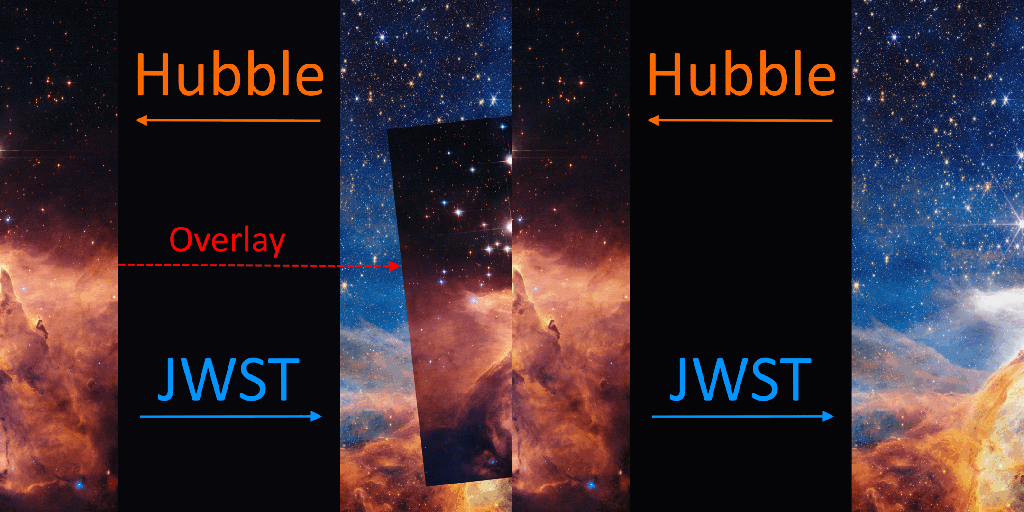
JWST isn't the first telescope to peer into this factory of star-birth some 5500 light-years away, but its views are the most educational.

NASA's 1958 charter's top priority was, "the expansion of human knowledge of phenomena in the atmosphere and space." Is this how it ends?

Even just by examining the Moon with the unaided eye, we can learn an incredible amount about the Moon, Earth, and more.

First 'Oumuamua, then Borisov, and now ATLAS have shown us that interstellar interlopers are real. Here's what the newest one teaches us.

Once every 12 years, Earth, Jupiter, Uranus, and Neptune all line up, opening a window for a joint mission. Our next chance arrives in 2034.
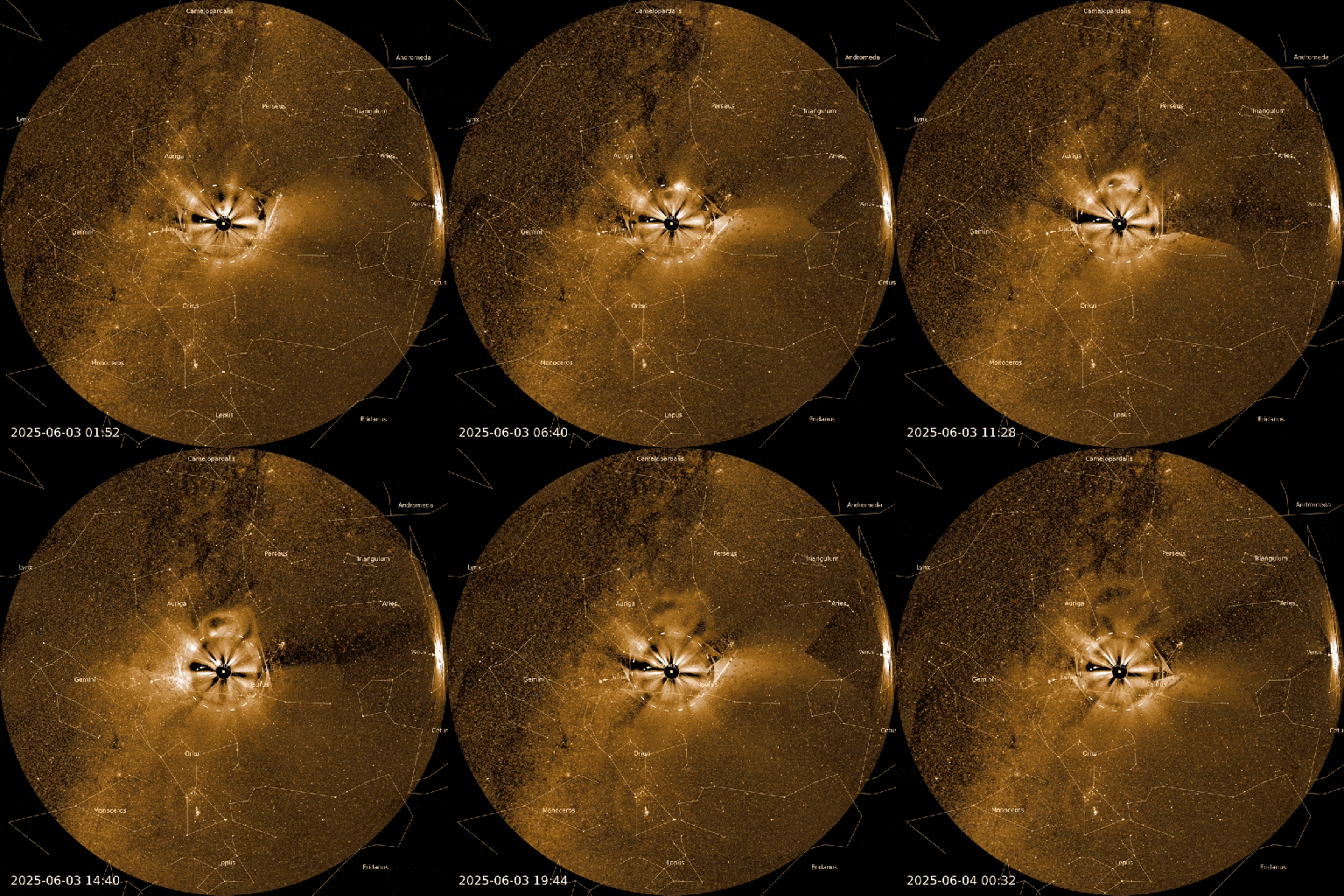
Launched in March, the PUNCH mission has viewed two incredible coronal mass ejections, tracking them farther from the Sun than ever before.

Viewing Uranus's largest moons with Hubble, astronomers hoped to find darkening on the trailing side. They found the exact opposite instead.

Many were hoping that JWST would find the first stars of all. Despite many hopeful claims, it hasn't, and probably can't. Here's how we can.

18mins
"There's a long history of people claiming planets which look Earth-like, Earth 2.0, Earth twins."

DESI, by mapping galaxies, has claimed they see evidence for dark energy evolving by getting weaker. But that's only one interpretation.

Even from a single pixel, multiwavelength data taken over time can reveal clouds, icecaps, oceans, continents, and even signs of life.

Some nebulae emit their own light, some reflect the light from stars around them, and some only absorb light. But that's just the beginning.

Back in 1970, Sister Mary Jucunda wrote NASA, decrying large investments in science. A former Nazi's legendary response is still relevant.

At extremely close distances to their stars, even rocky planets can be completely disintegrated. We've just caught our first one in action.

Ring galaxies are rare, but we think we know how they form. A new, early-stage version, the Bullseye galaxy, provides a new testing ground.

Here in our Solar System, terrestrial bodies get moons from gravitational capture or collisions. The Pluto-Charon system? It was both.

A young, nearby, massive star, whose protoplanetary disk appears perfectly edge-on, was just viewed by JWST, with staggering implications.