




















Search
Space Telescopes

The most famous Hubble images show glittering stars and galaxies amidst the black backdrop of space. But more was captured than we realized.

1hr 33mins
"Many astronomers are really driven by the search for Earth twins because I think deep down the natural endpoint of this whole goal of looking for planets is to answer the question, are we alone?"

Even from a single pixel, multiwavelength data taken over time can reveal clouds, icecaps, oceans, continents, and even signs of life.

Our scientific instruments are constantly improving, revealing nature's workings as never before. Without them, we'll remain in the dark.

The tiniest galaxies of all are the most susceptible to violence by their larger, bullying siblings. That's why we need them in isolation.

Barnard's star, the closest singlet star system to ours, has long been a target for planet-hunters. We've finally confirmed it: they exist!

One of the most promising dark matter candidates is light particles, like axions. With JWST, we can rule out many of those options already.

The full extent of the Andromeda galaxy, the nearest large galaxy to our own, has been entirely imaged with Hubble's exquisite cameras.

At extremely close distances to their stars, even rocky planets can be completely disintegrated. We've just caught our first one in action.

Seeking life beyond the Solar System, we first look to the closest star systems with Earth-like planets. Here's why that's not good enough.

New telescopes, radio dishes, and gravitational wave detectors are needed for next-generation science. Will the USA lead the way?

The Ring Nebula, a bright, circular planetary nebula, is created by a dying Sun-like star. After centuries, we finally know its true shape.

Since mid-2022, JWST has been showing us how the Universe grows up, from planets to galaxies and more. So, what's its biggest find of all?

The most massive early galaxies grew up faster, and have more stars, than astronomers expected, according to JWST. What does it all mean?

The 5th brightest star in our night sky is young, blue, and apparently devoid of massive planets. New JWST observations deepen the mystery.

NASA's space telescopes and observatories bring humanity unrivaled science images and scientific discoveries. Here's what should be next.

More than two years after JWST began science operations, our Universe now looks very different. Here are its biggest science contributions.

National Geographic's first James Webb Space Telescope book shows us the cosmos like never before.

Interferometry gave us a black hole's event horizon, but that was in the radio. What can we accomplish with a new optical interferometer?

Comet A3, also known as Comet Tsuchinshan-ATLAS, has sprung to life since 2024's last equinox. Here's how to catch the show for yourself.

Despite many ultra-distant galaxy candidates found with JWST, we still haven't seen anything from the Universe's first 250 million years.

Almost all of the stars, planets, and interesting physics happens in the inner portions of galaxies. Is that conventional wisdom all wrong?

Finding life beyond our Solar System requires understanding its host planet.
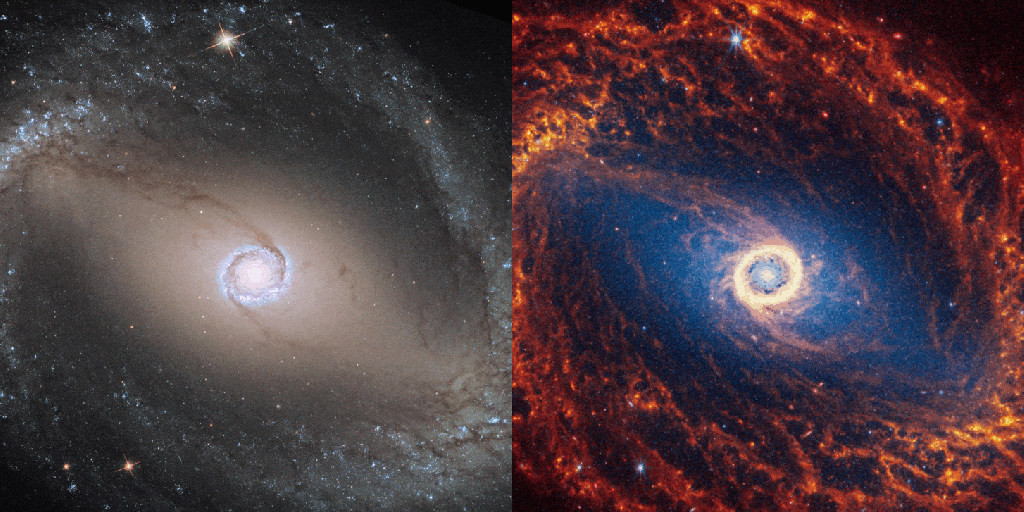
In July of 2022, the first science images from JWST were unveiled. Two years later, it's changed our view of the Universe.

The Extremely Large Telescope (ELT) will have a light-collecting power 10 times greater than today's best telescope.

For its 2-year science anniversary, JWST has revealed unprecedented details in "the Penguin and the Egg." Here are the surprises inside.

All telescopes are fundamentally limited in what they can see. JWST reveals more distant galaxies than Hubble, but still can't see them all.

The sharpest optical images, for now, come from the Hubble Space Telescope. A ground-based technique can make images over 100 times sharper.

Newborn stars are surrounded only by a featureless disk. Debris disks persist for hundreds of millions of years. So when do planets form?

In 2023, data from the James Webb Space Telescope soured hopes that TRAPPIST-1 c had an atmosphere. That disappointment might have been premature.