




















Search
Standard Model

Dark matter doesn't absorb or emit light, but it gravitates. Instead of something exotic and novel, could it just be dark, normal matter?

When we divide matter into its fundamental, indivisible components, are those particles truly point-like, or is there a finite minimum size?

A proton is the only stable example of a particle composed of three quarks. But inside the proton, gluons, not quarks, dominate.

In the year 2000, physicists created a list of the ten most important unsolved problems in their field. 25 years later, here's where we are.

Our Universe isn't just expanding, the expansion is accelerating. Instead of dark energy, could a "lumpy" Universe be at fault?

Electromagnetism, both nuclear forces, and even the Higgs force are mediated by known bosons. What about gravity? Does it require gravitons?

There was a lot of hype and a lot of nonsense, but also some profoundly major advances. Here are the biggest ones you may have missed.

Matt Strassler's journey into fundamental physics culminates in a brilliant explanation of the Higgs field. Enjoy this exclusive interview.

From a hot, dense, uniform state in its earliest moments, our entire known Universe arose. These unavoidable steps made it all possible.

We have very specific predictions for how particles ought to decay. When we look at B-mesons all together, something vital doesn't add up.

One of the fundamental constants of nature, the fine-structure constant, determines so much about our Universe. Here's why it matters.

Humans, when we consider space travel, recognize the need for gravity. Without our planet, is artificial or antigravity even possible?

The secret sauce is the real world.

LHC scientists just showed that spooky quantum entanglement applies to the highest-energy, shortest-lived particles of all: top quarks.
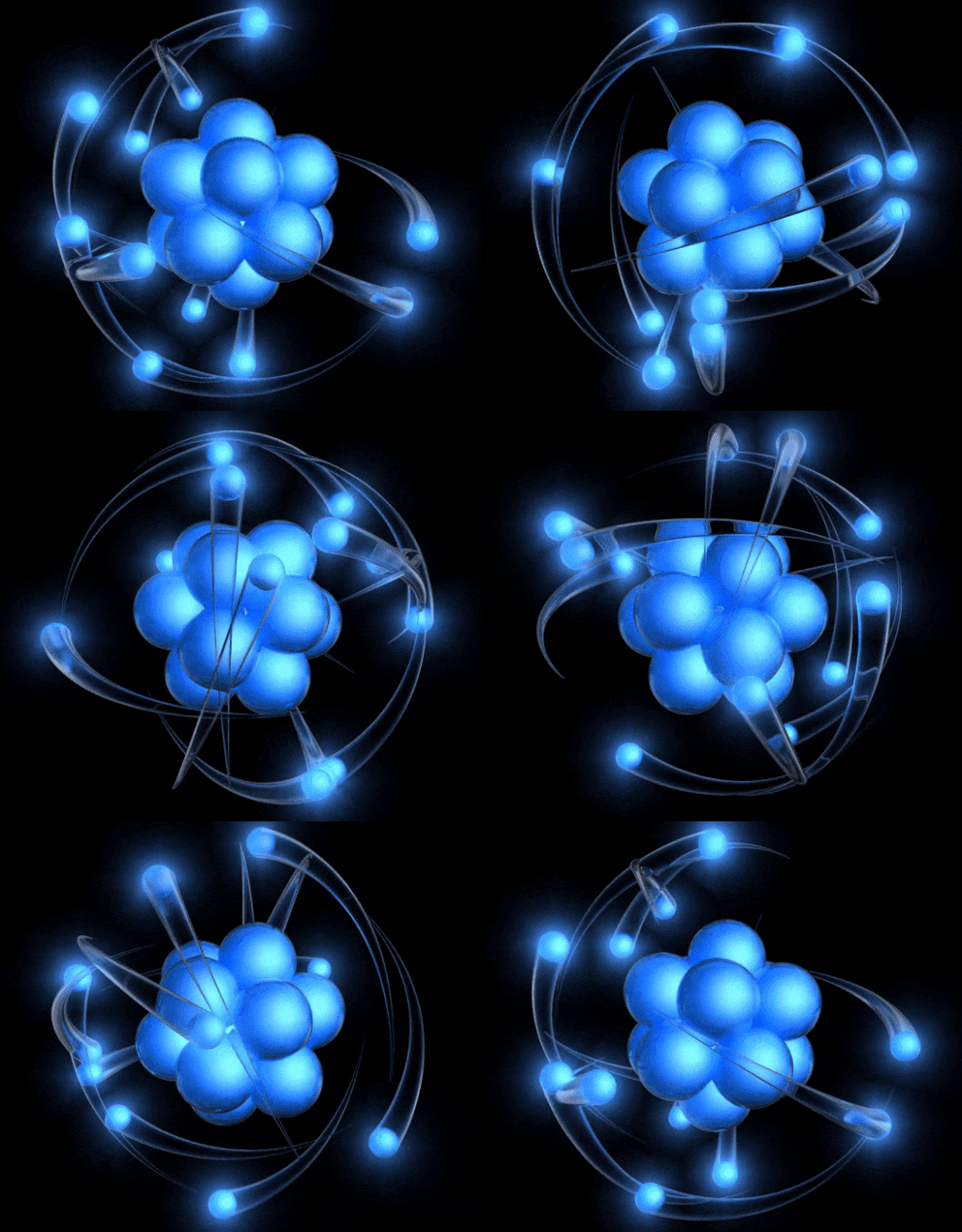
Most fundamental constants could be a little larger or smaller, and our Universe would still be similar. But not the mass of the electron.

The observation that everything we know is made out of matter and not antimatter is one of nature's greatest puzzles. Will we ever solve it?

Scientific surprises, driven by experiment, are often how science advances. But more often than not, they’re just bad science.

In all the Universe, only a few particles are eternally stable. The photon, the quantum of light, has an infinite lifetime. Or does it?

Quarks and leptons are the smallest known subatomic particles. Does the Standard Model allow for an even smaller layer of matter to exist?

Dark matter's hallmark is that it gravitates, but shows no sign of interacting under any other force. Does that mean we'll never detect it?

A longstanding mismatch between theory and experiment motivated an exquisite muon measurement. At last, a theoretical solution has arrived.

Almost 100 years ago, an asymmetric pathology led Dirac to postulate the positron. A similar pathology could lead us to supersymmetry.

From forming bound states to normal scattering, many possibilities abound for matter-antimatter interactions. So why do they annihilate?

It's 2024, and we still only know of the fundamental particles of the Standard Model: nothing more. But these 8 unanswered questions remain.

Predicted way back in the 1960s, the discovery of the Higgs boson in 2012 completed the Standard Model. Here's why it remains fascinating.

CERN's Large Hadron Collider is the most powerful particle accelerator ever. To go even further, we'll have to overcome something big.

With new W-boson, top quark, and Higgs boson measurements, the LHC contradicts earlier Fermilab results. The Standard Model still holds.
Glueballs are an unusual, unconfirmed Standard Model prediction, suggesting bound states of gluons alone exist. We just found our first one.

Dark energy is one of the biggest mysteries in all the Universe. Is there any way to avoid "having to live with it?"

Our Universe requires dark matter in order to make sense of things, astrophysically. Could massive photons do the trick?