




















Search
Stellar Evolution

Temperatures in the Sun's core exceed 10 million degrees Celsius. But how on Earth did we actually come to know that?

This beautiful JWST image of Wolf-Rayet star WR 124 has been called a "prelude to a supernova" by NASA. That might be entirely wrong.

Somewhere out there in the Universe is the heaviest neutron star, and elsewhere lies the lightest black hole. Where's the line between them?

What kind of object will you form? What will its fate be? How long will a star live? Almost everything is determined by mass alone.

If stars don't go supernova at first, they can get a second chance after becoming a white dwarf. But can their companions survive?


A fascinating 90 minute podcast between Dr. Ivanna Escala and Ethan Siegel on Starts With A Bang!

The Universe certainly formed stars, at one point, for the very first time. But we haven't found them yet. Here's what everyone should know.

One study suggested that the "Methuselah Star" is older than the Universe itself.

Most globular clusters appear to form their stars all at once, but there are exceptions. JWST just observed how "second formations" happen.

Red dwarf stars were supposed to be inhospitable. But TOI-700, now with at least two potentially habitable worlds, is quite the exception.

Most of us have heard that the Sun is an ordinary, typical, unremarkable star. But science shows we're actually anything but average.


In the grand scheme of the cosmic story, a single year isn't all that significant. But over time, the annual changes really add up!

The most common element in the Universe, vital for forming new stars, is hydrogen. But there's a finite amount of it; what if we run out?


By studying the dwarf galaxy Wolf-Lundmark-Melotte ~3 million light-years away, JWST reveals the Universe's star-forming history firsthand.

At 1,600 light years away, the black hole is practically in our cosmic backyard.

It's rare that one single image packs so much beauty and science simultaneously. This Hubble view of a nearby star-forming region has both.

In 1995, Hubble peered at the Pillars of Creation, forever changing our view. Now in 2022, JWST completes the star-forming puzzle.

The stars circle each other every 51 minutes, confirming a decades-old prediction.

1.9 billion years ago, a star's explosive death created a black hole. Its light just arrived at Earth. But did it set a cosmic record?

With its first view of a protoplanetary disk around a newly forming star, the JWST reveals how alone individual stellar systems truly are.

Before we discovered gravitational waves, multi-messenger astronomy got its start with light and particles arriving from the same event.

It's the very closest stars to us that hold the key to unlocking the possibilities for life in star systems all throughout the Universe.

Black holes aren't just the densest masses in the Universe, but they also spin the fastest of all massive objects. Here's why it must be so.
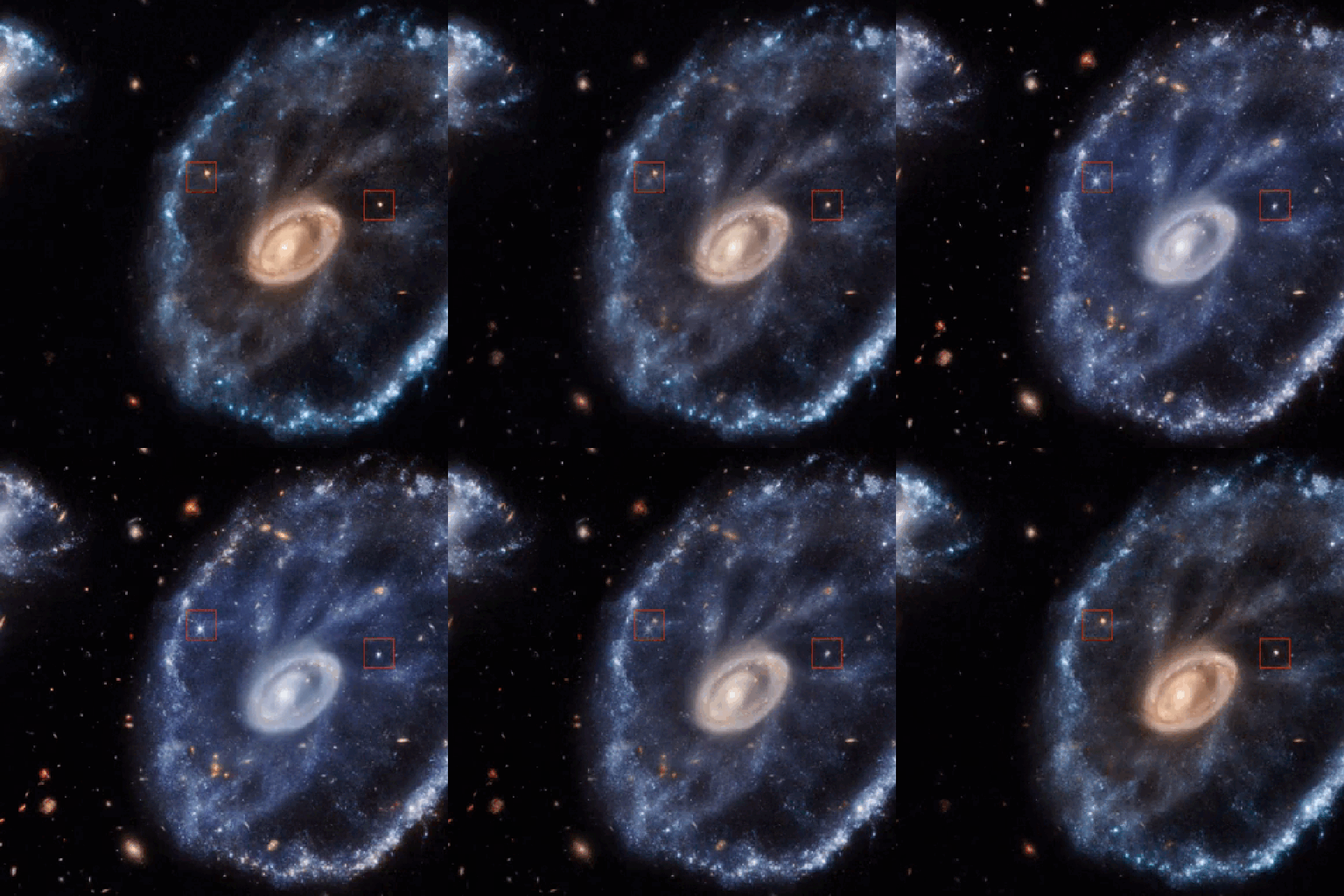
The first set of James Webb's images blew us all away. In just 2 mere months, it's seen highlights that no one could have predicted.
At their cores, stars can reach many millions or even billions of degrees. But even that doesn't touch the hottest of all.

The key problem with the dark matter hypothesis is that nobody knows what form dark matter might take.

Unless you have a critical mass of heavy elements when your star first forms, planets, including rocky ones, are practically impossible.