




















Search
Stellar Evolution

When three wise men gifted baby Jesus with gold, frankincense, and myrrh, they had no idea one was made from colliding neutron stars.

Carl Sagan was far from the first to declare we are the children of ancient stars.

The Firefly Sparkle galaxy was only spotted because of gravitational lensing's effects. Yet galaxies like these brought us a visible cosmos.

The closest known star that will soon undergo a core-collapse supernova is Betelgeuse, just 640 light-years away. Here's what we'll observe.

The Sombrero is the closest bright, massive, edge-on galaxy to us. JWST's new image, taken with MIRI, finally shows what's under its hat.
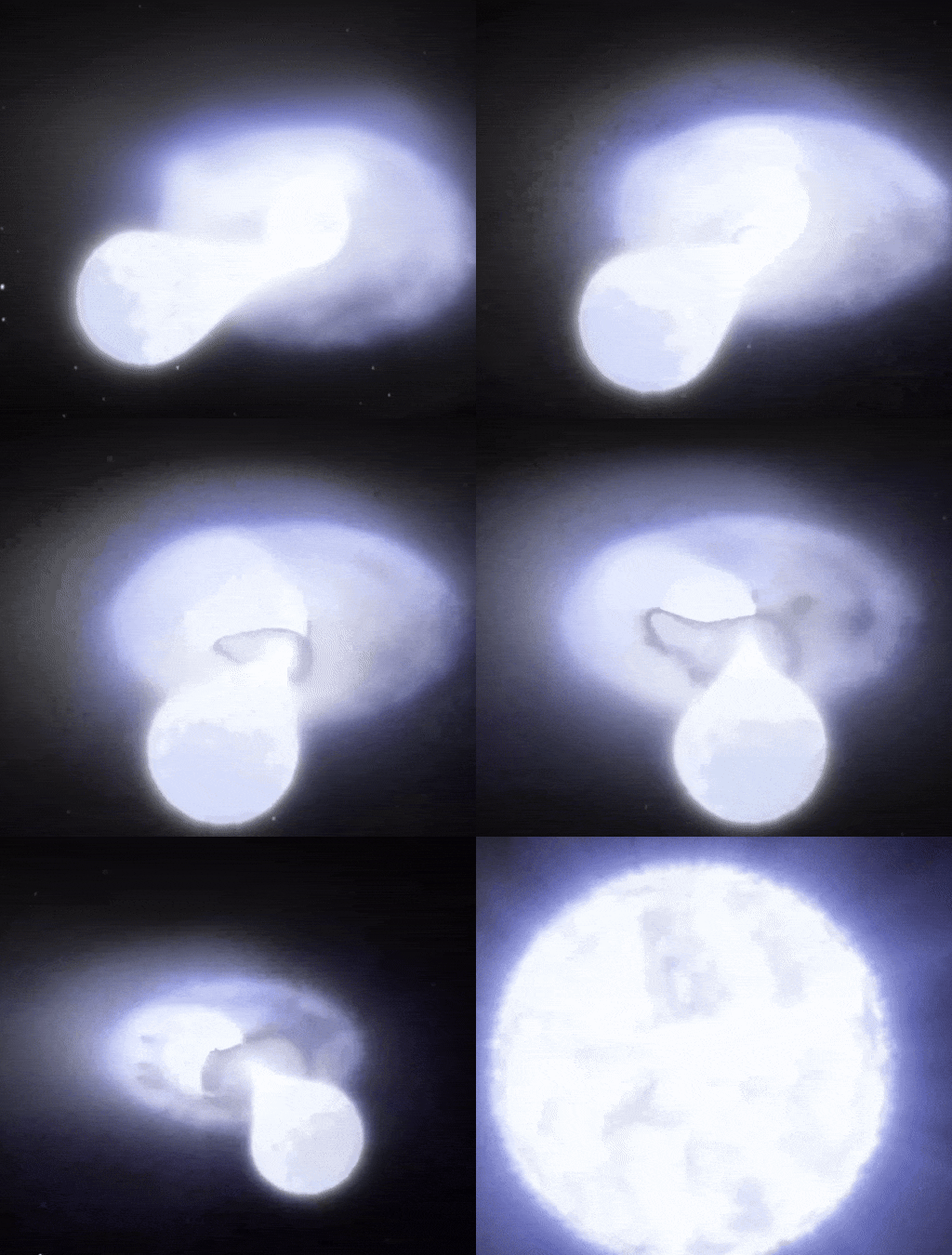
Since 1930, type Ia supernovae have been thought to arise from white dwarfs exceeding the Chandrasekhar mass limit. Here's why that's wrong.

In astronomy, a star's initial mass determines its ultimate outcome in life. Unless, that is, a stellar companion alters the deal.

The 5th brightest star in our night sky is young, blue, and apparently devoid of massive planets. New JWST observations deepen the mystery.

In the year 1181, a "guest star" was recorded in the constellation of Cassiopeia. Its modern supernova remnant is weirder than we imagined.

More than two years after JWST began science operations, our Universe now looks very different. Here are its biggest science contributions.

The Universe changes remarkably over time, with some entities surviving and others simply decaying away. Is this cosmic evolution at work?

The earliest Milky Way-like galaxy, REBELS-25, was spotted rotating about its axis. It's only 700 million years old: 5% of our present age.

Just 460 light-years away, the closest newborn protostars are forming in the Taurus molecular cloud. Here are JWST's astonishing insights.

Almost all of the stars, planets, and interesting physics happens in the inner portions of galaxies. Is that conventional wisdom all wrong?

Galactic activity doesn't just arrive when supermassive black holes feast on matter. Before, during, and after all create fascinating signs.

Most stars in the Universe are located in big, massive, Milky Way-like galaxies. But most galaxies aren't like ours at all.

Straddling the bounds of science and religion, Newton wondered who set the planets in motion. Astrophysics reveals the answer.

As the Sun ages, it loses mass, causing Earth to spiral outward in its orbit. Will that cool the Earth down, or will other effects win out?

We know of stellar mass and supermassive black holes, but intermediate mass ones have long proved elusive. Until now.

The last infant stars are finishing their formation inside these pillars of gas. The evaporation of those columns is almost complete.

The sharpest optical images, for now, come from the Hubble Space Telescope. A ground-based technique can make images over 100 times sharper.

Known as hypervelocity stars, we originally thought just one would be ejected every 100,000 years. The real number is much greater.

Northern lights in the American South, clusters of huge geomagnetic storms—the Sun is throwing a tantrum right on schedule.

Newborn stars are surrounded only by a featureless disk. Debris disks persist for hundreds of millions of years. So when do planets form?

The Universe is precisely dated at 13.8 billion years old, but astronomers claim the Methuselah star is 14.5 billion years old. What gives?

In ~7 billion years, our Sun will run out of fuel and die. So will every star, eventually. Here are the different fates they'll encounter.
In 2017, we detected gold being forged in a neutron star-neutron star merger. Now, in 2024, the amounts created simply don't add up.

The most iconic "dark nebula" of all lights up under JWST's infrared gaze. Here's what's newly discovered inside.

This first-of-its-kind image offers a detailed look at the magnetic fields within the Central Molecular Zone.

The JWST's observations of well-developed galaxies early in universal history may coincide with accepted astronomical theory after all.