
















Sustainability

Sustainability

World map showing global oil reserves, rare earth elements deposits (yellow dots), and major shipping routes and chokepoints, with oil reserves highlighted by pink circles of varying sizes.
As the global economy moves beyond oil, the strategic importance of the world’s most critical hydrocarbon chokepoint is likely to decline rapidly.
A group of people stands and plays cricket in an urban park at dusk, with city buildings, trees, and illuminated streetlights in the background.
The ozone hole was going to destroy life as we know it, but an unprecedented global effort fixed the problem.
A small human figure stands at the base of a very tall tree, emphasizing the tree’s large size against a background with faint grid lines.
Every generation has faced a version of this moment — the question has never been what our tools can do, but what we choose to do with them.
A woman in traditional attire stands among a group of people, next to maps showing global data with colored grids and overlays.
A growing movement shows that protecting the world’s forests — and the people who have safeguarded them for centuries — is one of the most powerful, and overlooked, tools in the fight against climate change.
Skoll Foundation
A traffic signal warning sign is partially submerged in floodwater.
The idea that it’s “too late” to reduce emissions fuels cynicism and despair, putting us on an even worse trajectory.
Illustration of silhouetted people on scaffolding assembling a large globe with a crane hook against a textured pink background.
New biotech tools could clean up everything from construction to agriculture.
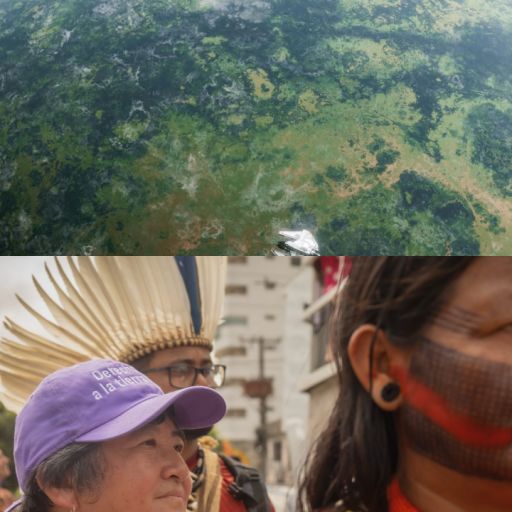
A collage shows an aerial view of a green planet above images of Indigenous people, some in traditional attire, participating in a gathering or march.
10mins
At COP30, Indigenous leaders came with a message the world can’t ignore: 5% of the global population is safeguarding 80% of Earth’s biodiversity. A $1.8B pledge was made to support their land rights — but will the money follow their lead?
Skoll Foundation
Book cover titled "The End of Driving: Automated Cars, Robotaxis, Sharing vs Owning, and the Future of Mobility" by Bern Grush, John S. Niles, and Andrew Miller, Second Edition.
Robotaxis can transform cities by improving mobile efficiency, equity, and safety — if cities adopt policies that prioritize the public good.
A sequence of four orange and black butterflies in motion, captured against a black background, their blurred wings a graceful display of butterfly wisdom in flight.
Welcome to The Nightcrawler — a weekly newsletter from Eric Markowitz covering tech, innovation, and long-term thinking.
A split image shows a person typing on a laptop on the left and gridlocked cars on the right, set against connected nodes and letters—a visual nod to Jack Nilles, pioneer of telecommuting.
Decades before COVID imposed remote work on the world, Jack Nilles pioneered WFH and championed its many benefits.
Abstract collage with network nodes, a vintage gear, a textured gray circle, and green gears on a graph background, divided into four colored quadrants.
An introduction to "The Engine of Progress" from Jason Crawford, founder of the Roots of Progress Institute.
A coastal landscape with rugged cliffs shaped by seaflooding and calm water at sunset, with mountains in the background and soft orange and purple hues in the sky.
Bold megaprojects could turn dry depressions into thriving new hubs of life.
A series of solar sail spacecraft harvest solar power at night, floating above Earth's atmosphere with the sun shining in the background.
Solar power has the disadvantage that there's no Sun at night. Satellite startup Reflect Orbital wants to change that, but at what cost?
A person holds an oval mirror in front of their face against a blue background, with their reflection appearing abstract and distorted, evoking the surreal influence of ai on self-perception.
If AI is modeled only on human intelligence, will it inherit only human ways of seeing the world?
An artist's rendering of the nasa jupiter spacecraft.
The Juno spacecraft, orbiting and imaging Jupiter since 2016, is still succeeding. Without a further extension, the mission now faces death.
Silhouetted quiver trees under a starry night sky, with the Milky Way forming a bright arc above the horizon—perfect for fans of stunning 2025 night sky images.
Across planet Earth, dark and pristine night skies are an increasingly rare resource. These photos showcase the best of what we still have.
Map showing Copenhagen, Denmark’s projected 2080 climate as similar to Demigny, France today, with a red arrow connecting the two cities and climate details listed in pop-up boxes.
“Climate analog mapping” finds the place that is currently as warm as your city might be in 60 years.
Halftone close-ups of a person's smiling mouth and eyes, with a small silhouette of people climbing a hill—evoking the adventurous spirit of Brad Feld—set against abstract backgrounds.
A conversation with the legendary VC on his latest book, his work at Techstars, and why “give first” is more than a motto — it’s a mindset.
A collage featuring an open book, a light source, and images of the moon captures post-AI wisdom, with the title "The Night Crawler" at the top.
Welcome to The Nightcrawler — a weekly newsletter from Eric Markowitz covering tech, innovation, and long-term thinking.
Three different 3D protein structures are displayed on a light grid-patterned background, each occupying a separate quadrant in the image.
By inviting players to tackle real scientific problems, games can offer a hand in solving medicine’s toughest challenges.
Book cover titled "After the Spike: Population, Progress, and the Case for People" by Dean Spears and Michael Geruso, featuring a population spike graph set against a blue background, highlighting themes of population and environment.
In "After the Spike," Dean Spears and Michael Geruso show why policy, rather than high population density, has the most significant impact on the environment.
Two men in suits stand in front of a graphic collage featuring technical drawings and a building with solar panels, overlaid with the text "The Nightcrawler," evoking innovation that stands the test of stellar age.
Welcome to The Nightcrawler — a weekly newsletter from Eric Markowitz covering tech, innovation, and long-term thinking.
Collage with clocks, footprints in sand, a hand drawing a world map, binary code, and the text "The Nightcrawler" at the top—an evocative piece rethinking civilization and our journey through time.
Welcome to The Nightcrawler — a weekly newsletter from Eric Markowitz covering tech, innovation, and long-term thinking.
A human cell and the Earth are shown side by side in outer space against a starry background.
1hr 11mins
“It's a remarkable series of events that were required for us to be here, and that so many things could have happened in a different way that we wouldn't be here at all, both individually, and as a species.”
An astronaut in a spacesuit stands facing a large red planet or celestial body with a glowing edge against a black background.
18mins
“We are beginning to take our first steps out into the cosmic ocean… and the water seems inviting.”
Large crowd of well-dressed people socializing at an indoor event; "Substack" is projected on a wall above.
The platform is a digital Royal Society for today's greatest minds — and it could play an essential role in shaping the next civilization.
An older man sits on a chair in front of a white backdrop, surrounded by rows of hanging beef carcasses in a meat processing facility.
1hr 55mins
“It’s not about being perfect. It’s about reducing suffering where we can, and right now, we’re choosing not to.”
Target symbol over a world map with a central orange circle displaying "< 2°", surrounded by numbers on concentric circles.
5mins
“I think the key point is that doesn't mean game over. That doesn't mean we're flipped into a world, and to a point of no return.”