




















Search
Universe Expansion

The big question isn't whether the Universe is expanding at 67 or 73 km/s/Mpc. It's why different methods yield such different answers.

Most stars in the Universe are located in big, massive, Milky Way-like galaxies. But most galaxies aren't like ours at all.

The largest particle accelerator and collider ever built is the Large Hadron Collider at CERN. Why not go much, much bigger?

More than any other equation in physics, E = mc² is recognizable and profound. But what do we actually learn about reality from it?

Dark matter's hallmark is that it gravitates, but shows no sign of interacting under any other force. Does that mean we'll never detect it?

Peaking on the night of August 11/12, up to 100 bright meteors per hour will be visible. Here's how to make the most of it.

How do normal matter and dark matter separate by so much when galaxy clusters collide? Astronomers find the surprising, unexpected answer.

Even in the very early Universe, there were heavy, supermassive black holes at the centers of galaxies. How did they get so big so fast?
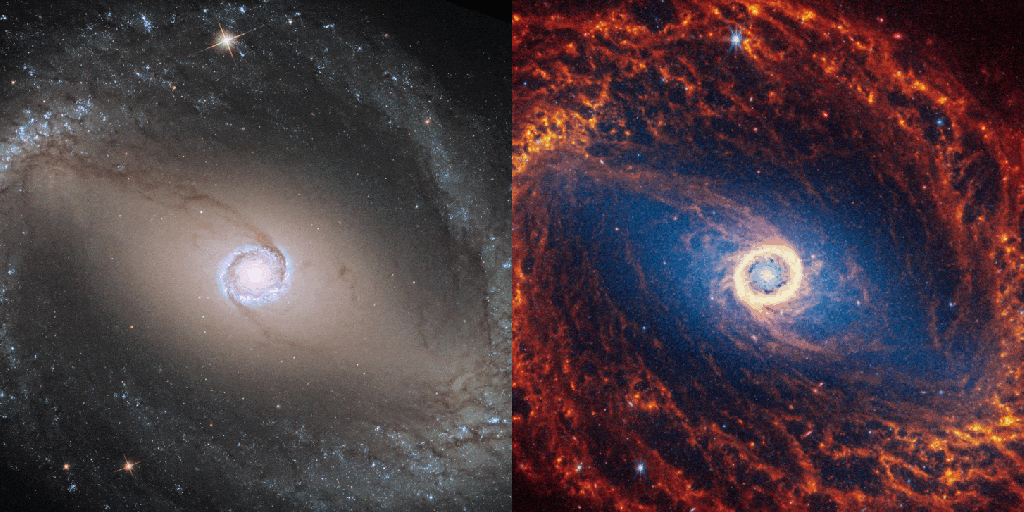
In July of 2022, the first science images from JWST were unveiled. Two years later, it's changed our view of the Universe.
From inside our Solar System, zodiacal light prevents us from seeing true darkness. From billions of miles away, New Horizons finally can.

For its 2-year science anniversary, JWST has revealed unprecedented details in "the Penguin and the Egg." Here are the surprises inside.

Just 13.8 billion years after the hot Big Bang, we can see objects up to 46.1 billion light-years away. No, this doesn't violate relativity.

We know of stellar mass and supermassive black holes, but intermediate mass ones have long proved elusive. Until now.

The Bullet Cluster has, for nearly 20 years, been hailed as an empirical "proof" of dark matter. Can their detractors explain it away?

On a cosmic scale, our existence seems insignificant and inconsequential. But from another perspective, humans are completely remarkable.

The standard picture of our Universe is that it's dominated by dark matter and dark energy. But this alternative is also worth considering.

The properties of a ghostly particle called a neutrino are coming into focus.

On the largest of cosmic scales, the Universe is expanding. But it isn't all-or-nothing everywhere, as "collapse" is also part of the story.

There are many things that separate science from ideology, politics, philosophy, or religion. Follow these 10 commandments to get it right.

The last infant stars are finishing their formation inside these pillars of gas. The evaporation of those columns is almost complete.

Sure, there's less daylight during winter than summer, as your hemisphere is tilted away from the Sun. But darkness goes deeper than that.

Our thermodynamic arrow of time explains why the entropy of any isolated system always increases. But it can't explain what we perceive.

All telescopes are fundamentally limited in what they can see. JWST reveals more distant galaxies than Hubble, but still can't see them all.

There was a time where no starlight was visible throughout the entire cosmos. That time was short-lived: shorter than astronomers imagined.

Gravitational waves carry enormous amounts of energy, but spread out quickly once they leave the source. Could they ever create black holes?

Traveling back in time is a staple of science fiction movies. But according to Einstein, it's a physical possibility that's truly allowed.

The sharpest optical images, for now, come from the Hubble Space Telescope. A ground-based technique can make images over 100 times sharper.

From the coldest planets to spacecraft that have exited the Solar System, these little-known facts stump even many professional astronomers.

The Universe's history, from cosmic inflation to the Big Bang to the present, is known. But whether it's infinite or not is still a mystery.

Although the Big Bang occurred at an instant in time long ago, we still see the light from it. Will the evidence ever disappear completely?