




















Search
Universe Expansion

Some vital, key ingredients must be in place for the Universe to make more matter than antimatter. The LHC took us one step closer in 2025.

As the lightest baryon in the Universe, the proton is thought by many to be eternally stable. But if it isn't, can we observe it decaying?

Finding alien Earths requires seeing Earth-sized planets at Earth-like distances from Sun-like stars. A new discovery completes the roadmap.

With a waning Moon and a denser-than-ever debris trail, 2025's Geminids might be the year's best meteor shower, and 2026's could be amazing.

We have a picture of how and when it will all come to an end. These three big ideas could still profoundly change how our cosmos evolves.

Science has assembled an incredible story outlining our Universe's whole history. Despite its unrivaled success, 9 profound gaps remain.

There are so many problems, all across planet Earth, that harm and threaten humanity. Why invest in researching the Universe?

Although American Thanksgiving only comes once a year, the scientific rules that make our Universe possible are always worth appreciating.

Such massive, early supermassive black holes have puzzled astronomers for decades. At last, we've finally figured out how they form.

Every observation out into deep space is also a look back in time.

From white holes to dark stars and multiverses, James Riordon explores the bizarre exhibits of general relativity's "cryptozoo."

Spirals, ellipticals, and irregulars are all more common than ring galaxies. At last, we know how these ultra-rare objects are made.

Wavelengths stretch, distances grow, and temperatures cool as the Universe expands with time. How are the various cosmic parameters related?

Weird-looking galaxies, with tentacle-like tails or prominent dual streams, appear like jellyfish or bunny ears. But that’s just the start.

For over 10 billion years, the cosmic star-formation rate has been dropping and dropping. Someday, the final star in the Universe will die.

In 2017, a kilonova sent light and gravitational waves across the Universe. Here on Earth, there was a 1.7 second signal arrival delay. Why?

Planets grow from protostellar material in disks, leading to full-grown planetary systems in time. At last, the final gap has been filled.
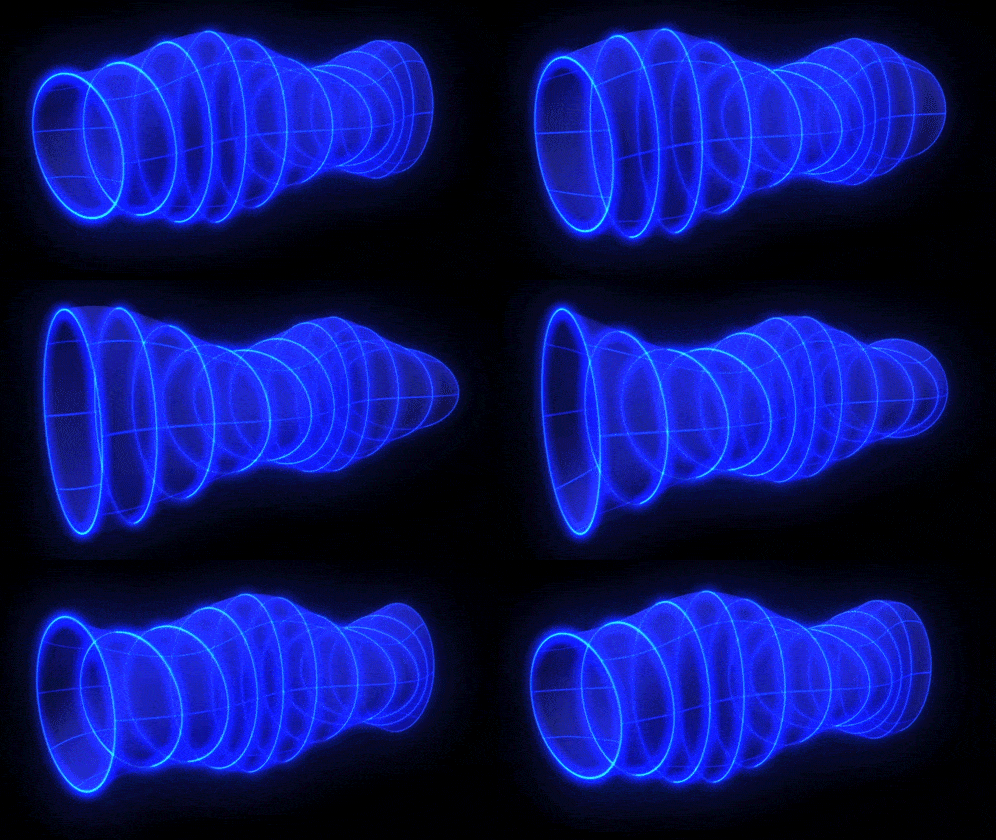
We've now detected hundreds of gravitational waves with LIGO, Virgo, and KAGRA. What if we tried Weber's original method in the modern day?

Stellar streams are faint trails of stars that appear to "stream" out of galaxies. A new one, escaping galaxy M61, may point to many others.

When dying, Sun-like stars have binary companions, spectacular sights arise from the ionization. JWST spots the Red Spider Nebula in action!

There's some, but not overwhelming, evidence that dark energy is evolving. What would it take for a "Big Crunch" to be our cosmic fate?

Physicist Daniel Whiteson challenges the notion that all intelligent species would eventually uncover the same laws of nature. Do you agree?

Nearly 100 years after being theorized, the strange behavior of the neutrino still mystifies us. They could be even stranger than we know.

The planet, the Solar System, and the galaxy aren't expanding. But the whole Universe is. So where does the dividing line begin?

For 13.8 billion years, the Universe has been expanding. But that couldn't have been the case for an eternity, and science has proven it.

Dark matter has never been directly detected, but the astronomical evidence for its existence is overwhelming. Here's what to know.

We've long known we can't go back to infinite temperatures and densities. But the hottest part of the hot Big Bang remains a cosmic mystery.

Found by Hubble before JWST's launch, GNz7q looked like a mix of a galaxy and a quasar. Was it actually our first known "little red dot"?

Observations with the Hubble space telescope helped cement dark energy and reveal the Hubble tension. How are these two things so different?

Inflation's two main criticisms, that it can predict anything and that the "measure problem" remains unsolved, can't erase its successes.