
After eluding his Japanese captors, an escaped prisoner of war found himself stranded on a previously unknown archipelago in the South Pacific in 1941. There, the Allied soldier discovered a species of mammal that walked on its nose. The creatures were later named rhinogrades, or, more colloquially, “snouters.”
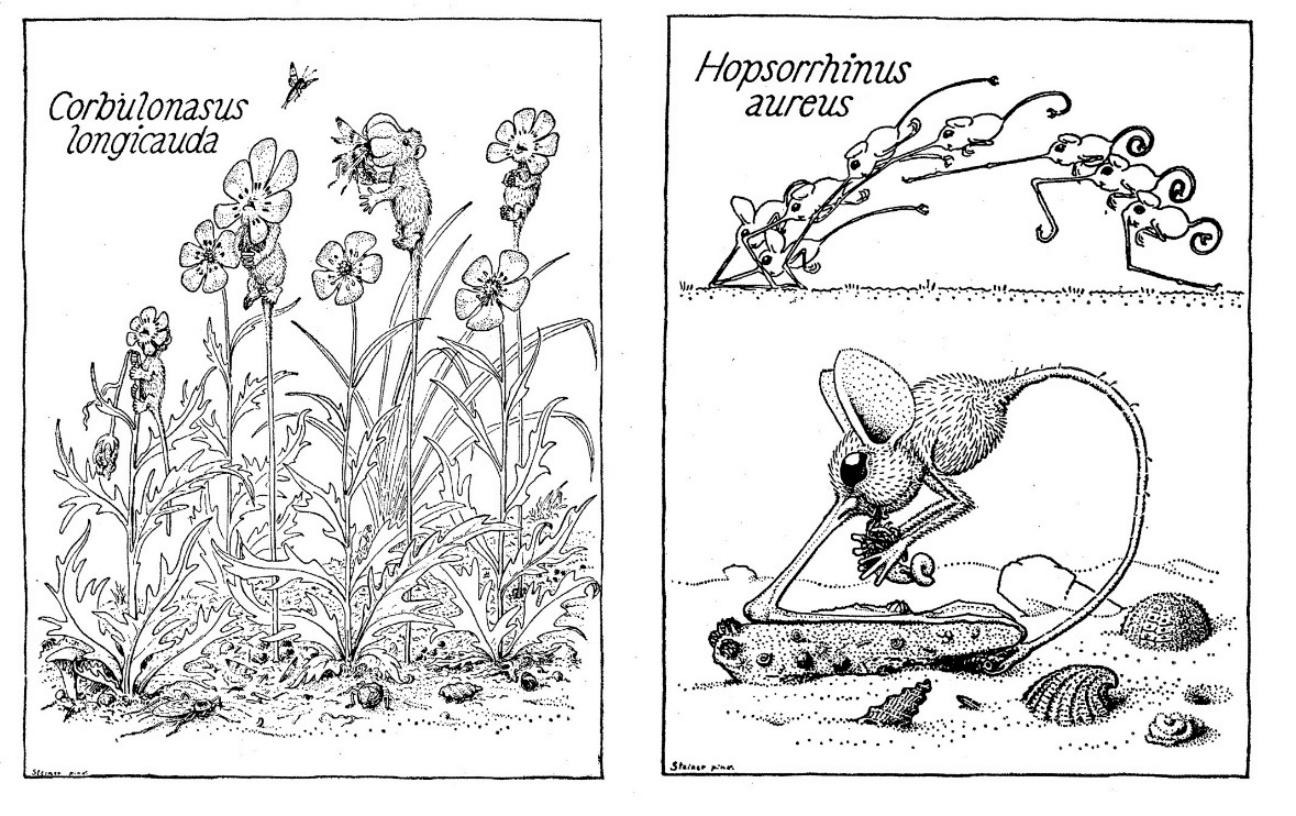
An idiosyncratic order of mammals comprising 138 species descended from a shrew-like ancestor, Rhinogradentia are typified by their luxuriant, exuberant noses. Some locomote by hopping, using their nasal appendage like a muscular flipper; others are sessile, attracting insects with flower-like petals that blossom from their nostril cartilage. Most rhinogrades have one nose, but some have evolved multiple proboscises, which they use for walking and hunting, like furry terrestrial octopuses. Others dangle strings of nasal mucus over water to snare aquatic prey, like fishers with their fishing lines.
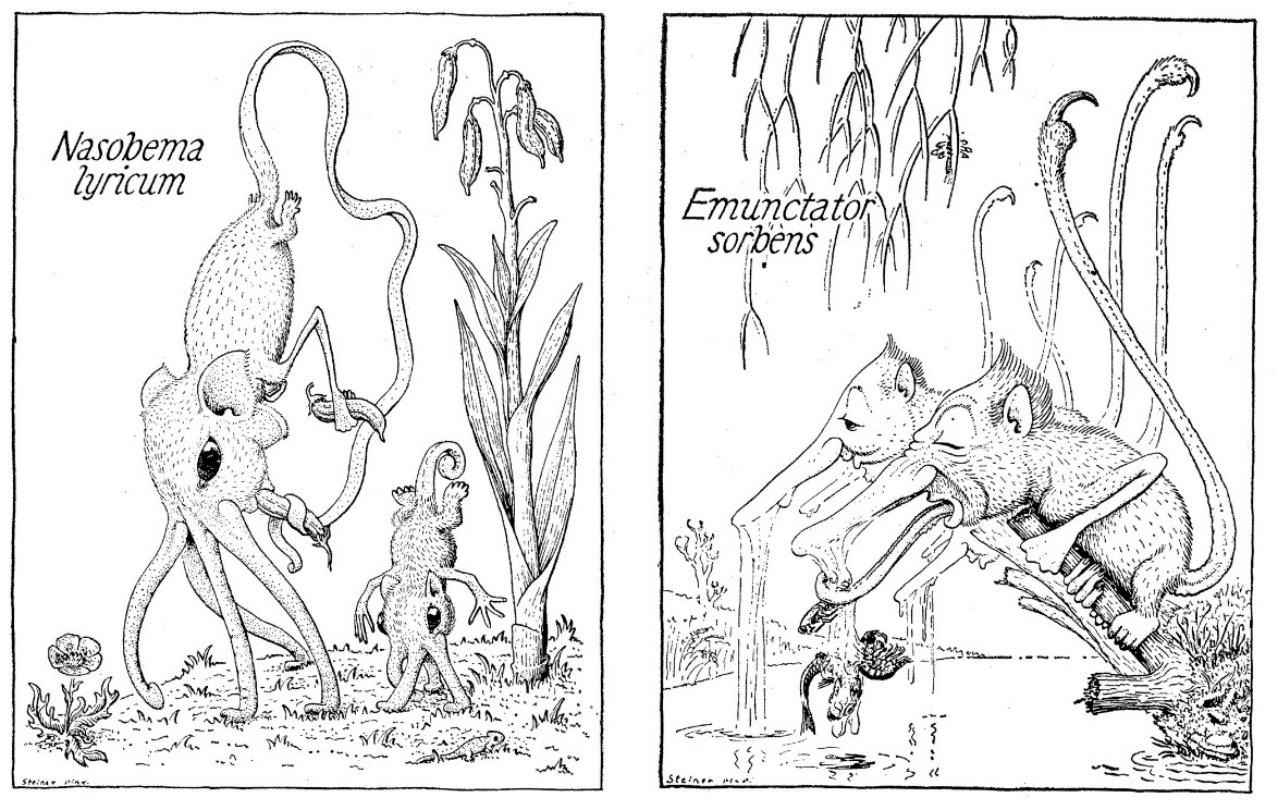
Here’s the thing: Rhinogrades don’t exist.
They were introduced to the world in 1957 by German zoologist Gerolf Steiner, writing under the pseudonym “Harald Stümpke.” What started as a collegiate joke inspired by an absurdist poem matured into The Structure and Life of the Rhinogradentia, an elaborate 92-page hoax first published in German by Gustav Fischer Verlag, a renowned press.

Written with meticulous detail, in impeccably sober scientific prose, Steiner’s book is now considered a classic of so-called “speculative evolution,” a sub-genre of science fiction devoted to imaginative conjurings of unrealized evolutionary possibilities and pathways.
Inventing imaginary life
Speculative evolution is irresistible fun. Steiner blessed his snouter species with names such as “Tyrannonasus imperator” and winkingly explained how a nearby thermonuclear test annihilated the rhinogrades’ archipelago, erasing all evidence of their existence.
Other scientists have fondly extended the joke by including Rhinogradentia in official taxonomies. Following the English translation of Steiner’s work (published on April Fool’s Day in 1967), a fan reportedly founded the National Organization for Snouter Ecology (NOSE). Even George Gaylord Simpson — the most renowned evolutionist of the generation — joined in, writing in Science that Rhinogradentia’s discovery was the 20th century’s “most startling zoological event.”
But speculative evolution is not just fun, conjuring airy nothing — it can be serious business.
Paradoxically, history is instructive because of all the things that didn’t happen. The entrenchment of certain prior possibilities, to the exclusion of others, explains why the present is the way it is rather than any other way. This applies to evolutionary history as much as to human history. Grasping common descent requires acknowledging that, had prior events gone otherwise, everything thereafter would have unfolded divergently, too.
This was the kernel of Darwin’s epoch-making insight: We can explain life’s current grandeur by considering its species as selections within a wider space of possibilities. Speculative evolution throws this into relief. It coaxes us to extend evolution’s causal principles beyond what’s merely actual: to probe this space within the crucible of thought experiment. It helps us clarify our grasp on said principles and better articulate what we mean by them. It’s not falsifiable, but it can be more than frivolity.
Speculative evolution now inspires high-budget Netflix documentaries and enthralls thriving online communities. But Darwin published On the Origin of Species in 1859, and conjecturing depictions of evolution “otherwise” only really became a popular pursuit during the later 20th century. Why the lag?
The monorail of evolution
People have long imagined alternative forms of life: angels, demons, and other aberrations. Nevertheless, before Darwinism, the overriding assumption was that all possible lifeforms exist, either consecutively or sequentially. There was no room in living nature for the entirely unrealized.
Darwin began unwinding this by intuiting that, of all organisms terrestrially possible, only a minority ever have or ever will exist. Life is the way it is today, he realized, because a select few creatures propagated in the past, to the enduring exclusion of other possibilities. This is what gives “hereditary” and other core Darwinian ideas their bite: the past can only be said to permanently constrain the future, and history can only be said to matter, if not all possible outcomes eventually come to pass regardless.
But the profounder ramifications of this insight took further generations to be extruded. It wasn’t immediately apparent how much the scope of what’s evolutionary possible may expand beyond what’s tangibly actual. Among early Darwinians and non-Darwinians alike, there remained a strong conviction that evolution would produce similar results each time it played out. Often, the result was something suspiciously shaped like us: bipedal and brainy, talkative and technological.
Darwin himself assumed that, invariably speaking, the forms rejected by natural selection were cul-de-sacs anyway — the organisms were somehow inherently less viable. He was convinced evolution tends everywhere toward “perfection,” which, again, looked like us. In one 1860 letter, he conjectured that if “every Vertebrate” were annihilated except for reptiles, then, in “millions of ages,” today’s lizards would eventually “become highly developed on a scale equal to mammals [and] possibly more intellectual!”
“[Humans are] things of this world, and of this world only.”
Grant Allen
While what was considered evolutionarily possible did not yet extend far beyond the concretely actual at the time of Darwin, a few of his disciples dimly sensed that his theory implied something more commodious.
In the 1880s, for example, Canadian science writer Grant Allen began stressing that — cosmically speaking — humans are “things of this world, and of this world only.” We are the product of countless chancy precedents — alter any of them, and we wouldn’t exist today. By the same token, Allen realized, should life exist elsewhere, it will likely be remarkably alien. No organism will “reappear identically in any two distinct planets.” (At the time, it remained common to assume “men” of some strain are found on all populated planets.) Goadingly, he asked why his peers continued to think it “absurd” that other living worlds “might go forever without rational inhabitants?”
Nonetheless, despite Allen’s willingness to entertain such alternatives, the main presumption was that evolution — everywhere, everywhen — tends in one very deterministic direction.
By the end of the 1800s, the “speculative” in “speculative evolution” had yet to fully take root.
Allen’s contemporary H.G. Wells is often cited as an early pioneer of speculative evolution. But even he readily bought into this presumption. His 1898 classic, War of the Worlds, depicts invading Martians as essentially oversized brains with vestigial bodies lacking skeletons and digestive systems. They lost these as an adaptive response to their highly technologized environment. Why bother with limbs when you can locomote with machines instead?
What’s important is Wells elsewhere revealed his conviction this was also the direction in which our evolution was tending. Post-industrial life, Wells believed, selected for brains not brawn. In this, he was not alone. So, his Martians weren’t so much alternate evolutionary possibilities as they were premonitions of a preordained future.
The distinction is important. At the time, people accepted that planets have histories — that they are born, age, and die — but not that they might have histories wildly different from Earth’s. Given contemporary theories of Solar System formation, Venus and Mars were thought to be “younger” and “elder” versions of Earth, respectively. Venus was envisioned as being in its virulent and swampy youth, populated by dinosaurs (yes, dinosaurs). Mars, contrarily, was arid and geriatric, home to a hyper-advanced techno-civilization reaching old age’s decadence and decay.
Wells’ visions, then, are not explorations of alternately splaying pathways so much as shuttlings forward and backward along a single, universal monorail of evolutionary progress. You can proceed or reverse, but you can’t change tracks. The “speculative” in “speculative evolution” had yet to fully take root. It is, after all, a failure of imagination to think of all other planets as earlier and later phases of a shared narrative arc, propelled by some “headward” surge to braininess.
Starting to stray
As the 1900s opened, scattered voices began extending Allen’s prior point. In 1933, American inventor H.P. Maxim reasoned in his book Life’s Place in the Cosmos that evolution needn’t always pour intelligence into an anthropoid mold. He claimed that an “interesting way for some zoologist to waste a lot of time” would be to “work out the various possible mechanical designs” that could host intelligence.
Soaring into speculation, Maxim noted how starfish eat not by swallowing their prey but by expelling their stomachs onto it. Had we evolved from starfish — not simian — stock, Maxim joked, we’d “no doubt” send our stomachs by post when we desire exotic food. “Painstaking effort,” he concluded, would naturally be required to ensure “each stomach was returned to its proper owner.”
Shippable stomachs aside, imaginings of evolutionary possibility still didn’t extend far beyond what had familiarly unfolded on Earth. Indeed, three years earlier, Flemish writer Maurice Maeterlinck admitted in his book The Magic of the Stars that humanity’s emergence “probably hung by a thread,” confessing that “the odds are a thousand to one that evolution would have taken a different turn.” But his sense of how alien other biospheres might be still didn’t venture beyond what’s terrestrially familiar. On one planet, Maeterlinck reasoned, the “formidable saurian may reign.” On other planets, “a gigantic fish,” “an enormous bird,” or “great social insects” might be the dominant species, he imagined.
This commitment to the familiar was reinforced by the healthy persistence of the presumption that humans represent an optimal form that evolution will convergently produce across different histories. In 1945, prominent Soviet paleontologist Ivan Efremov discussed plausible extraterrestrial biologies in a correspondence with his colleague Alexey Bystrov. In reply, Bystrov produced a diagram of what he took to be a plausible alien skull morphology.
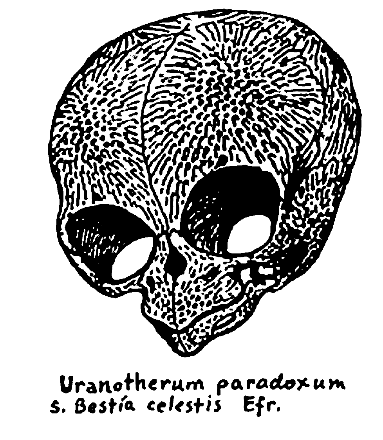
Bystrov’s speculative “turtle-philosopher” (as he baptized it) was toothless, tortoise-beaked, and reptilian — but distinctly humanoid. Inspired by the image, Efremov soon after penned his sci-fi epic Starships, in which humans encounter just such an extraterrestrial lizard-person. That encounter, Efremov’s narrator rejoices, confirms that the “form of man” isn’t “accidental” but the cosmic default. We learn there is only “profound brotherhood” between biospheres.
Efremov vocally maintained his belief in the cosmic inevitability of humanoids until his death in 1978. Nevertheless, a growing cadre of scientists had, by then, finally begun stressing a different view. In 1976, the Smithsonian exhibited an extraterrestrial “bestiary” in its Air and Space Museum that showcased creatures designed by paleobiologist Bonnie Dalzell. Refreshingly, it was devoid of anything humanoid, featuring instead lighter-than-air “dirigible” organisms and other imaginative lifeforms.
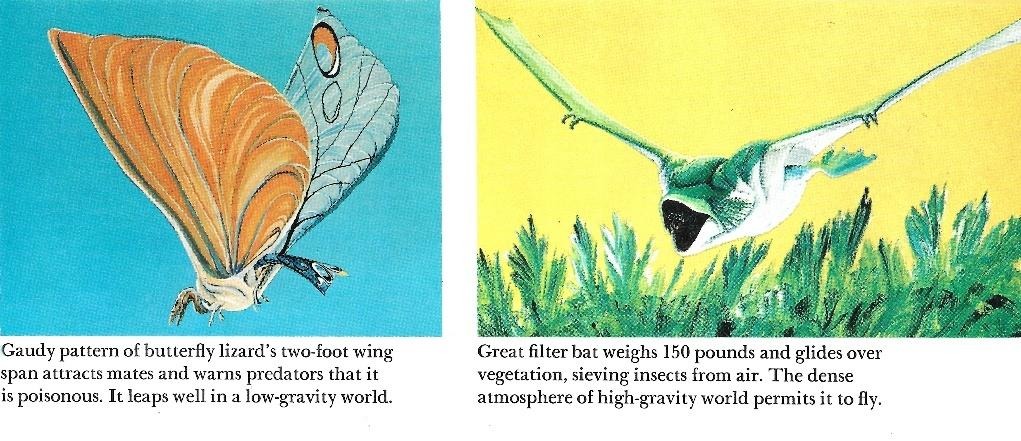
Still, in 1977, Nobel Prize-winning biologist François Jacob complained that, a century after Darwin, most people still imagined extraterrestrial organisms as “not too different from terrestrial ones,” even though the “living world as we know it is just one among many possibilities.” The more complex an object is, Jacob wrote, the less likely it is to independently repeat or recur. This is because complex objects are wrought by selective histories rather than universal conditions. The more history involved, the more unrepeatable the result, and organisms are the products of long, contingent histories. Aliens will not “look like us,” Jacob concluded.
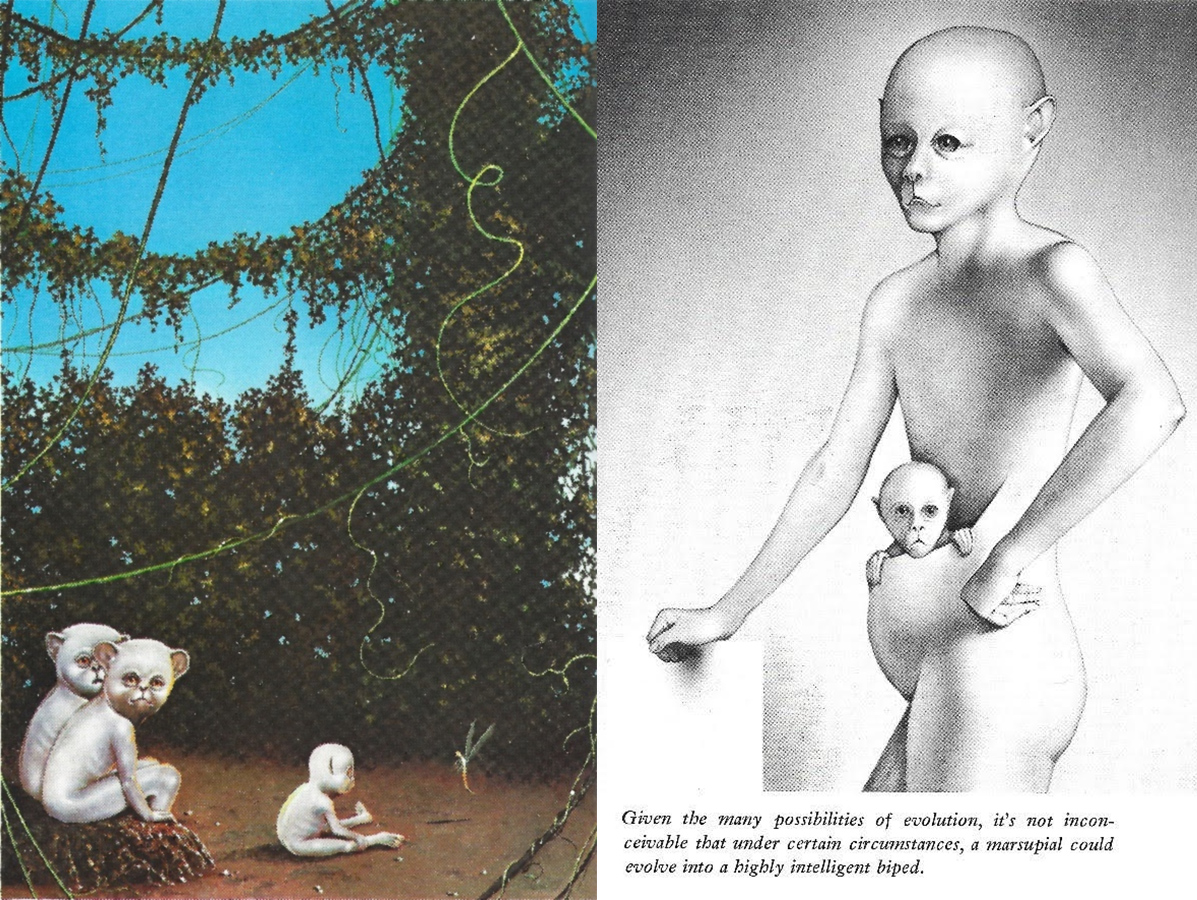
But old habits die hard. In 1981, Gene Bylinsky repeated the same anthropocentric motifs while imagining alien biospheres in his book Life in Darwin’s Universe — he and his illustrator Wayne McLoughlin conjured everything from “dolphin men” to “marsupial men” to “bat men.” In support, Bylinsky cited the recent conjectures of Canadian paleontologist Dale Russell, who’d come to believe that trends in Earth’s fossil record implied that evolution tends implacably towards the blossoming of ever-bigger forebrains.
That same year, Russell attempted to body forth his conviction, producing a life-sized statue depicting what he believed non-avian dinosaurs would have evolved into had they not succumbed to extinction. Dubbed “the dinosauroid,” Russell’s conjectural creature — bipedal and big-brained, with prehensile forelimbs — is undeniably, uncannily familiar.
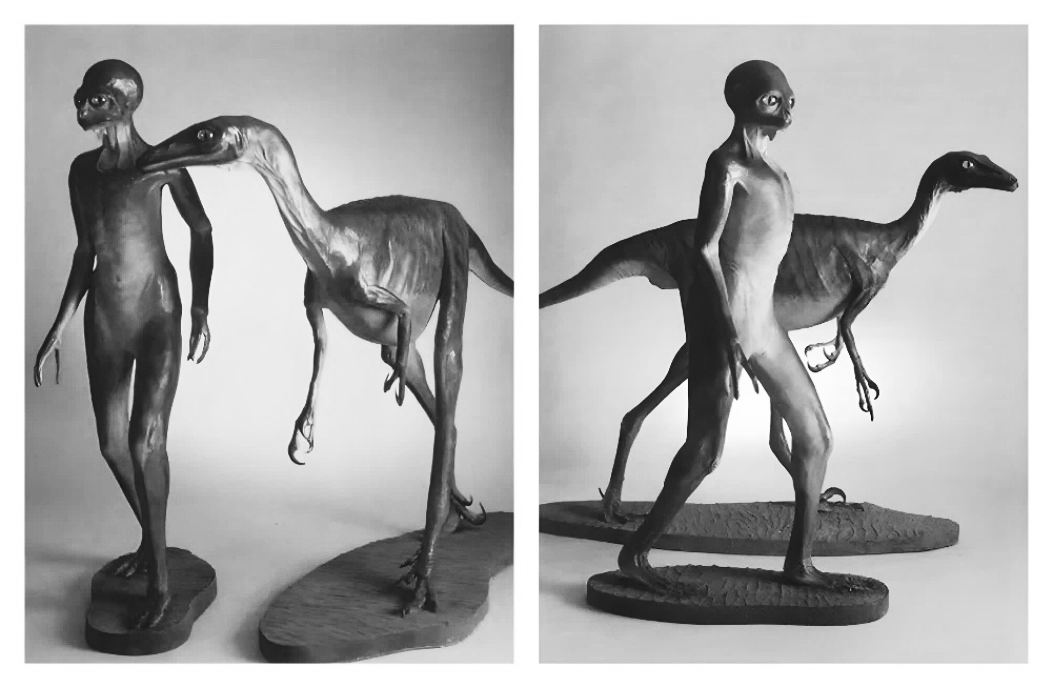
Despite claiming his intention was simply to encourage others to conduct similar thought experiments, Russell admitted he was also motivated by the conviction that “man’s general body form is no fluke.” In private letters, he revealed his dinosauroid filled him with the comforting feeling that “the world is, after all, a rather friendly place.”
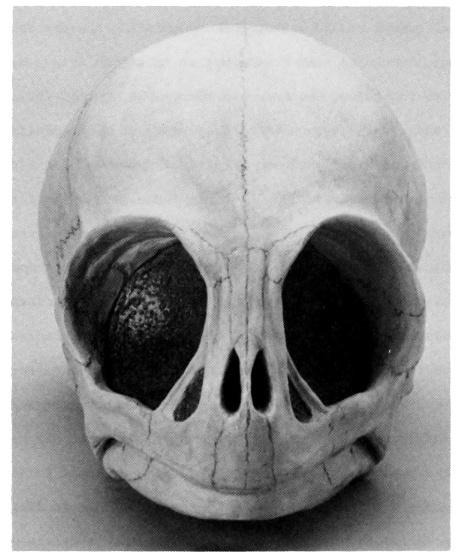
Russell also produced a cast of the dinosauroid’s skull. Curious how convergent it is with Efremov and Bystrov’s earlier “turtle-philosopher.” Curious, also, the resemblance to classic depictions of alien visitors. Indeed, Betty Hill (perhaps America’s most famous UFO abductee) took keen interest in Russell’s dinosauroid and travelled to attend his lectures. It seems we yearn, as Efremov put it, for “brotherhood.”
A time for true speculation
Around this same time, a new perspective was undermining such views, forcing further expansion of evolution’s acknowledged possibility space.
In the 1980s, researchers began publishing persuasive evidence that the dinosaurs had died out due to a chance collision with something from outer space. This realization made the profound role of contingency in shaping the deep histories of biospheres impossible to ignore. Biologists, accordingly, began more seriously entertaining the suggestion that, if it wasn’t for this celestial serendipity (at least from our latter-day, mammalian perspective), minds like our own may never have evolved on Earth. And, by corollary, why be so sure they will always evolve elsewhere?
By no coincidence, it was around precisely this time that speculative evolution started to become more seriously speculative.
This was best embodied in the books Scottish geologist Dougal Dixon wrote in the 1980s. Forging fictional ecosystems, Dixon balanced plausibility and peculiarity to evocative effect. In his 1988 work, The New Dinosaurs, he imagined what non-avian dinosaurs might have become if it weren’t for the asteroid. Looking back on Russell’s “dinosauroid” tellingly, he conceded that descendants of non-avian dinosaurs may have developed novel forms of cunning, but he doubted they would have become anything like us. Dixon ventured that our type of intelligence, talkative and technological, has yet to “prove itself a feature that has any long-term evolutionary advantage at all, let alone representing the ultimate goal of evolutionary development.” It’s an open question, he implied, whether it has any survival value at all.
It appears we live in a Universe where there will always be room for speculative evolution.
“Replay the tape” on evolution, as Stephen Jay Gould started insisting in the mid-1980s, and you’ll get wildly different results each time. Ever since, speculative evolution has become a mainstay of entertainment, inspiring myriad TV shows, books, and blogs.
Where people once thought terrestrial life came close to exhausting the space of what’s cosmically possible, we now recognize it probably forms one infinitesimal mote. The history of evolutionary conjecture reveals evidence of a steady expansion of what’s considered evolutionarily possible over and above what’s tangibly actual.
The trend continues today, with novel frameworks such as “assembly theory” providing its vanguard. Developed by Sara Walker, Lee Cronin, and others, assembly theory seeks to explain how biology arises from chemistry and physics through time, combination, and constraint. By redefining complexity as a physical measure of the minimal history required to build an object, it shows how specific sequences of past events are strictly necessary to unlock a previously inaccessible — yet exponentially expanding — space of possibilities. It implies that this space of potentials for complex, living systems may be so vast that the Universe itself simply won’t have enough time to manifest them all.
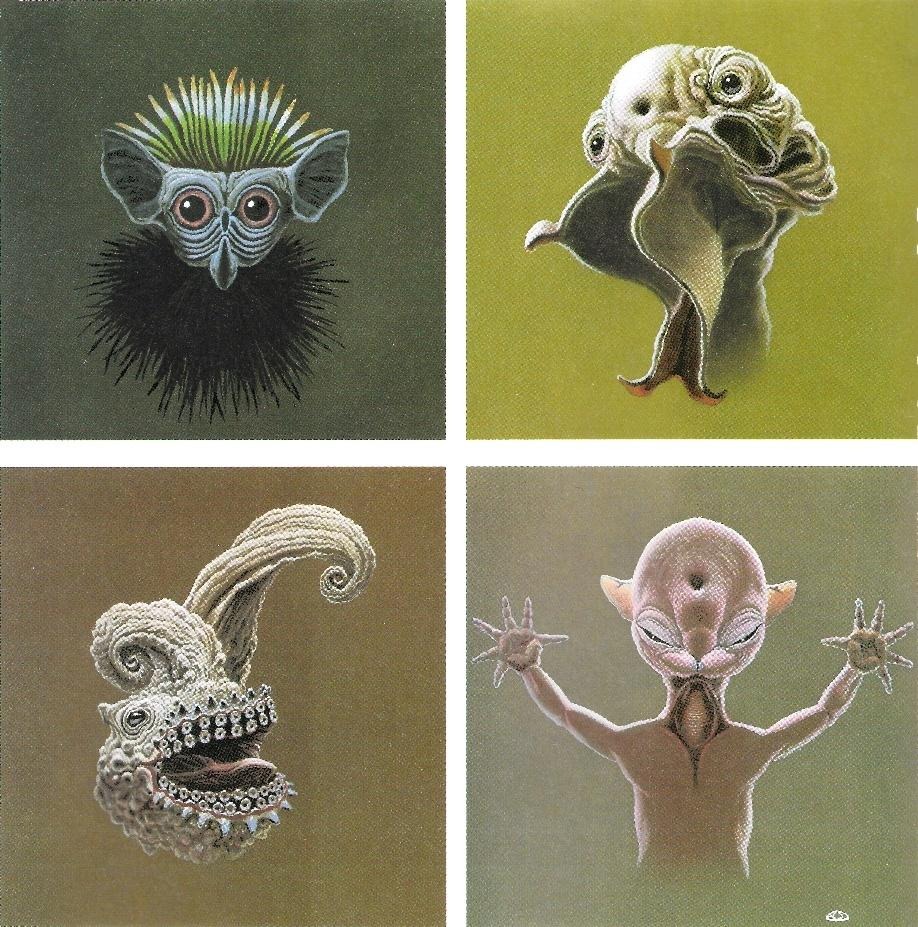
All of which is just an extension of Darwin’s fundamental insight: The transformations life actually entrenches itself with are consequential because there are more possibilities than can ever tangibly be explored. Darwin demonstrated how this applies at the level of our planet; recent developments hint that it may apply at a cosmic level.
Which is to say, it appears we live in a Universe where there will always be room for speculative evolution. There will always be inaccessible possibilities. This not only leaves room for imaginative fun, but also makes what we choose to do next more significant because not every outcome will come to pass regardless.
Of course, the question of how much extraterrestrials may converge with — or diverge from — evolutionary solutions on Earth remains radically open. But one thing seems certain: Whatever the aliens look like, they’re unlikely to resemble us.
This article is part of Big Think’s monthly issue Biology’s New Era.

The Energy Transition