
Imagine that you live in total freedom among a group of people unencumbered by traditions, customs, and any other restrictions. Would that be the pinnacle of joy? Maybe not so much. There would be no government, no police, no fire department, no traffic laws, no court of justice; life would be totally free but totally lawless. As the political philosopher Thomas Hobbes (1588–1679) wrote in his magnum opus Leviathan, there would be no culture, no navigation, no knowledge of the face of the earth, no arts, no letters, no society; instead, there would be rapes, thefts, murders, and continual fear of violence. Human life would be “solitary, poor, nasty, brutish and short.”
As more and more people began to live in close proximity, they realized the need for some sort of arrangement among themselves as an alternative to the chaotic state of nature. Such an arrangement, generally called a social contract, is based on the explicit or tacit consent of the citizens. In exchange for the curtailment of some freedoms, the people submit to an authority, thereby gaining protection and security. Only then is it possible to live in an orderly and safe manner within a community. Hence, to form a society, the individuals must enter into a contract that defines their moral and political obligations.
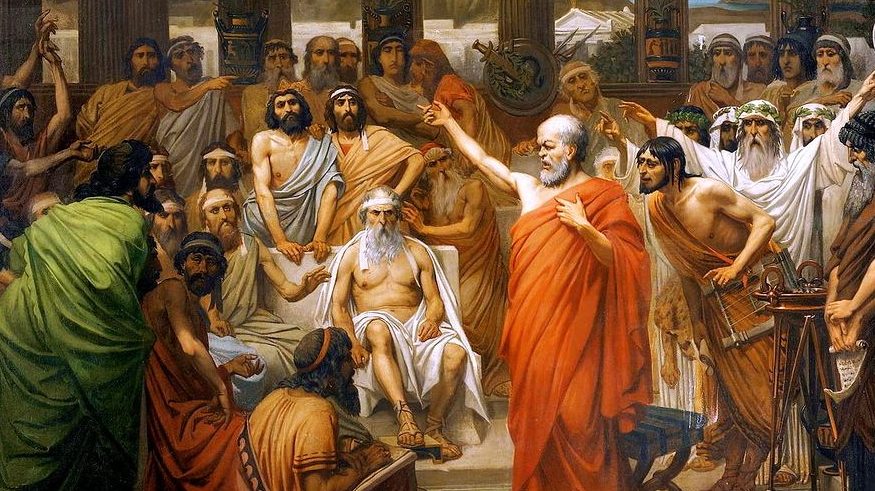
An early discussion about social contracts comes down to us in Plato’s dialogue Crito in which Socrates, condemned to death for allegedly corrupting the youth, refused an offer to escape from prison. He explained to Crito that as a citizen of Athens he had agreed to live by the nation’s rules, even if they seem unfair in his case. A state cannot exist without rules, and citizens are not allowed to decide whether to follow or disobey them. By residing as a citizen in Athens, Socrates implicitly agreed to abide by the nation’s laws. From this it follows that he must accept the punishment that the nation may impose on him. That is the nature of the social contract.
Another notable thinker after the ancients who addressed this question was Hobbes. He agreed with Socrates and gave his reasoning a solid footing. Because people are self-interested but rational, it is in their interest to live together in a civil society. Hence they must be willing to give up some freedoms and agree on a social contract that encompasses laws and enforcement mechanisms. Even if the authority manages affairs poorly, be it a benevolent king, a tyrant, or a plodding government, the situation will be better than the original state of nature. Nobody may resist the authority’s power to defend order and protect society from a chaotic state of nature.

But what form should a social contract take? On what principles of government could or should a community of people agree? Political philosophers have been wrestling with this question ever since Hobbes: John Locke (1632–1704), Jean-Jacques Rousseau (1712–1778), and John Stuart Mill (1806–1873) all weighed in on the subject.
One suggestion put forth by the English jurist and social reformer Jeremy Bentham (1748–1832) is called utilitarianism. It consists of measuring people’s utility for the pleasures that governmental policies provide, minus the pains. And then it becomes the government’s objective to provide the greatest happiness for the greatest number of citizens; the sum total of the citizenship’s happiness should be maximized. Bentham even invented something that he called the felicific calculus, which would measure hedons for pleasures and dolors for pains.
Widening a sidewalk would provide pedestrians with additional utility while creating disutility for horse-drawn carts. According to Bentham, all one has to do is add the hedons of all pedestrians, deduct the dolors of all cart-drivers, and if the result is positive, then widen the sidewalk, otherwise don’t. But the problem with utilitarianism is that just as the subjective, first-person experiences of sensory perceptions cannot be compared among individuals, neither can pleasures and pains. One person’s dislike of beetroots cannot be compared by another person’s love for tomatoes. Hence people’s utilities cannot be summed in a meaningful way. But even if one could, would the policy be just? Would it be fair?
A century after Bentham, the Italian sociologist and economist, Wilfredo Pareto (1848–1923), developed his principle of economic welfare, known as Pareto optimality. Whereas Bentham strove to maximize total welfare, Pareto avoided utility comparisons by emphasizing efficiency. His notion of the best of all worlds was a state in which no one could be made better off without making someone else worse off. Regrettably, neither Bentham nor Pareto had any regard for fairness.
Enter John Rawls (1921–2002), one of the foremost philosophers of the 20th century. His book, A Theory of Justice, published in 1971, sold hundreds of thousands of copies in the United States alone. In his view, utilitarianism was defective because “the greatest good of the greatest number” ignores what he called “the priority of the right over the good.” Similarly, he criticized Pareto’s notion of efficiency because it permits highly unequal distributions as long as no one is made worse off. In stark contrast, Rawls’s principle of “justice as fairness” regarded fairness to be paramount, treating efficiency as a secondary concern. Whether policies resulted in advantages for a certain part of the society was less important.
The challenge now was to find a procedure that would produce a social contract that would be fair and acceptable to all. That is no easy task: The poor want welfare, the rich want tax breaks; men want to be the breadwinners, women want equal pay; the gifted want advancement based on merit, the untalented want remedial help; minorities want affirmative action, majorities complain about reverse discrimination. And adherents of each religion want their church to be the dominant one. To bring all wishes under one umbrella is impossible.
To show how a random group of people would come up with a just social contract, fair to all, Rawls devised a thought experiment. In the original state of nature, ground zero of social contract theory, a group of people would come together to decide on the principles that would permit them to live together in an orderly community. Rawls calls this the “original position.” The crucial point in Rawls’s thought experiment was that these people, when making their decision, should act behind what he called a “veil of ignorance”: They are ignorant as to their ethnicity, race, gender, age, social status, talents, intelligence, and disabilities. Also, they do not know what type of life they would consider to be a good life. I will call these ignorant people proto-citizens. Because the conditions in the original state of nature are fair, whatever social contract these proto-citizens come up with will be just.
So what are the principles on which these proto-citizens, in their eukaryotic state, will agree? Being ignorant but rational, the proto-citizens will necessarily settle on what Rawls called the Two Principles of Justice. The first: Every citizen must have as much liberty as possible as long as everybody else possesses the same liberties. The second: Social and economic qualities must (a) be available to all, and (b) be to the greatest benefit to the least-advantaged member of society.
But if justice is to be understood as fairness, as per Rawls’s scheme, ignorance is the key concept.
The first principle, affording everybody equal basic rights and liberties, supersedes everything else and should be anchored in the nation’s constitution. The second principle, regulating the distribution of wealth, position, social status, etc., says that inequalities are permissible and even desirable but must benefit the least advantaged. For example, when a talented hi-tech engineer becomes manager of a start-up company, the company creates jobs and thus will be of benefit to society. But the proto-citizen is ignorant as to whether she will turn out to be the hi-tech manager making a ton of money or the janitor living on a minimum wage. Because being rational means being risk averse, she will opt to maximize the minimum wage. In economic lingo, she will opt for the maximin.
Had she assumed that she would turn out to be the manager, she would have opted for maximax, for maximization of her compensation, by lowering the minimum wage. But that would have been risky: It could have turned out that she would become the janitor. And being rational, as Rawls stipulated that proto-citizens are, means being averse to risk. Hence the social contract on which proto-citizens situated behind the veil of ignorance would agree, arranges social and economic inequalities in such a manner as to make the worst off as well off as possible; economic policies would benefit the well-being of the least advantaged.
Rawls’s two principles stand in contrast to modern versions of Bentham’s utilitarianism, as set out for example by John Harsanyi (1920–2000), recipient of the 1994 Nobel Memorial Prize in Economic Sciences. According to his theory, rational, self-interested people in the original proto-state are not risk-averse but strive to maximize their expected utility. According to modern utilitarianism, this makes society better off and the social contract should reflect this. Hence, if managers’ utilities for higher compensation more than offset the resulting disutilities of the minimum wage earners, then so be it. Life just ain’t fair.
But if justice is to be understood as fairness, as per Rawls’s scheme, ignorance is the key concept. Even when they eventually get to know their economic and social status in real life, nobody can complain about being treated unfairly because everyone explicitly agreed to the policies in the proto-state, before the veil of ignorance was lifted.

The Energy Transition