History & Society

History & Society

Trace how culture, power, and ideas shape societies across time.
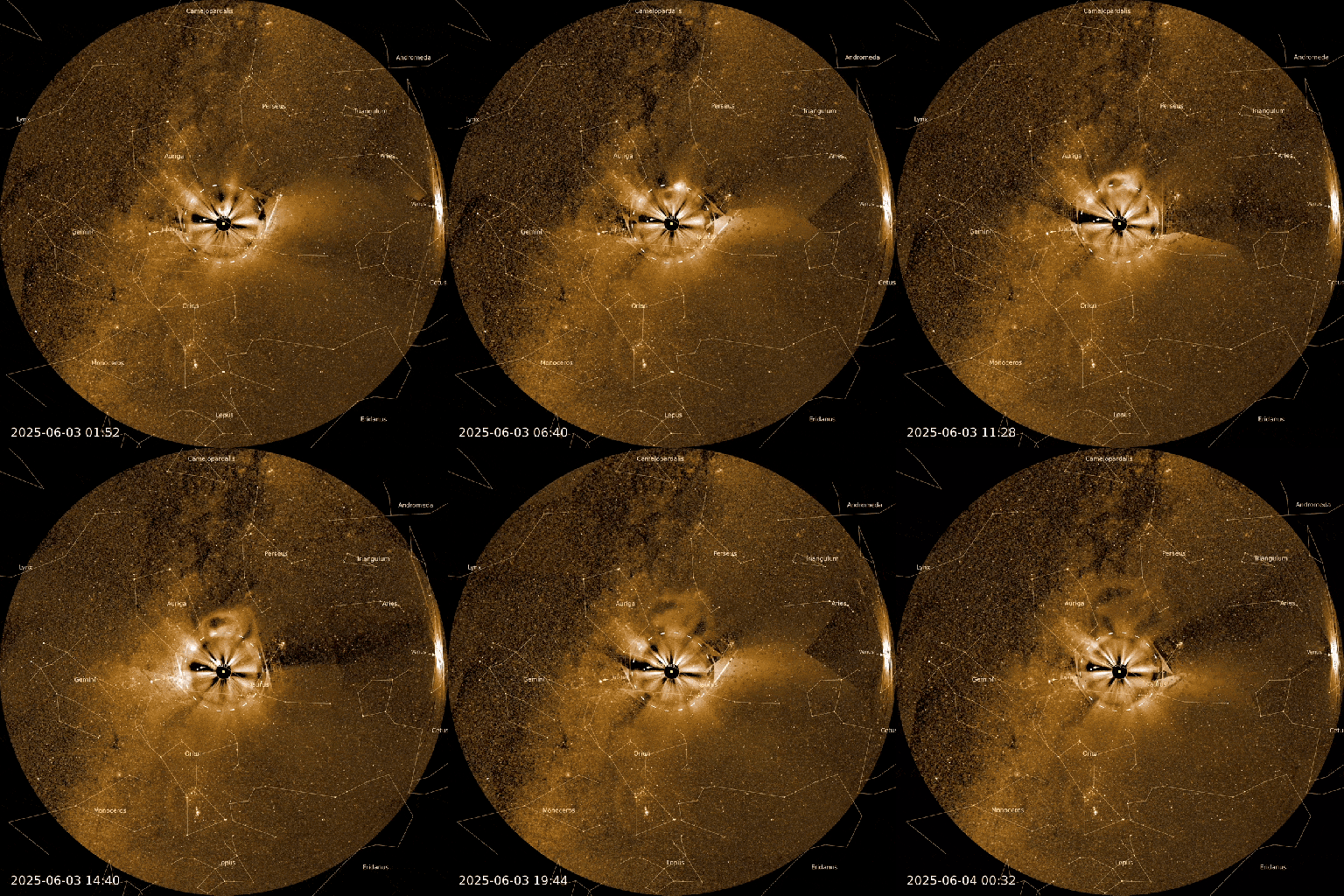
Circular astronomical image showing constellations and celestial objects labeled against a dark sky, reminiscent of a NASA PUNCH video sun corona visualization, with a timestamp of 2025-06-03 01:52 at the bottom left.
Launched in March, the PUNCH mission has viewed two incredible coronal mass ejections, tracking them farther from the Sun than ever before.
Map of Bhutan showing its borders with China and India, highlighting several disputed regions with labels indicating their names and locations.
As Beijing encroaches on the territory of the Himalayan kingdom, its ultimate aim is leverage over India.
A woman, resembling a paranormal investigator, holds a rectangular glass dish above her eyes, which are illuminated by light shining through the dish in a dark setting.
For his new book, “The Ghost Lab,” Matt Hongoltz-Hetling spent time with paranormal investigators to understand their relationship with science and society.
Two men in suits stand in front of a graphic collage featuring technical drawings and a building with solar panels, overlaid with the text "The Nightcrawler," evoking innovation that stands the test of stellar age.
Welcome to The Nightcrawler — a weekly newsletter from Eric Markowitz covering tech, innovation, and long-term thinking.
Timeline of the universe from the Big Bang, as described in cosmology, showing inflation, formation of atoms, stars, galaxies, and expansion to the present day over 13.8 billion years.
If you want to understand the Universe, cosmologically, you just can't do it without the Friedmann equation. With it, the cosmos is yours.
Book cover titled "Speak, Memorably: The Art of Captivating an Audience" by Bill McGowan and Juliana Silva, featuring a red background and blue and orange text, inspired by the storytelling flair of Francis Coppola.
The “primacy/recency effect” is used by celebrated movie-makers, Broadway composers, and restaurateurs — it can work for you too.
An illustration shows a cosmic ray entering Earth’s atmosphere, creating a cascade of secondary particles—some of the highest energy particles astronomers study—detected by an array of sensors on the ground.
On Earth, our particle accelerators can reach tera-electron-volt (TeV) energies. Particles from space are thousands of times as energetic.
Black-and-white portrait of Steve Hanke, an older man in a suit and glasses, centered on a background with graph lines and dotted patterns.
The veteran economist joins Big Think to unpack the new rules of social media, explain tariffs, and recount his adventures in Albania.
A grey, icy planet or moon with surface cracks is shown against a backdrop of stars and the Milky Way galaxy.
The hunt for extraterrestrial life begins with planets like Earth. But our inhabited Earth once looked very different than Earth does today.
A man in glasses and a suit jacket, resembling John Green, stands in front of a light background with a purple rectangle and abstract black lines.
John Green opens up about his struggle to remain hopeful while writing about suffering and injustice.
Collage with clocks, footprints in sand, a hand drawing a world map, binary code, and the text "The Nightcrawler" at the top—an evocative piece rethinking civilization and our journey through time.
Welcome to The Nightcrawler — a weekly newsletter from Eric Markowitz covering tech, innovation, and long-term thinking.
A split image shows a star field on the left and a COSMOS-Web survey area diagram on the right, with labeled NIRCam and MIRI footprints alongside the moon for scale, highlighting galaxies explored by JWST science.
The COSMOS-Web has just finalized their release of their full field: larger and deeper than any other JWST program. Here's what's inside.
Book cover with a gray textured background, featuring the title "DE KAI RAISING AI" and the subtitle "An essential guide to raising AI and parenting our future," all in white capital letters.
In "Raising AI," De Kai argues that today's AIs are already more like us than we think they are.
Bold black letters "MTWTF" on a light background, with the final "F" scribbled over in red crayon-like marks—a playful nod to the 4-day week.
A reduced working week, argues Juliet Schor, is part of a sane response to the impacts of AI and robotization on human labor.
Edwin Hubble and Andromeda galaxy
For decades, astronomers have claimed the Milky Way will merge with Andromeda in ~4 billion years. Here's why, in 2025, that seems unlikely.
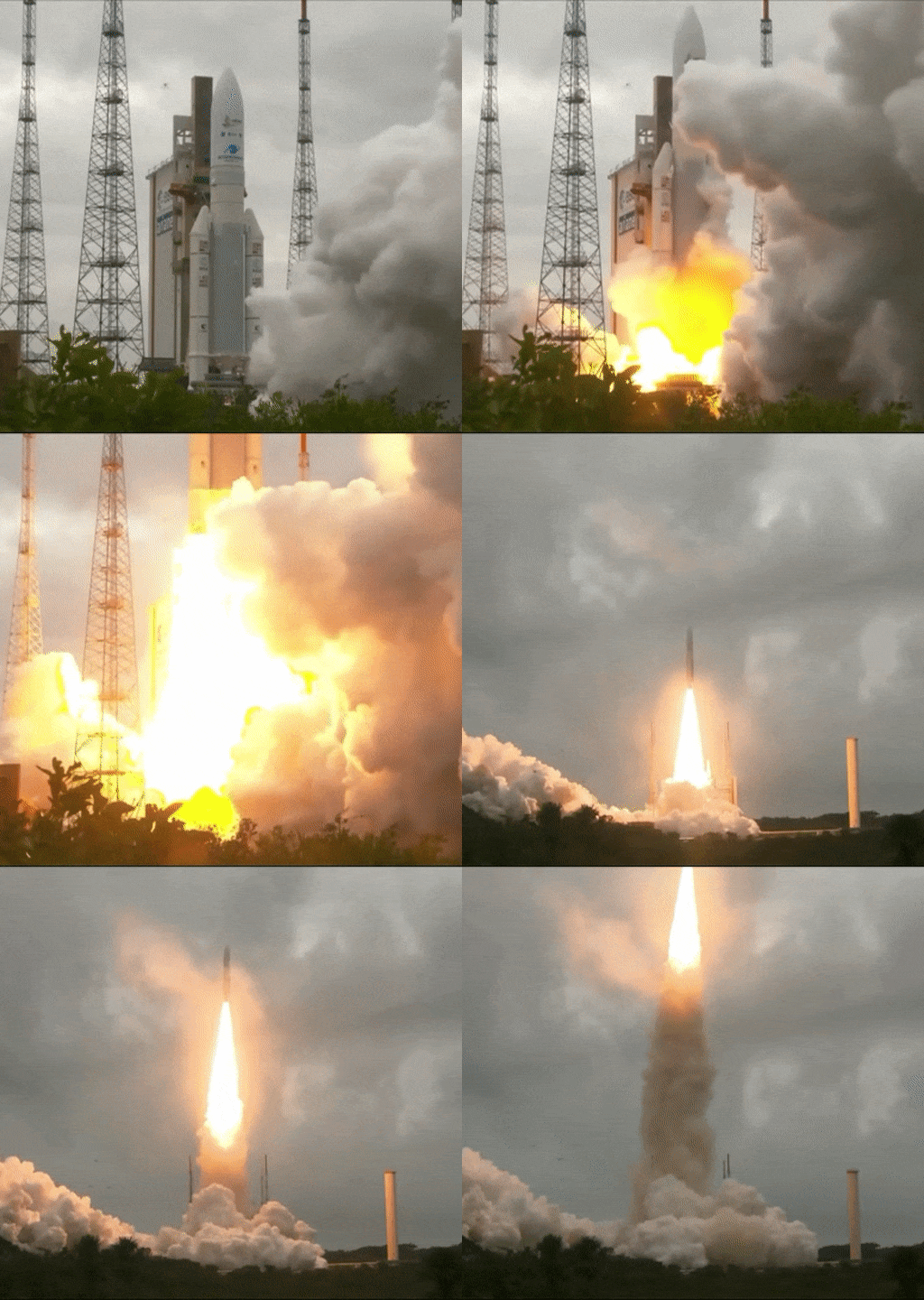
launch James Webb
As US science faces record cuts to funding, jobs, and facilities, these 10 quotes help remind us how science brings value to us all.
A man in seventeenth-century attire walks away as a group of people gesture behind him; a book title page, possibly referencing Spinoza, is visible on the right side.
From bondage to freedom: Baruch Spinoza’s guide to the rational life.
Silhouette of a person carrying a cross in front of the United States Capitol building, symbolizing cross purposes between faith and politics.
An atheist's case for why American democracy needs a more Christlike Christianity.
A collage with "The Nightcrawler" text, historic photos of Indigenous people, a blue-toned statue reminiscent of Leonardo da Vinci's art, and blue ocean waves overlapping the images.
Welcome to The Nightcrawler — a weekly newsletter from Eric Markowitz covering tech, innovation, and long-term thinking.