




















Search


Innovation training encourages the kind of creativity and problem solving that can lead to breakthroughs in business.

One of the winners. Dr. K. Barry Sharpless, is now the fifth person in history to win two Nobels.

After 10,000 years of civilization, have we figured out what virtue is?

Forensic researchers call such places “limited access environments.”
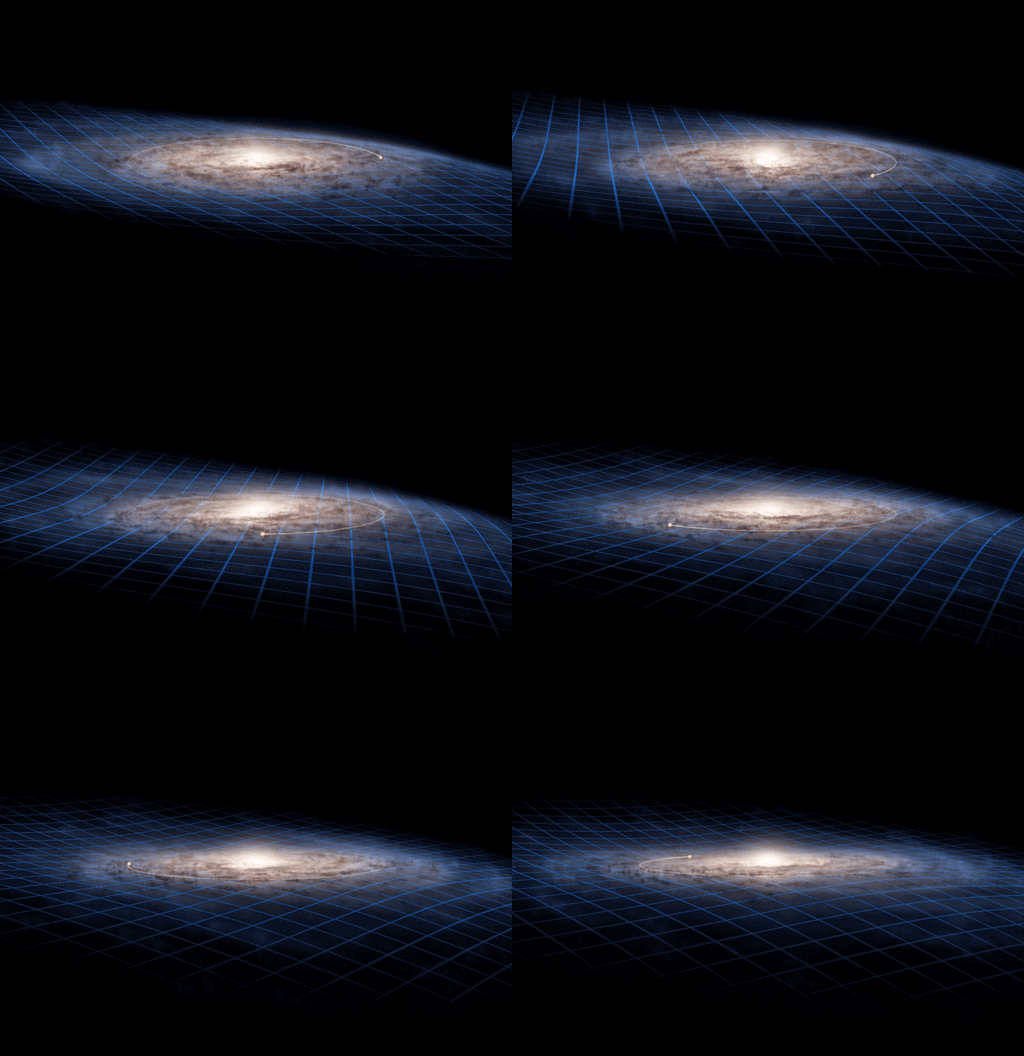
The Universe begins with negligible amounts of angular momentum, which is always conserved. So why do planets, stars, and galaxies all spin?

More than 1,000 years ago, Mesoamerican societies conducted one of history's most interesting experiments in commodity money.
Million Stories

Many were expecting extremism survivor and free speech advocate Salman Rushdie to take home the Nobel Prize in Literature, but Annie Ernaux beat him to it.

Einstein always loses in the quantum realm.

Venerated astrophysicist Carl Sagan entertained the possibility.

Questioning isn't just a way to get the right answer — it's also a means for sustaining relationships and creative thinking.

Before we discovered gravitational waves, multi-messenger astronomy got its start with light and particles arriving from the same event.

Japan just opened to tourists for the first time since the coronavirus pandemic began, echoing the island country’s isolationist policies during the feudal era.

There's no escaping the death of loved ones. But that doesn't mean we're powerless in the wake of loss.

Flashy desalination technology is more costly and cumbersome than many other solutions.

Uncertainty is inherent to our Universe.

It turns out it's hard to make work at an Amazon warehouse fun.

This is a perversion of justice.

We can never hope for a future with no problems. The solutions to problems create new problems, which in turn require new solutions, as WIRED founder Kevin Kelly explained recently.

Fiona Broome remembered Nelson Mandela dying in prison in the 1980s (he didn't). Oddly, many people had the same false memory.

People think that unhappiness causes our minds to wander, but what if the causation goes the other way?