




















Search


Just eight of Etched’s Sohu chips could replace 160 Nvidia GPUs.

Why human attempts to mechanize logic keep breaking down.

Philosophy cures no disease and invents nothing new. What's even the point?

7mins
The winners of the remote work boom? Utah, Arizona, and Maine. Here’s what the US’ post-pandemic migration looks like.

3mins
How do scientists measure and define life in the natural world? Dr. Lee Cronin gives us a definition, in 4 minutes:

The mass that gravitates and the mass that resists motion are, somehow, the same mass. But even Einstein didn't know why this is so.

Thinking of a number between one and ten? Here's how predictable human responses create the illusion of telepathy.

"When you feel the isolation setting in at times, you have to reframe your mindset."

Welcome to The Nightcrawler — a weekly newsletter from Eric Markowitz covering tech, innovation, and long-term thinking.

Scientific surprises, driven by experiment, are often how science advances. But more often than not, they’re just bad science.

As creatures and machines meld together in increasingly advanced forms, ethicists are starting to take note.

Gary Vaynerchuk, CEO of VaynerMedia, explains how to find branding success by making "boulders" out of "pebbles."
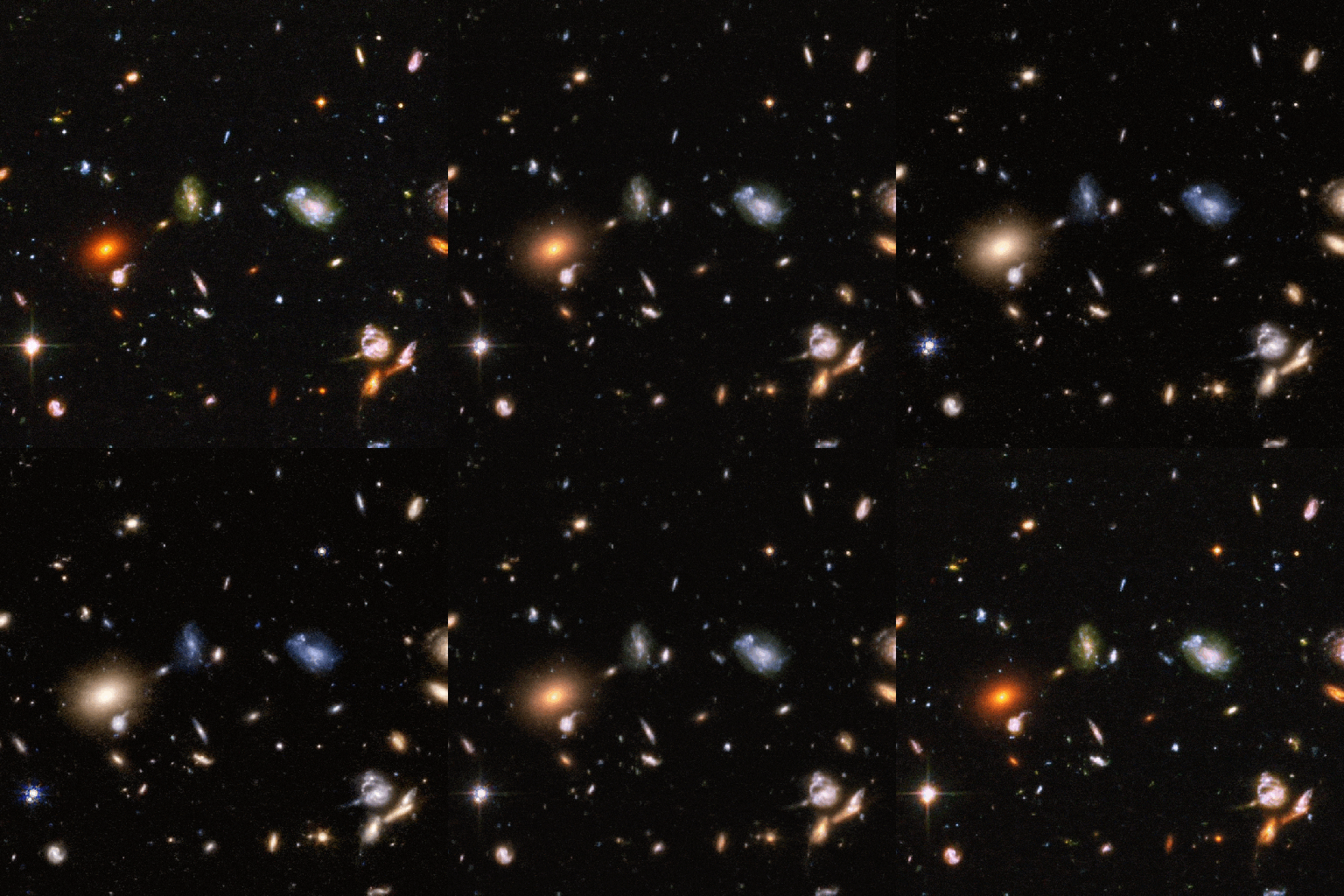
The "little red dots" were touted as being too massive, too early, for cosmology to explain. With new knowledge, everything adds up.

Researchers at the Brookhaven National Laboratory recently created the heaviest exotic antimatter hypernucleus ever observed.

Most leaders get the psychology of human motivation all wrong — here’s how a presidential encounter with a leaf-sweeper puts it right.

6mins
Algorithms dictate a lot more than your social media feeds. Here’s how to win back your agency.

For extraordinary long-term success in business we can look to insights from British Olympic cycling, Roger Federer and neuroeconomics.

Here on Earth, we commonly use terms like weight (in pounds) and mass (in kilograms) as though they're interchangeable. They're not.

In "Life As No One Knows It," Sara Imari Walker explains why the key distinction between life and other kinds of "things" is how life uses information.
We can address the misalignment between the current leadership reality and traditional leadership practices with a simple formula.