

















The Latest from Big Think

Text reading "The Latest" in a large, serif font on a light background.
Collage featuring a surfer, hands holding a Rubik's cube, and text "The Nightcrawler." Abstract elements include graphs, car parts, and a cityscape interwoven with life lessons.
Welcome to The Nightcrawler — a weekly newsletter from Eric Markowitz covering tech, innovation, and long-term thinking.
Satellite image showing a dense cloud mass over the southeastern United States and the Gulf of Mexico, with an inset graph from NOAA depicting hurricane frequency peaking around mid-August to late September, a trend exacerbated by global warming.
The laws of physics aren't changing. But the Earth's conditions are different than what they used to be, and so are hurricanes as a result.
A collage features geometric shapes including a green triangle, a white sphere, a purple circle, and a white cube. Partially visible is a grayscale photo of a man wearing glasses.
By focusing on the role of human experience, we may uncover new insights on the fundamental structure of reality.
A dark cloud, laced with cynicism, is topped with a colorful iridescent layer against a dim sky.
Stanford psychologist Jamil Zaki discusses the dangers of cynicism and how skepticism can invigorate our relationships and communities.
6mins
“People will claim that something is rigorous because it's by an authority figure or it's written in a book. But anyone can write a book.”
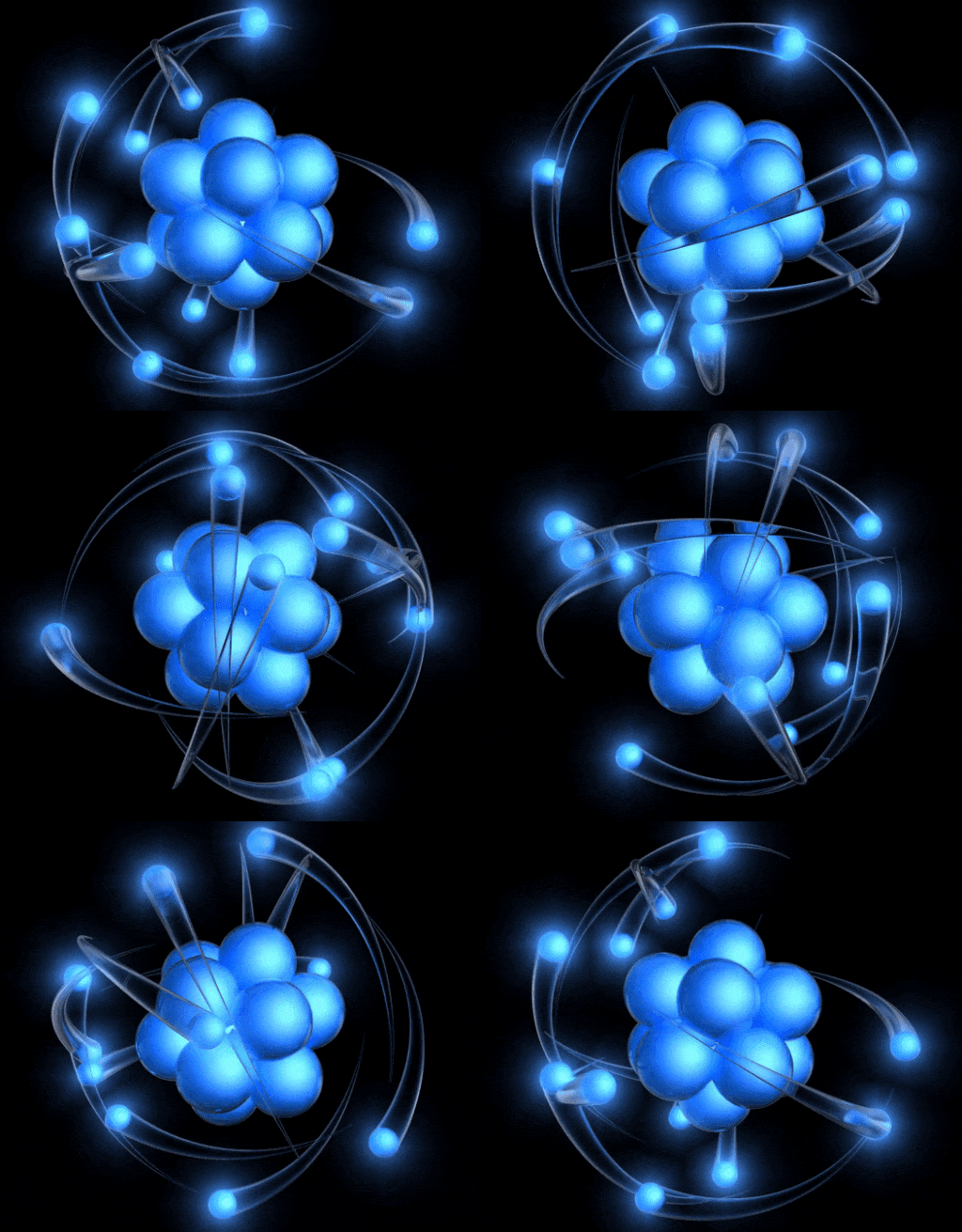
atom illustration
Most fundamental constants could be a little larger or smaller, and our Universe would still be similar. But not the mass of the electron.
Image of Mimas, one of Saturn's moons, partially illuminated. The large Herschel crater is prominently visible on the right side of the moon's surface.
The existence of another watery world in the outer solar system may offer clues to how such seas form — and hope for another spot to search for life.
A pole with numerous traffic lights mounted in different directions creates an illusion of control against a clear sky background.
How to find the right balance between controlling teams and allowing them the agency to make mistakes — and learn from them.
A collage featuring close-up images of hands, faces, eyes, and text excerpts. The central focus is on various hand gestures performing actions with small objects and cards, evoking the mysterious art of mentalism.
Meet the scientist mixing mentalism with principles from positive psychology and the science of human potential.
A collage features a tennis player and a basketball player against a backdrop of financial charts, graphs, and mathematical equations on a checkered pattern.
How Daniel Kahneman and Amos Tversky cracked open behavioral economics and enlightened all our choices.
Top image: Close-up of hands slicing a piece of raw meat with a knife, emphasizing precision akin to the longevity sought in business immortality. Bottom image: Close-up of two Zildjian cymbals of different sizes on a grid pattern background.
In a world of distractions, several remarkable companies show why focus is the ultimate strategy for endurance.
Two breathtaking pictures of a galaxy and a star taken by the Hubble telescope, highlighting the beauty and cosmic magnitude that fuels the Hubble tension.
In the expanding Universe, different ways of measuring its rate give incompatible answers. Nobel Laureate Adam Riess explains what it means.
A person in minimal clothing pushes a large clock up a blue hill against a grid background with various numbers and graphs, embodying the diligence reminiscent of the Rule of Saint Benedict.
Oliver Burkeman — author of "Four Thousand Weeks: Time Management for Mortals" — tells Big Think about modern life lessons from a 6th-century monk.
Open book with an image of a brain on the left page and a pencil eraser unlearning old marks on the right page.
By unlearning old leadership mindsets, cultures, and assumptions we can move from Industrial Age thinking to Intelligence Age thinking.
Illustration featuring an eye, an ear, and a hand, each encircled by overlapping multicolored circles.
7mins
Expanding your worldview starts with understanding your brain. Stanford neuroscientist David Eagleman explains.
Unlikely Collaborators
A black-and-white portrait of a man with curly hair, glasses, and a beard is centered against a green and blue background with abstract DNA helix patterns, representing leadership essentials.
Benjamin Oakes — CEO of buzz-worthy biotech company Scribe Therapeutics — joins Big Think for a chat about innovation, human endeavor, and more.
White text on a black background reads "The Impact of Nothing.
3mins
From nothing to everything: How zero changed our understanding of the universe, forever.
The image shows a bright spot labeled "JADES-GS-z13-1-LA," seemingly an impossible light captured by the JWST, surrounded by measurement markers, including a scale bar for 1 kpc and 0.28 arcsec. Filters and colors are listed at the bottom.
The Lyman-α emission line has never been seen earlier than 550 million years after the Big Bang. So why does JADES-GS-z13-1-LA have one?
A detailed image of two galaxies in space, one with spiral arms on the left and the other, more elliptical, on the right, surrounded by distant stars.
Galactic activity doesn't just arrive when supermassive black holes feast on matter. Before, during, and after all create fascinating signs.