12.5 to 12.6 billion years after the beginning of the Universe .
On Earth, biological organisms are getting more and more interesting as the years tick by. As the unbroken chain of life continues, the combined factors of inheritance, random mutations, and horizontal gene transfer serve to increase the total amount of genetic information found in the genomes of the most complex organisms. This results in them gaining more specialized features, and many new characteristics begin emerging.
Some organisms thrive together in colonies, with identical unicellular lifeforms binding to one another to ensure that the majority of them survive and thrive. Other organisms develop multicellularity: the ability for a single organism to produce multiple component parts — cells — that all remain bound together as part of the original, parent organism. And still other organisms become differentiated, where new subcomponents develop within an organism, conferring features and abilities onto it that it didn’t possess before. At this moment in time, the last of these effects leads to an entirely new kingdom of life on Earth: the fungi.
Evolving well before plants or animals arise on our planet, these early fungi likely thrive in aquatic environments and possess flagella: tiny, thread-like tails that allow them to control their motion through water. The fungi are all eukaryotic organisms that reproduce through the creation of spores, which mature atop microscopic, soft-tissue structures known as fruiting bodies. In aquatic environments, flagella are required to transport spores away from the parent body, towards locations where they can gain nutrients, thrive, and survive until they reach reproductive age.
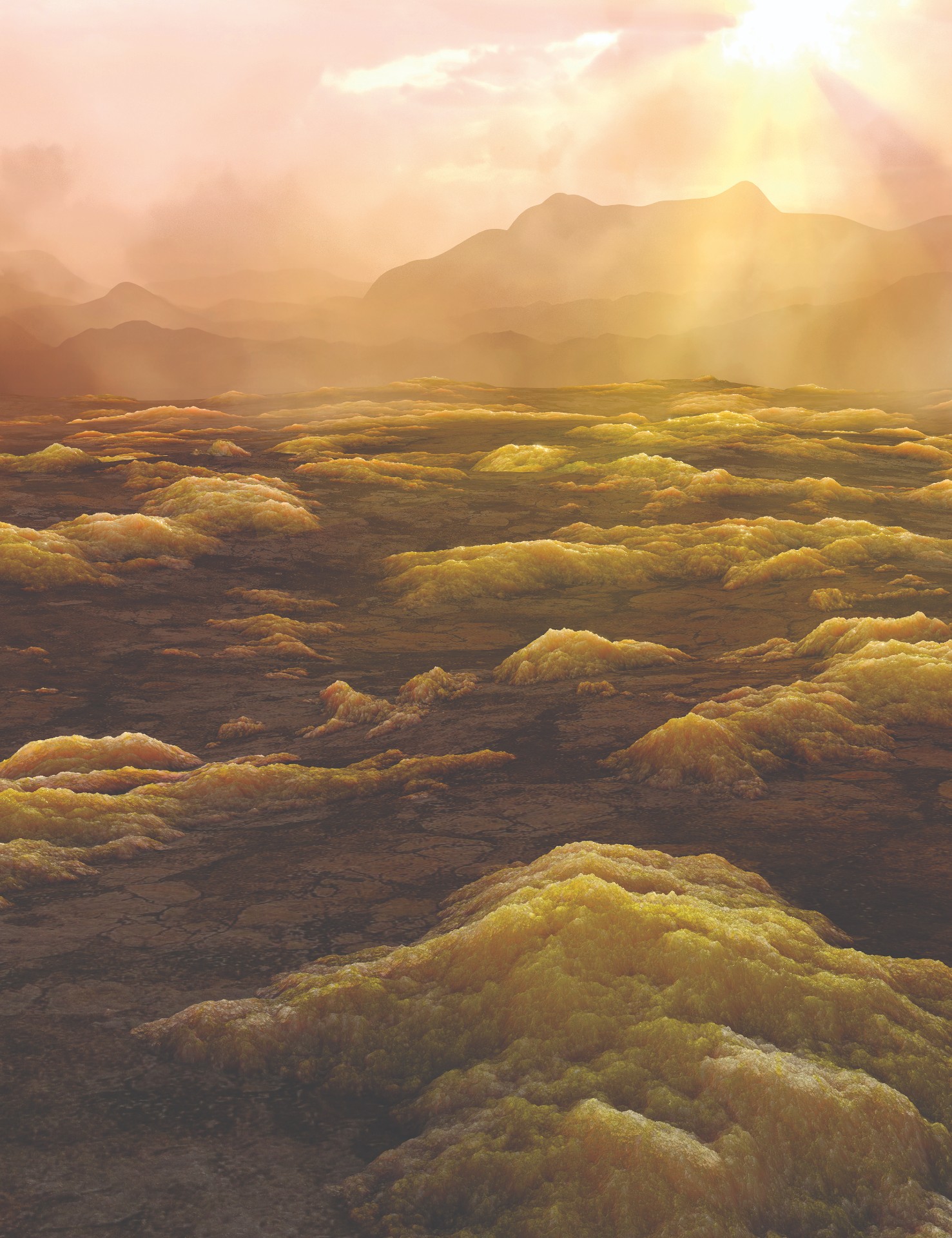
However, many species of fungus soon adapt to thrive on land as well. On land, fungi develop filament-like structures that connect member organisms with one another, where they then form a mycelium-like network. By radiating branches outward that have the potential to connect with the branches of neighboring fungi, they create a network through a process known as anastomosis, where splitting branches recombine. Due to their small sizes and soft, easily degradable bodies, fungi only rarely fossilize, leaving little trace of their presence from so long ago. While aquatic fungi are known to arise during approximately this epoch, substantial debate exists as to when terrestrial fungi first arose, with time estimates varying by more than half a billion years.

Among the oxygen producers, cyanobacteria still dominate the biosphere. While oxygen-producing algae have already come into existence during this time, they produce only a tiny fraction of Earth’s oxygen and won’t rise to prominence for several hundred million years. However, small populations of terrestrial algae can — in concert with fungi — begin producing structures that resemble modern-day lichen, where algae and fungi enter into a symbiotic relationship in wet environments on land. The land itself continues to shift due to Earth’s tectonic activity, with the ancient supercontinent Rodinia beginning to assemble during this time.
Although the most well-known form of fungus is the mushroom, containing the familiar cap-and-stem structure, they won’t arise for more than a billion years after the first fungi appear. Instead, these early fungi are mostly single-celled, aquatic-based forms of life with flagella and spores capable of traveling great distances through their watery environments. With mitochondria operating within their cells, the machinery is already in place for multicellular, sexually reproducing eukaryotes to arise. Over the next several hundred million years, these components pave the way for the first large, complex organisms.
The stage on Earth is set, at long last, for the appearance of plants and animals.

The Energy Transition