
















Mind & Behavior

Mind & Behavior

Study the science of how we think, feel, and act, with insights that help you better understand yourself and others.

A man with long hair, a beard, glasses, and a bandana on his head, reminiscent of David Foster Wallace, poses for a portrait against a plain background.
The writer’s tragic death at age 46 has led many to view him as a tortured artist. Here’s why this label is reductive.
Two men wearing glasses walk side by side outdoors in a sunlit park, with blurred greenery and other people in the background, discussing recent incidents of romance fraud.
Cecilie Fjellhøy, from the Netflix documentary The Tinder Swindler, shares her experience.
An open book with a black-and-white photo of a woman on the left page and a close-up image of a flower bud on the right page.
Late bloomers often find their moment of transformation when life throws them a curveball.
Two scenes: Top shows climbers on an ice-covered terrain, embodying fun and success. Bottom captures an airplane in flight against a clear sky.
Fun in business is no laughing matter — it can create a golden strategic advantage and bring serious success in the long term.
A diagram combines a 3D brain connectome with text and geometric shapes, with arrows pointing to areas labeled "The child bent down to smell the rose." A list and graph are shown on the left, illustrating how words in the brain are processed.
The findings show that even small areas in the brain may have the potential to represent complex meanings.
Three wireframe human heads are depicted against a dark background, their complex overlapping patterns evocative of the Johari window model, revealing multifaceted layers within each head's structure.
It's hard to know what other people know. But it's not impossible.
An illustration showing a side view of a human brain with colored dots representing neurons and text excerpts in three languages in circular insets.
In the brain's language-processing centers, some cells respond to one word, while others respond to strings of words together.
A labeled diagram of a human head's profile showcases areas of the brain related to career, self-esteem, conscientiousness, integrity, ambition, and more personality traits that help individuals work happy.
We spend over a third of our lives at work, yet the global workplace is often not a happy place. The solution may lie with our feelings of attachment.
Open book showing two pages: the left page has a red-toned illustration of early humans, while the right page features a blue-toned photo of an ocean wave, capturing the hyperefficient balance between art and nature.
From hunter-gathers to desk jockeys, we work best when short, intense sessions are followed by lighter fare.
Young child sitting on a couch, illuminated by the screen of a tablet they are holding in a dimly lit room.
The digital world will always entail risks for teens, but that doesn’t mean parents aren’t without recourse.
A dark cloud, laced with cynicism, is topped with a colorful iridescent layer against a dim sky.
Stanford psychologist Jamil Zaki discusses the dangers of cynicism and how skepticism can invigorate our relationships and communities.
A collage features a tennis player and a basketball player against a backdrop of financial charts, graphs, and mathematical equations on a checkered pattern.
How Daniel Kahneman and Amos Tversky cracked open behavioral economics and enlightened all our choices.
A collage featuring close-up images of hands, faces, eyes, and text excerpts. The central focus is on various hand gestures performing actions with small objects and cards, evoking the mysterious art of mentalism.
Meet the scientist mixing mentalism with principles from positive psychology and the science of human potential.
Two men in profile face each other. One points a finger at the other, who remains still, poised to embrace counterarguments. The image features a blue color overlay.
There's value to be found in the arguments that make you uncomfortable — especially in a culture that has trained us to avoid them.
A collage of clock faces—one depicting cavemen, another showing hands typing on a laptop, and a blank clock—symbolizes the hyperefficient evolution of work over time.
These practical strategies can help you conquer burnout and achieve a state of calm and focused productivity.
A high-rise office building at night with one illuminated corner office visible amidst the darkened windows, a lone workaholic burning the midnight oil.
In a major shift, psychologists now view an out-of-control compulsion to work as an addiction with its own set of risk factors and consequences.
A storefront with signs for psychic telepathy readings and a phone number. Two white plastic chairs are placed in front. The storefront is pink with a black awning and a large hand sign advertising $10 readings.
Thinking of a number between one and ten? Here's how predictable human responses create the illusion of telepathy.
A room simulating a Martian landscape with red sand, rocky walls, a green tent, and NASA equipment.
"When you feel the isolation setting in at times, you have to reframe your mindset."
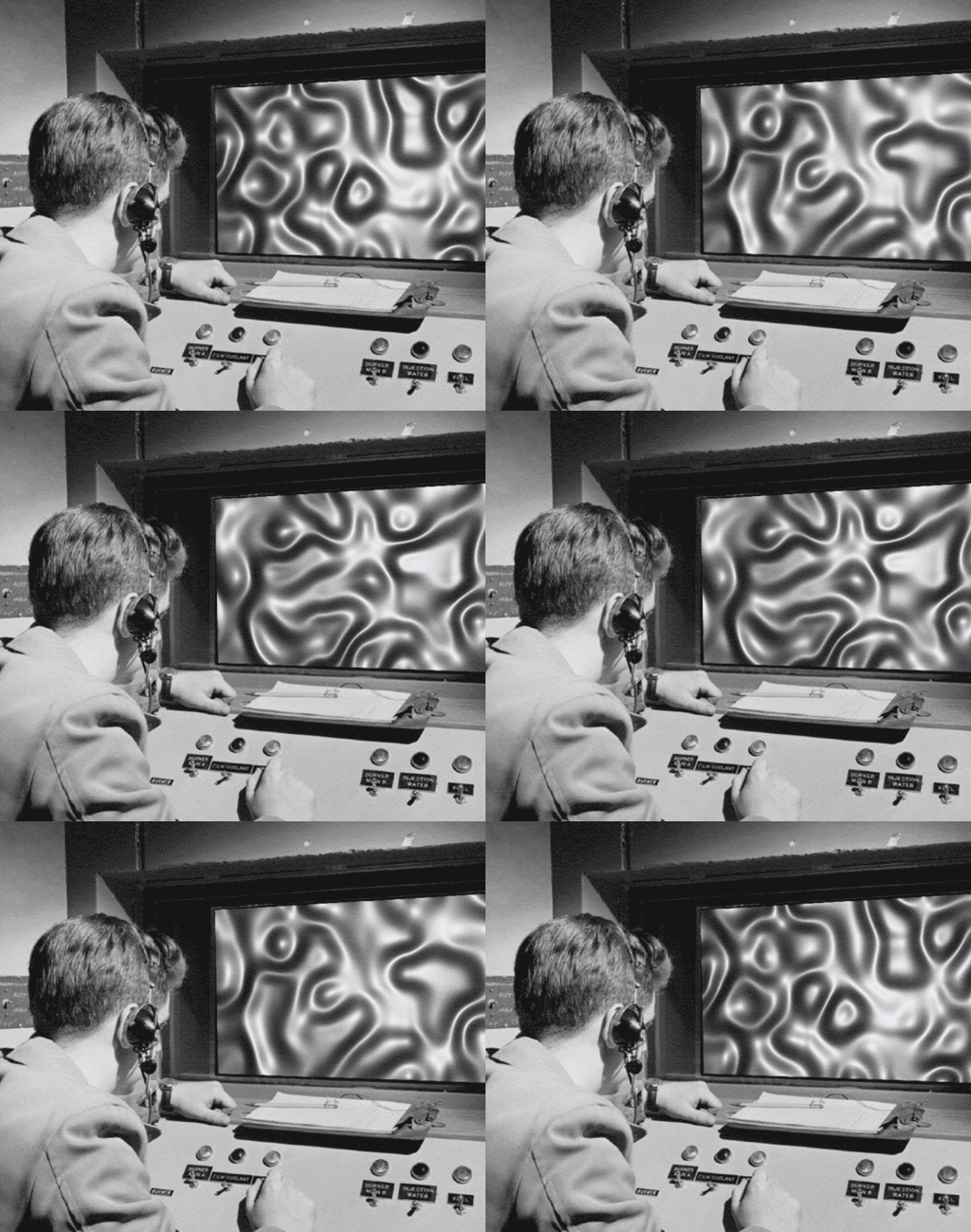
A man sits at a control panel with knobs and buttons, wearing a headset, looking at a screen displaying abstract, distorted wavy patterns—the antidote for leaders in navigating complex data.
We can address the misalignment between the current leadership reality and traditional leadership practices with a simple formula.