This article is part of Big Think’s monthly issue The Roots of Resilience.
For nearly every sport, there are innate attributes that can give an athlete an edge. Basketball has a height advantage. With NFL linemen, a little girth tends to help. Most jockeys are small and lean. The best ballet dancers are light on their feet. A high limb-length ratio offers some runners a natural advantage. With sumo wrestling, it’s … well, you get the point.
In rock climbing, a few such traits include longer fingers, shorter forearms, and scraggly wrists, all of which might help a climber clutch at tiny crimps in the rock with substantially more ease. The addition or subtraction of mere millimeters on the hand could mean the difference between struggling with an intermediate climb at your local bouldering gym and pioneering an untouched route along some precipitous wall in any far-flung corner of the world.
There is, however, another trait worth mentioning, one perhaps even more foundational to the literal and metaphorical heights of professional rock climbing. It’s a quality that cannot be as easily quantified by a tape measure or an MRI or any suite of blood tests. I’m not even exactly sure what to call this trait, but it lets you look down at your legs and see the ground removed from them by approximately 3,000 feet, then look up and see yourself hanging onto a mountain by only the top fold of your left index finger — and somehow not lose your entire mind.
“I just seem to be able to suffer.”
Tommy Caldwell
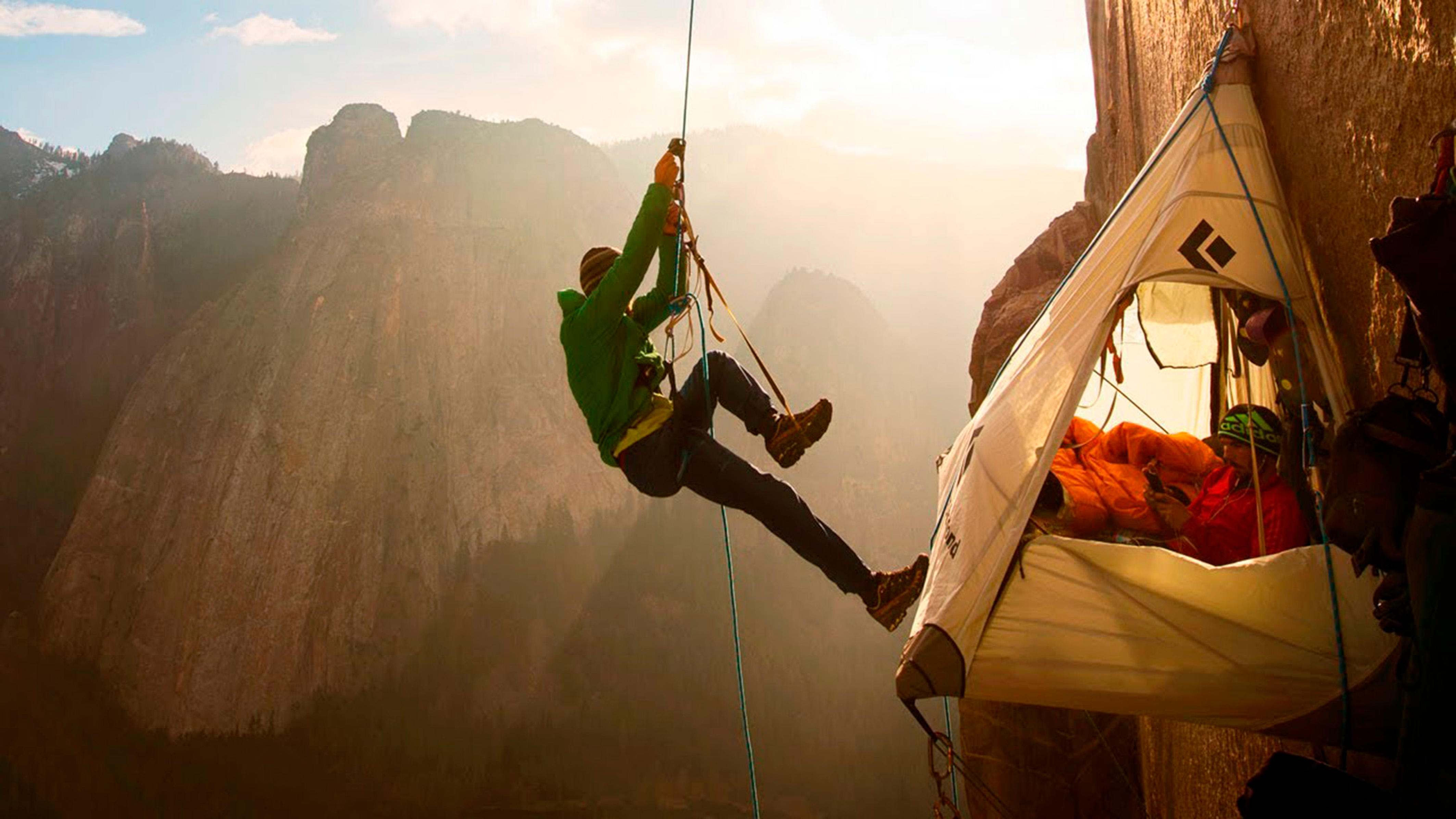
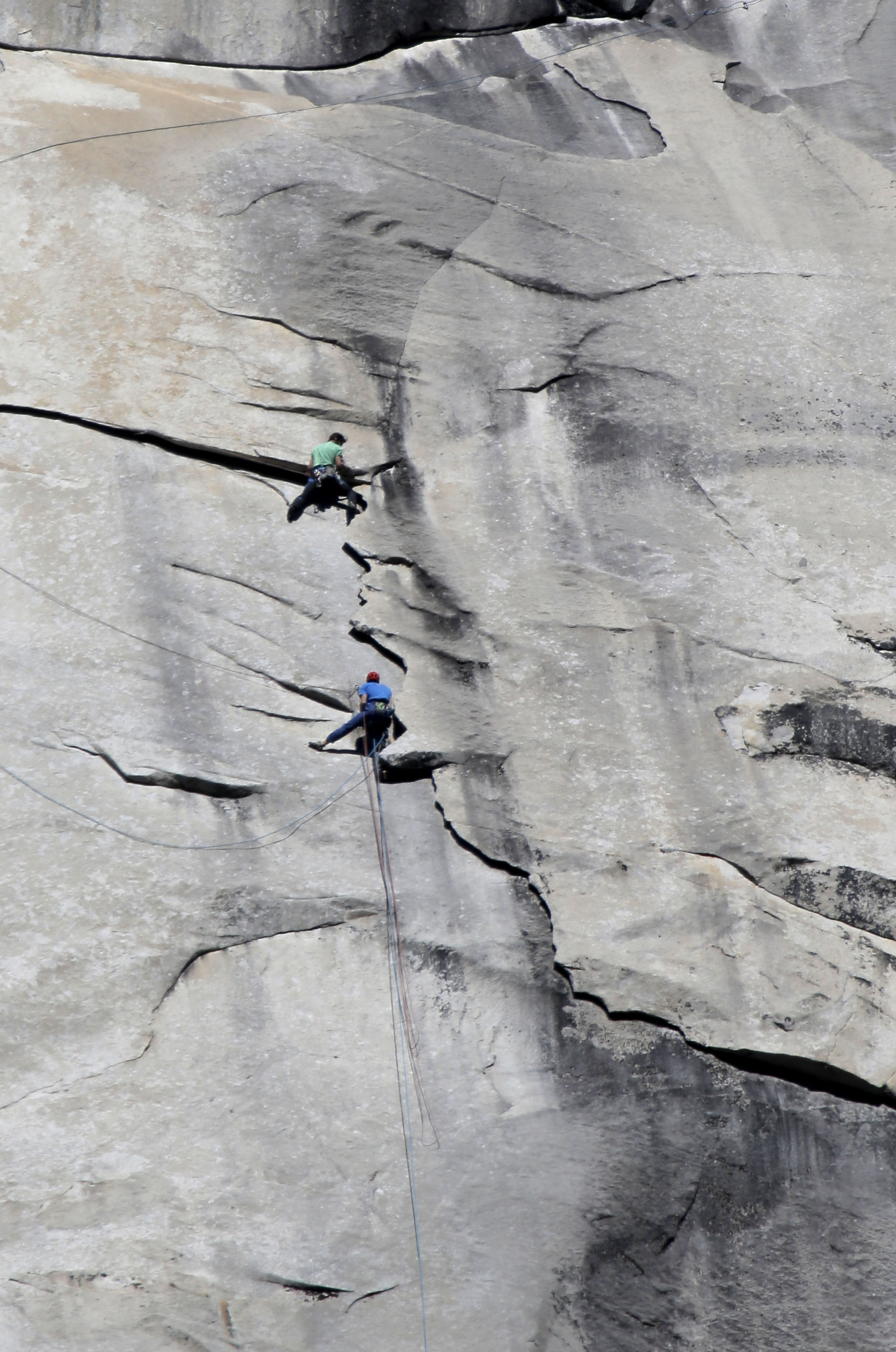
Tommy Caldwell appears to be endowed with this quirk of courage. Considered among the world’s greatest living rock climbers, he is known for his daring inaugural ascents of natural skyscrapers, like the east-facing “Dawn Wall” of Yosemite’s El Capitan, and for scaling, along with Free Solo climber Alex Honnold, the five peaks of Alaska’s Devil’s Thumb over the course of a single 12-hour day.

“Tommy has the disposition of a Golden Retriever, which is what makes him an absolute pleasure to climb with,” Honnold told me. “But he’s also got the tenacity of a dog with a bone, which is why he’s established so many of the hardest, most iconic climbing routes in the country.”
His displays of extreme fortitude aren’t limited to the mountains. When it comes to left index fingers, Caldwell lost the top of his in a sawing accident that should have ended his climbing career at age 23. Yet he was shirking his doctor’s orders from the edge of another soaring escarpment only days after leaving the hospital. The year prior, Caldwell and three other climbers, none older than 25, were taken hostage by Islamist militants during an expedition trip to Kyrgyzstan. After six days of marching under the barrel of an assault rifle, Caldwell triggered his group’s escape by pushing one of their captors off a cliff.
Caldwell commands an amorphous, hard-to-define trait we might call “resilient composure” — an ability to maintain strength and emotional balance in the face of stressful, life-threatening stimuli. It’s an obvious part of what’s made him one of history’s most accomplished climbers. What I wanted to know was where this trait came from. Was he born with it? Was it cultivated through careful practice? Or was it, like so much else in Caldwell’s life, thrust upon him?
Into the storm
The snow was falling about as hard as I’d ever seen when Caldwell’s pickup pulled next to me, and I loaded my snowboard into the well-worn bed of his truck. We were three days into the new year, and Caldwell had invited me on an adventure. “This is some wild wintry weather,” he laughs as we climb toward 9,000 feet in the heart of the northern Sierra Nevada.
The fresh precipitation had rendered the thin roads above Lake Tahoe almost indistinguishable from the frosted forests around them. “I have driven this route a lot,” Caldwell casually assures me. He threads the truck through icy alpine curves, passing less capable cars that had skidded into road barriers or peeled off to wait out the high-altitude storm. One ill-timed turn would send us similarly into a blustering abyss. But for Caldwell, it seemed to be just another day at the office.

We spend the slow and, thankfully, uneventful drive through the mountains discussing a remarkable anecdote from Caldwell’s youth. When he was about three years old, he began digging a hole to China in his Colorado backyard. Unlike most toddlers with similar ambitions, however, Caldwell continued his excavation for over two years, until bedrock finally halted his efforts. “I do think that was probably more innate,” he admits. His parents ran a rowdy daycare out of their home an hour north of Denver, and Caldwell looks back at his dogged digging as an early attempt to find the kind of peace and clarity his mind has always naturally craved. “To this day, I enjoy going out and doing something that’s repetitive, simple, and grinding.”
Caldwell references the 2,500-mile bike ride he took with Honnold to reach the Alaskan base of the Devil’s Thumb in 2023, all before the duo actually climbed the fabled peak. The journey, intended to raise awareness for conservation efforts, also served as an athletic reawakening for Caldwell after being homebound by injury, COVID-19, and domestic responsibilities for the previous several months. “I just really loved getting on the bike and riding 100 miles a day for 26 days. I was like, ‘Oh my God, my brain is suddenly free.’”
Built for suffering
When I tell Caldwell that 23andMe has identified 392 genetic markers associated with a fear of heights (or a lack thereof), he says he is curious to have his own spit analyzed, but he doubts that his biological blueprint bears much responsibility for his life as a legendary climber. “When I compare myself to my professional climbing peers, it’s harder for me than a lot of them,” he says. “I’m not phenomenally talented.” His wingspan-to-height ratio is about average, and his build is on the leaner end of the scale. Then, of course, there is the issue of the missing finger. Taken together, it’s far from a blueprint for unrivaled climbing success. Caldwell says he really only has one thing going for him: “I just seem to be able to suffer. My morale stays high, even when I’m in a lot of pain.”
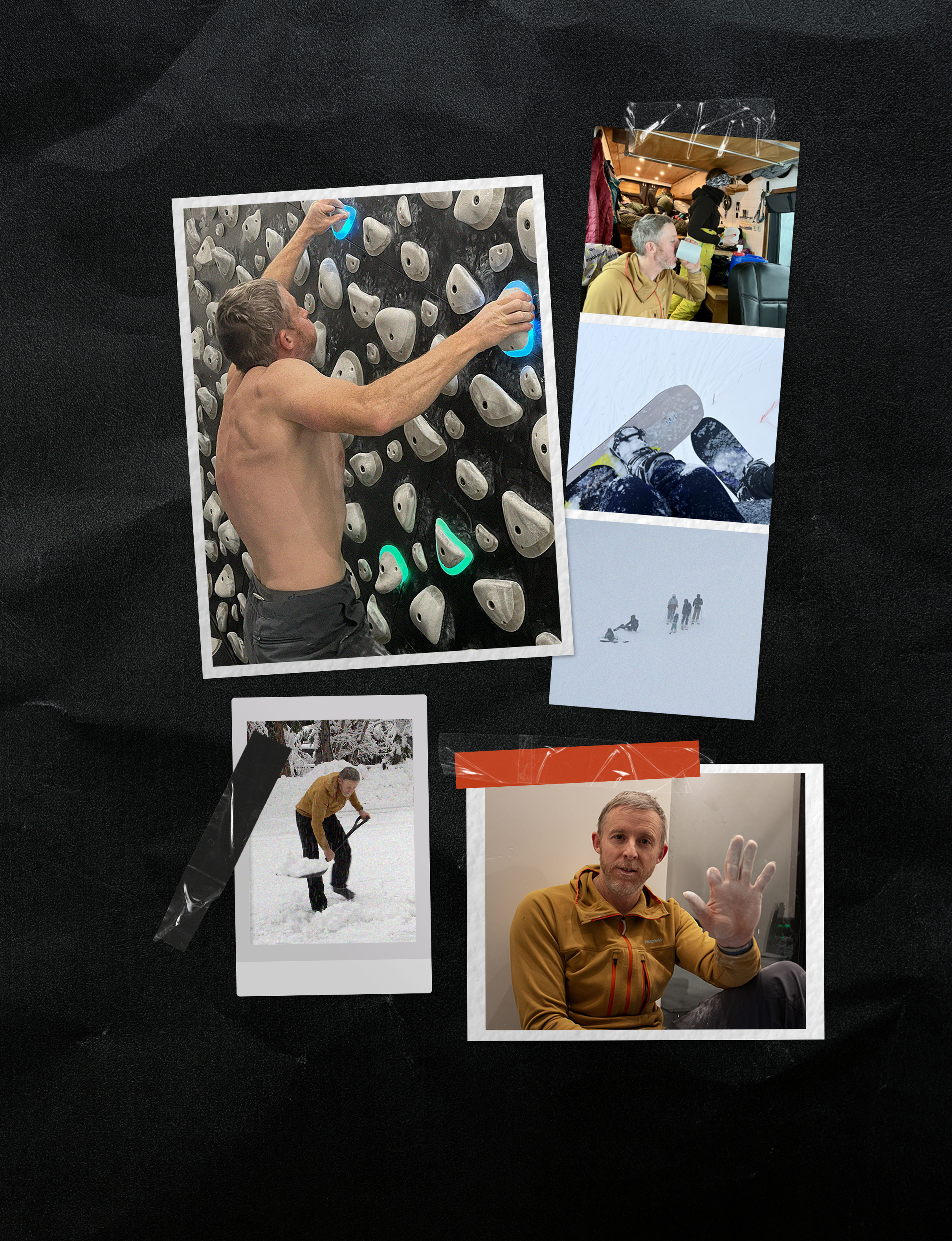
Now approaching age 50, Caldwell is expanding his athletic repertoire far beyond his roots in rock climbing, embracing new adventures that require fresh physical skill sets. Among his latest charges is the role of ski dad. His 12-year-old son Fitz — named after the traverse of Patagonia’s Fitz Roy mountain, which Caldwell and Honnold became the first to climb in 2014, just a few months after Fitz’s birth — has embraced competitive skiing in the wake of the family’s recent move to Lake Tahoe. The purpose of our mountain drive this morning is to rendezvous with Fitz and the rest of the Caldwell clan and take advantage of the virgin powder now piling up around California’s Carson Pass.
Waiting for us in a commercial-size van outfitted for long-term living are Fitz, Caldwell’s wife Becca, and his daughter Ingrid. The family often spends months on the road together in the cozy camper. Today, Fitz and Becca sport several layers of snow gear, but nine-year-old Ingrid will stay behind in the van to read Nancy Drew and nurse an overused Achilles tendon. “I feel like we do have one weird genetic thing going on with my family,” Caldwell mentions. “My dad stopped running when he was 20 because he had Achilles pain. I’ve torn my Achilles and then re-ruptured it a couple of times. Now my daughter has insanely tight Achilles.”
It seems like a small thing, but given Caldwell’s line of work, a stiff Achilles could make for a disastrous hereditary heirloom. However, as we near our destination at the top of the mountain pass, and the driving conditions become ever more fraught, Caldwell tells me of a different, potentially countering genetic force, the one he thinks might have actually played some meaningful role in shaping his career.
“I can recover really quickly after getting hurt,” he explains. “I can just grind for a long time. My dad always said that he also recovers quickly from physical injury. It’s hard to know how much of that is nature and how much is nurture. But if you have some sort of genetic ability to recover quickly, you can train a lot more, which makes you stronger. Because of that, I think we have a capacity to just do so much more.”
Caldwell’s father, Mike, was himself an accomplished climber and bodybuilder; at age 75, he still works as a Colorado mountain guide. His grandchildren, Fitz and Ingrid, have lived most of their young lives above 6,000 feet, their lungs and arteries working overtime to keep oxygen flowing through their ever-active little bodies. Living in a seemingly perpetual athletic prime between the two generations, Caldwell would likely climb to the Moon if such a feat were possible.
He tells me more about his 2014 experience on the Fitz Traverse with Alex Honnold. The technicality of the climb had forced the duo to carry only the most basic provisions. “We were in one sleeping bag. We had one jacket. We had no sleeping pad. We were super wet, on the verge of hypothermia, and just under a lot of duress the whole time,” he says. “And we loved it. We were laughing our way through the whole thing.”
No fear on the mountain
A counterpoint to any argument that Caldwell’s mental fortitude may be purely genetic is his wife Becca. She is waiting for us in shin-deep snow when we pull up to the family’s camper van. On our drive, Caldwell admitted to me that he is actually the softy in the couple, and it’s often Becca who pushes the kids (and occasionally Caldwell himself) to their physical limits. “There are days when the kids will be like ‘I don’t want to go climbing,’ and I’m like, ‘That’s okay,’” he says. “And then my wife will look at them and be like, ‘You’re Caldwells. You’re going climbing right now.’”
Before she met Caldwell, Becca was an amateur outdoorswoman from Minnesota. She had dabbled in gym-based rock climbing, grown up hiking in Midwest mountains (i.e., hills), and moved to Colorado seeking general adventure. She was introduced to Caldwell through friends at a common hangout, and when she learned that he was a professional climber, she took it as a bit of a joke. “I didn’t realize how deep this whole world goes,” she tells me. Among their first outings together was a trip to a local Colorado crag. Seeing how well Caldwell handled himself on the rock immediately impressed her. By the time Caldwell guided Becca to the top of the cliff, that admiration had evolved into something a little closer to outright trust.
For Caldwell, weighing the risks of his work has always felt more like a mental abstraction, an algorithm of constantly shifting variables, than an instinctive act of self-preservation. Marrying Becca and having two children with her has added a few additional variables to the safety side of that equation. “I don’t get scared on the mountain,” he says. “I just think logically, ‘I don’t want to take this risk because it isn’t right for my family.’”
And yet, the push and pull between those two drives remains, and as Becca tells me, she sometimes has to be the voice of reason. “But Becca also knows that I wouldn’t be me, the person she loves, the father of her child, without the core element of who I am,” Caldwell writes in his 2017 memoir, The Push. “What do you do if your one God-given gift, the thing you seem preordained to do, the thing without which you might become a hollow shell, is something that could kill you?”
Strongly disagree
According to a 2015 report from Harvard, perhaps the key environmental input for early-life resilience is the presence of a stable, reliable relationship with a trusted adult. The lack of any such connection will literally change the architecture of a developing young brain for the worse, leaving one impulsive and susceptible to all kinds of pressures as an adult. Fitz and Ingrid seem to have two formidable rocks in their lives with Caldwell and Becca. For Caldwell himself, that adult was his father, Mike.
“Most of us are taught to avoid hardship. That life should be easy. My dad taught me something else,” Caldwell said in a 2015 TED Talk. “From a very young age, my dad was taking me up on mountains, and we were doing hard things.” Those hard things included scaling thousand-foot peaks in Yosemite Valley and spending nights in snow caves under a single sleeping bag shared by the whole family — all before Caldwell had finished his first year of elementary school.
Mike coined a term to describe these deliberately difficult experiences: elective hardship. “It seems to me one of the best gifts you can give your kid is an ability to deal with adversity,” he says in The Dawn Wall, a 2017 documentary about Caldwell and Kevin Jorgeson’s 19-day free climb of what is widely considered El Capitan’s most difficult route. As a boy, Caldwell never doubted his father’s logic. Having been born premature and lagging in physical stature for most of his young life, he welcomed these grinding experiences as opportunities to grow mentally tough when his innate physicality often felt insufficient. “What I think that did for me is, whenever I had traumatizing experiences happen, I had these tools, and I knew how to cope,” he says.
“They want an instant fix, and my fix isn’t instant.”
Tommy Caldwell
Caldwell mentions that he recently spoke with cadets on board the USS Ronald Reagan, one of the U.S. Navy’s biggest nuclear-powered aircraft carriers, about strategies for resilience. He remembers some of the other invited experts encouraging the sailors to engage in ruminative techniques like meditation and slow breathing.
“That’s not how it ever worked for me,” Caldwell jokes. “For me, it’s just been this very long, slow, steady learning that started at a really young age with my dad.” He chuckles further, realizing that was probably the last thing those soldiers wanted to hear. “I don’t know if my message truly worked. We were on an aircraft carrier where there are suicides every year, and people are living a really hard life. They want an instant fix, and my fix isn’t instant.”
The night before our trip into the mountains, I asked Caldwell to complete a couple of short psychological surveys. The first was the Brief Resilience Scale, a six-question test that measures one’s ability to bounce back from rough experiences. Caldwell scored in the 96th percentile, answering prompts like “I have a hard time making it through stressful events” and “I take time to get over setbacks” with an emphatic “strongly disagree.”
The second was the Connor-Davidson Resilience Scale, on which Caldwell scored about 15 points lower. This test measures not only resilience but also the various ideological and emotional factors typically associated with it, such as family support, personal competence, and faith in God — a higher score reflects more of these attitudes and supports. It includes prompts like “I believe things happen for a reason” and “Sometimes fate can help me.” That Caldwell marked himself a bit lower on this scale suggests that his resilience may draw less from traditional sources and more from something else entirely.
Past the breaking point
We were halfway up the mountain, and Caldwell and Becca were itching to take on the piles of fresh powder. Meanwhile, I was working to put on my snowboard bindings after having breathlessly trudged through the final couple hundred feet of knee-deep snow to catch up to their position. Caldwell carried a walkie-talkie to stay in touch with Ingrid, whose boredom in the van had been vigorously articulated across the airwaves.
Fitz had already sped off toward the bowls at the top of the summit, too cool to wait for his slow-poke parents, the world-famous climber and the nurse-turned-expedition matron. It’s a totem pole of pluckiness, and today I am obviously at the bottom. Caldwell and Becca are speeding down the trackless mountain before I even have the chance to stand up, and I’m left to find my own path down, not seeing much of the Caldwells for the next couple of hours.
At one point in The Dawn Wall, Caldwell says, “I think we all have this idea of where our limits lie. If you’re hurting really bad, you get to a point where you’re like, ‘I can’t endure any more.’ And it takes something extraordinary to force you past that.” When Caldwell was kidnapped in the Pamir-Alai mountain range by an affiliate of Al-Qaeda in 2000, the mettle of his biology and upbringing were pushed to their extreme. Yet neither Caldwell’s mind nor body ever broke. “In Kyrgyzstan, I realized my preconceived limits were totally off base. That I’m capable of so much more than I could ever imagine,” he tells me.
“I was the guy who pushed him off the cliff.”
Tommy Caldwell
Over the course of six inconceivably traumatic days, Caldwell and three friends were forcibly marched and starved, shoved under boulders to evade detection, and made to watch their kidnappers execute members of the rival Kyrgyz Army at point-blank range. The group grew physically weak, wasting away until there was little left of their corporeal selves but skin and bones. Yet inwardly, psychologically, something new awoke inside Caldwell.
“I still don’t know how it happened or where it came from, but as everyone else grew weaker, I felt stronger,” he writes in his memoir. That wave of inner strength crested when Caldwell made the fateful decision to push one of his captors over a cliff, giving his group the opportunity to escape toward a nearby military installation. The 22-year-old, freckle-faced rock climber believed he had just killed a man. He thought the weight of that moment would be a burden he would bear for the rest of his life.
And yet, upon returning home, Caldwell realized that the experience had left a totally unexpected imprint on him. “I came back from Kyrgyzstan logically knowing it was hugely traumatic,” he tells me. “But I never had this physiological trauma response to it.” As for the three other captives, Caldwell says at least two remain deeply scarred to this day. “They still can’t really live their lives completely free of this experience.”
Worried he may have unhealthily buried his own trauma, Caldwell recently undertook a suite of therapy sessions, including one instance of MDMA-assisted therapy, to find out what, if anything, might be hiding under the hood of his psyche. But the sessions uncovered little of concern. “There’s no trauma there,” Caldwell laughs. “I came out more confident that I’m not hiding anything.” He now attributes his lack of PTSD to the agency he exhibited during the kidnapping. “I was the guy who pushed him off the cliff,” he says of his ill-fated kidnapper (Caldwell later learned that the young militant had miraculously survived the fall). “I came out of that experience knowing that when things go wrong, I’m gonna find a way to react, which is pretty empowering.”
Antifragile living
By the early afternoon, I make it back to the van, where the Caldwell clan, sipping on ramen noodles cooked in the camper’s spartan kitchen, greets me with a “what took you so long?” sort of look. We agree to split up for the evening, with Caldwell, Ingrid, and me heading back toward their house in South Tahoe, while Becca and Fitz stay behind for one final lap on the mountain. As I wait for Caldwell to grab his truck from a nearby lot, Becca asks me to say something interesting about the science of resilience. I decide to tell her about mathematician Nassim Taleb, who has written a bit on the subject.
Taleb points out that the opposite of fragility — of breaking under pressure — is not resilience. Resilience only assumes that an object is unchanged by pressure. To showcase the true converse of fragility requires something to actually grow from a negative experience, to be what Taleb calls “antifragile.” It’s a perspective that, in the human realm, sees some stress and trauma as beneficial, as sources of development and maturation. Becca, who is getting Fitz ready for his fifth or sixth lap of the day on the mountain, nods and smiles, as if I’m preaching to an iron choir.
Later, on our drive home, Ingrid tells me about the aerial silk ropes installed in the beams of the family’s living room ceiling and promises to put on an acrobatics show worthy of its own write-up. At just nine years old, she has already branched out from her family’s traditional sports to find her own way of defying gravity — like her father and mother and brother and grandfather before her.
As Ingrid blasts Muppets songs on the car speaker, Caldwell’s thoughts return to the topic of Kyrgyzstan. “There were four of us on that expedition, and I think two decades afterward, if you were to ask all three of the other people, they would have this very negative view of it,” he says. “But I think I had all these different tools at a very young age that made me cope with that moment in a way that I’m proud of now. … I do think it was post-traumatic growth.”
We arrive home to find the Caldwell house covered in a thick layer of crystalline white. Ingrid runs inside to her silk ropes on which she hangs tangled in increasingly complex knots for the rest of the night. Meanwhile, Caldwell and I start shoveling the driveway, removing the snow only slightly faster than it falls. Most of our work will be reversed within the hour, but that seems to be beside the point. Soon, a call comes from Becca. Several cars have crashed near Carson Pass, and the highway patrol has closed the roads, stranding her and Fitz at the top of the mountain. They plan to hunker down in the van for the rest of the night, watching the finale of Stranger Things and waiting for the roads to reopen in the morning.
While the two are safe, I imagine their condition to be more than a little precarious. I ask Caldwell whether he is at all stressed about his wife and son’s uncomfortable situation. “Not even a little,” he smiles from the freshly shoveled driveway.
This article is part of Big Think’s monthly issue The Roots of Resilience.
The Energy Transition