




















Search
Ethan Siegel
Theoretical astrophysicist and science writer

Ethan Siegel is a Ph.D. astrophysicist and author of "Starts with a Bang!" He is a science communicator, who professes physics and astronomy at various colleges. He has won numerous awards for science writing since 2008 for his blog, including the award for best science blog by the Institute of Physics. His two books "Treknology: The Science of Star Trek from Tricorders to Warp Drive" and "Beyond the Galaxy: How humanity looked beyond our Milky Way and discovered the entire Universe" are available for purchase at Amazon. Follow him on Twitter @startswithabang.
Read Less

When it comes to our Universe's origins, scientists discuss the Big Bang, cosmic inflation, and other theories. Why doesn't "God" come up?

On the largest scales, galaxies don't simply clump together, but form superclusters. Too bad they don't remain bound together.

The conversation you're having with an LLM about groundbreaking new ideas in theoretical physics is completely meritless. Here's why.

Somewhere, at some point in the history of our Universe, life arose. We're evidence of that here on Earth, but many big puzzles remain.

Even just by examining the Moon with the unaided eye, we can learn an incredible amount about the Moon, Earth, and more.

The Big Bang was hot, dense, uniform, and filled with matter and energy. Before that? There was nothing. Here's how that's possible.

Realizing that matter and energy are quantized is important, but quantum particles aren't the full story; quantum fields are needed, too.

With the right material at the right temperature and a magnetic track, physics really does allow perpetual motion without energy loss.

Whether you run the clock forward or backward, most of us expect the laws of physics to be the same. A 2012 experiment showed otherwise.

When the Hubble Space Telescope first launched in 1990, there was so much we didn't know. Here's how far we've come.

Once you cross a black hole's event horizon, there's no going back. But inside, could creating a singularity give birth to a new Universe?

From high school through the professional ranks, physicists still take incredible lessons away from Newton's second law.

No matter what it is that we discover about reality, the fact that reality itself can be understood remains the most amazing fact of all.
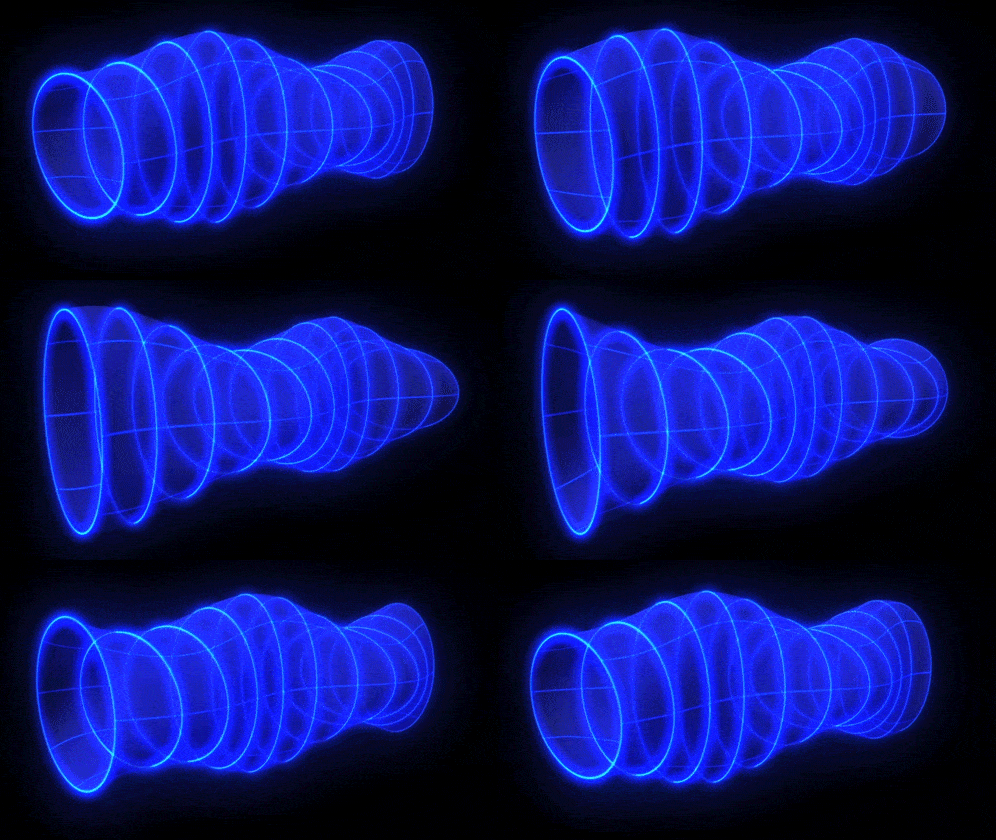
With over 300 high-significance gravitational wave detections, we now have a huge unsolved puzzle. Will we invest in finding the solution?

Will we build a successor collider to the LHC? Someday, we'll reach the true limit of what experiments can probe. But that won't be the end.
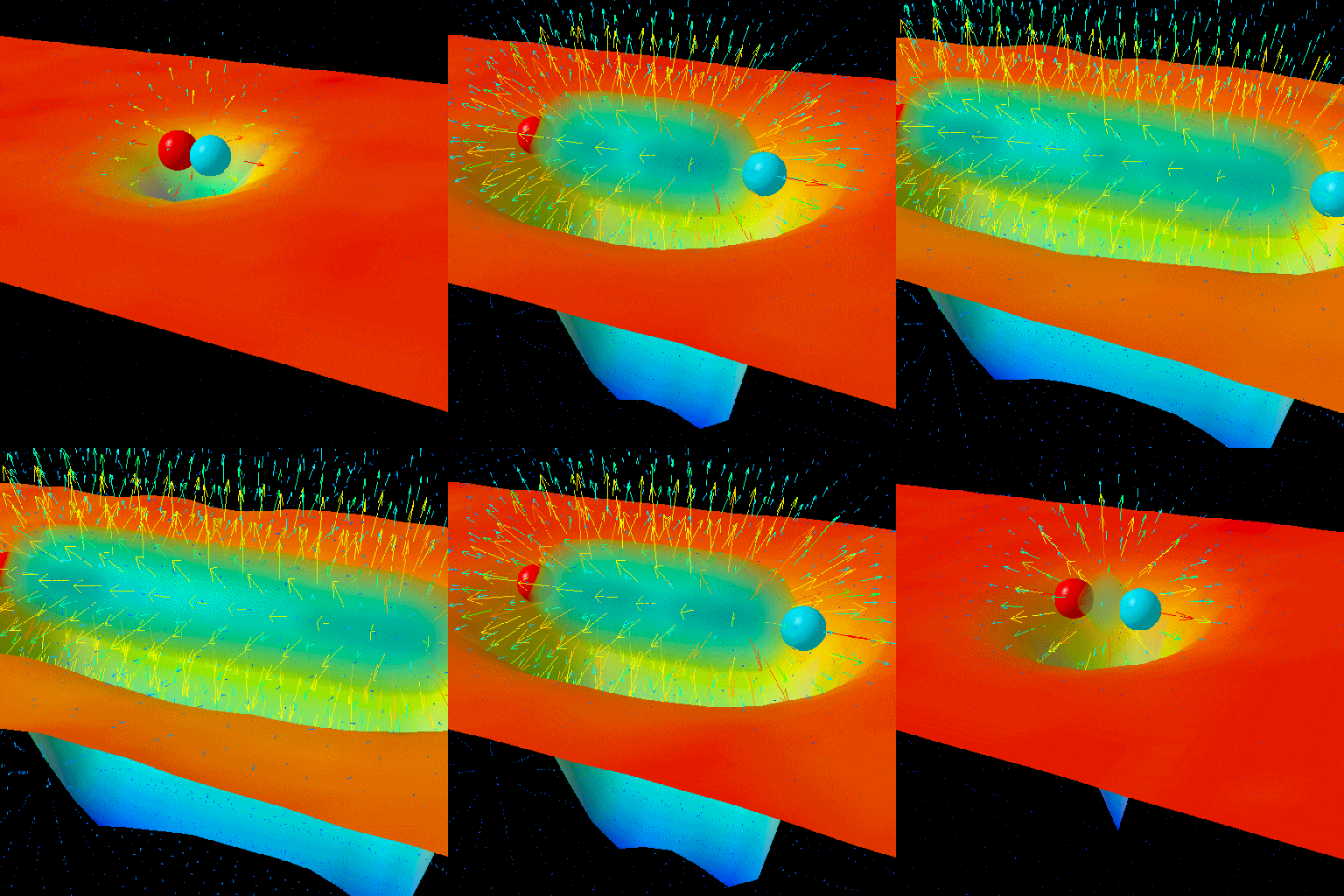
The measured value of the cosmological constant is 120 orders of magnitude smaller than what's predicted. How can this paradox be resolved?

65 million years ago, a massive asteroid struck Earth. Not only did Jupiter not stop it, but it most likely caused the impact itself.

Can the top quark, the shortest-lived particle of all, bind with anything else? Yes it can! New results at the LHC demonstrate toponium exists.

First 'Oumuamua, then Borisov, and now ATLAS have shown us that interstellar interlopers are real. Here's what the newest one teaches us.

The relic signal that first proved the Big Bang has been known and analyzed for 60 years. Join us at the frontiers of modern cosmology!