




















Search
Science & Tech
Explore the discoveries that reveal how the world works, alongside the technologies that extend, reshape, and sometimes challenge what’s possible.

With new labs, funding models, and institutions, metascience is reinventing the machinery of discovery.

Government-spec’d glory projects produce tech demos. Enduring progress demands a better way forward.

The case that a bipartisan movement structured around progress and reform may be reaching critical mass.

Wavelengths stretch, distances grow, and temperatures cool as the Universe expands with time. How are the various cosmic parameters related?

Leaders in China hope that AI and robotics can finally resolve the flaws of a centralized planned economy. But US technoculture has an edge.

Weird-looking galaxies, with tentacle-like tails or prominent dual streams, appear like jellyfish or bunny ears. But that’s just the start.

For over 10 billion years, the cosmic star-formation rate has been dropping and dropping. Someday, the final star in the Universe will die.

Digital tools are pulling us away from fixed texts and back toward fluid, interactive communication.

We first measured G, the gravitational constant, back in the 18th century. As the least well-known fundamental constant, can it be improved?

Welcome to The Nightcrawler — a weekly newsletter from Eric Markowitz covering tech, innovation, and long-term thinking.

In 2017, a kilonova sent light and gravitational waves across the Universe. Here on Earth, there was a 1.7 second signal arrival delay. Why?

NASA’s Caleb Scharf talks with Big Think about life’s long experiment in expansion.

Dark matter, dark energy, and the Big Bang are all part of a solid scientific foundation. Here's why popular media often claims otherwise.

What if the first search for life beyond Earth actually succeeded?

Planets grow from protostellar material in disks, leading to full-grown planetary systems in time. At last, the final gap has been filled.

We chat with Mark Klarzynski, founder of PEAK:AIO, on how his company became an international player in data storage for the age of AI.

Until the late 20th century, there wasn't a truly universal standard. Under our current definition, everyone agrees on what "one meter" is.

Do aliens speak the same physics that we do, with similar laws, observables, and underlying mathematics. Maybe not, argues Daniel Whiteson.
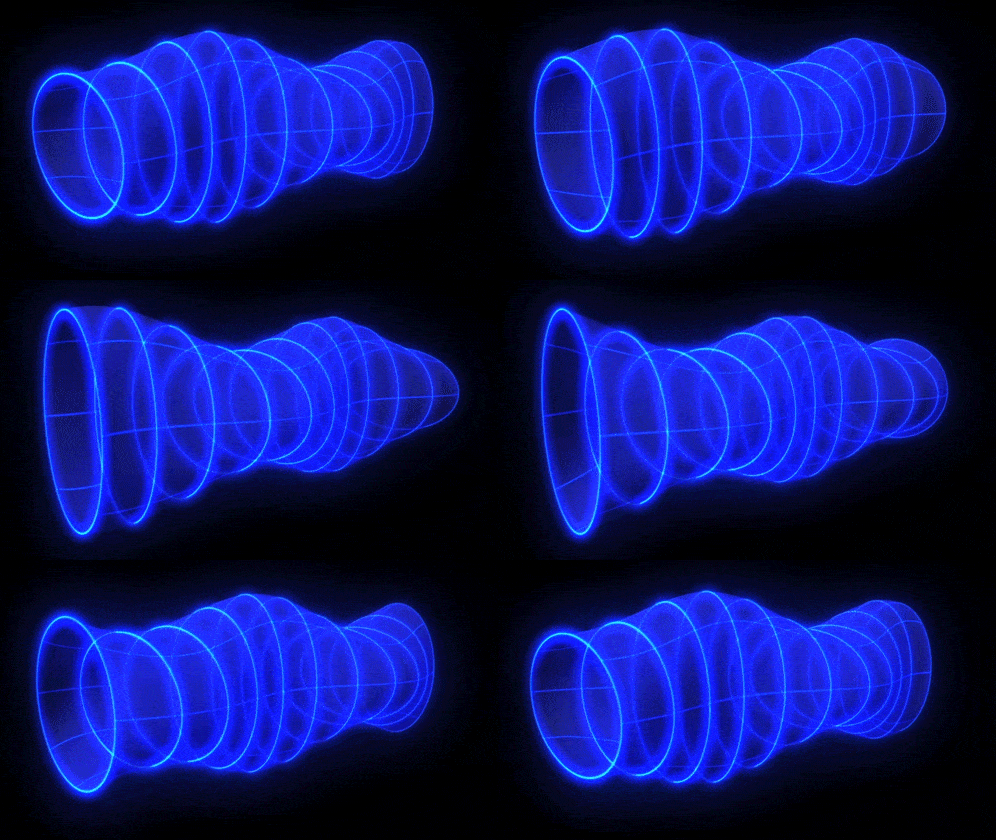
We've now detected hundreds of gravitational waves with LIGO, Virgo, and KAGRA. What if we tried Weber's original method in the modern day?

The great books aren’t just classics — they’re cultural Schelling points that give our minds a place to meet up in the world of ideas.