

We often talk about searching for truth in the world, and find ourselves at odds with people who seek it differently from how we do. But in many ways, the human endeavor of science is the ultimate pursuit of truth: the truth of our reality as shared by each and every one of us. By asking the natural world and Universe questions about itself, we seek to gain an understanding of:
- what the Universe is like,
- what the rules that govern it are,
- and how things came to be the way they are today.
Science is neither a collection of facts nor merely a process, but rather the combination of both. All at once, science is simultaneously the full suite of knowledge that we gain from observing, measuring, and performing experiments that test the Universe, as well as the process through which we perform those investigations and refine our conclusions based on an ever-increasing set of data.
It might be easy to see how we gain knowledge from that endeavor, but it’s less clear how that knowledge leads to an approximation of “the truth” of our reality. How do scientists arrive at the idea of a scientific truth? When we do get there, how closely related to our notions of “absolute truth” are these scientific truths? And, more explicitly, what are the grounds upon which we, scientifically, determine something to be true or untrue?
When we’re speaking scientifically, the notion of a “truth” is something very different than how we colloquially use it in our everyday speech and experience. Here’s how to understand the scientific uses of the word truth, including what it does and doesn’t mean for our reality.
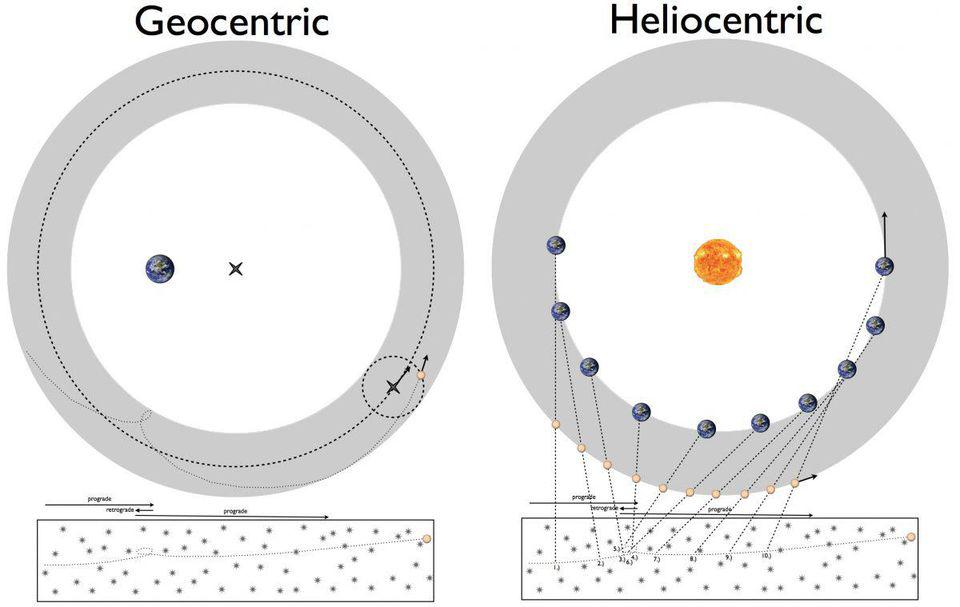
Let’s consider the following statement: “The Earth is round.”
If you’re not a scientist (assuming, of course, that you’re also not a flat-Earther), you might think that this statement is unimpeachable. You might think of the “roundness of the Earth” as being a statement that’s completely scientifically true. Under most circumstances, these instincts of yours should be considered correct. In fact, stating that “the Earth is round” is both a valid scientific conclusion and also an established scientific fact, specifically if what you’re doing is contrasting a round Earth with a flat Earth.

However, there’s always an additional nuance and caveats at play, especially if you’re willing to look at the problem with a greater attention to detail than the simple “round vs. flat” question. If you were to measure the diameter of the Earth across our equator, you’d get a certain value: 7926 miles (or 12,756 km). If you then went and measured the diameter in a different direction, from the north pole to the south pole, you’d get a slightly different value: 7901 miles (12,714 km). These differences are small, at the 0.3% level or so, but they’re very real. The Earth is not a perfect sphere, but rather possesses a near-spherical shape that bulges at the equator and is compressed at the poles: what’s known as an oblate spheroid.

To a scientist, the example of a round Earth illustrates extremely well the caveats associated with a term like “scientific truth.” When scientists use a term like “scientific truth,” they aren’t talking about truth in an absolute sense, but rather whether this attempt at a truth is a better approximation of our reality than any other alternative we’ve arrived at so far. Sure, it’s more true that the Earth is a sphere than that the Earth is either a disc or a circle; in that sense, the Earth is round.
But it isn’t an absolute truth that the Earth is a perfectly round sphere, where all points on the surface are equidistant from the true center of the Earth. It’s more correct to call Earth an oblate spheroid as opposed to a sphere, for example, as that shape provides a more accurate description for the Earth’s shape. And, if we’re being as rigorous as possible, we have to recognize that calling the Earth an oblate spheroid isn’t necessarily the absolute truth, either.
There are surface features on Earth that demonstrate significant departures from a smooth shape like either a sphere or an oblate spheroid. There are:
- mountain ranges,
- rivers,
- valleys,
- plateaus,
- deep oceans,
- trenches,
- ridges,
- volcanoes,
and many other features that depart from “smoothness” on Earth’s surface. There are locations where the land extends more than 29,000 feet (nearly 9,000 meters) above sea level, and places where you won’t touch the Earth’s surface until you’re 36,000 feet (11,000 meters) beneath the ocean’s surface.

The example of examining the true shape of the Earth, and refining our models of it to better match the shape we measure at greater and greater precisions, gives us a window into how scientists think about “the truth” of reality. Moreover, it highlights a few important ways where thinking scientifically differs from how we think colloquially. This can be summed up in three statements, all of which may be unfamiliar to a non-scientist.
- The notion of “absolute truth” is not something we worry about or even attempt to prove in a scientific fashion. There are no absolute truths in science; there are only approximate truths, and the “goodness” of a truth depends on how well it matches experiment, observation, and what we measure.
- Whether we can rightfully consider a statement, theory, or framework to be true (or not) depends on quantitative factors, and measured amounts of “how much,” as opposed to qualitative factors such as whether a phenomenon exists or not. The more closely you examine or measure the results that test your quantitative predictions, the more robustly your idea can be established (or refuted) as a scientific truth.
- And, perhaps most profoundly, every scientific theory has only a finite range of validity over which it is established. Inside that range, the theory is indistinguishable from true, outside of that range, the theory is no longer necessarily true, and may even be known to not be valid outside of it.
This represents an enormous difference from how we commonly think about fact vs. fiction, truth vs. falsehood, or even right vs. wrong.

For example, if you drop a ball on Earth, you can ask the quantitative, scientific question of how its motion will behave. Like everything on Earth’s surface, we can be certain that the ball, once it’s dropped (or in free-fall), will accelerate downward at 9.8 m/s² (32 ft/s²). This is a great answer, from a scientist’s perspective, because it’s so useful when we’re on the surface of the Earth, and dealing with the small accelerations and low velocities we’re accustomed to experiencing. Scientifically, this description of a dropped ball’s motion is a good approximation to the truth of what’s observed to occur.
In science, though, you can begin to look more deeply, and a more comprehensive consideration of the problem will lead to you discovering where (and how) this approximation is no longer true. If you perform this experiment at sea level, at a variety of latitudes, you’ll find that the acceleration at Earth’s surface actually varies dependent on where you are: from 9.79 m/s² at the equator to 9.83 m/s² at the poles. If you travel to higher altitudes, you’ll find that the acceleration starts to slowly decrease, while at deeper depths, the acceleration increases. And if you leave the Earth’s gravitational pull entirely, you’ll find that this rule isn’t universal at all, but is rather superseded by a more general rule: the law of Universal gravitation.

As far as scientific laws go, this one is even more generally true. Newton’s law of universal gravitation can explain all the successes of “the round Earth,” which models Earth’s acceleration as a constant, but it can also do much more. It can describe the orbital motion of the moons, planets, asteroids and comets of the Solar System, as well as giving successful predictions for how much you’d weigh on any of the planets, moons, or dwarf planets that are present. That same law also describes how the stars move around inside galaxies, and even allows us to predict how to send a rocket to reach, orbit, and even to land humans on the Moon, providing extraordinarily accurate trajectories.
But even Newton’s law has its limits to how well it can approximate the truth of our reality. When you:
- move close to the speed of light,
- or get very close to an extremely large mass,
- or want to know what’s occurring on cosmic scales (such as in the case of the expanding Universe),
Newton and his law of universal gravitation are unable to help you. For that, you have to supersede Newton if you want an answer that agrees with what we observe and measure. In the early 20th century, it was exactly considerations such as this that led humanity to move on beyond Newton, and to instead embrace Einstein’s general relativity.
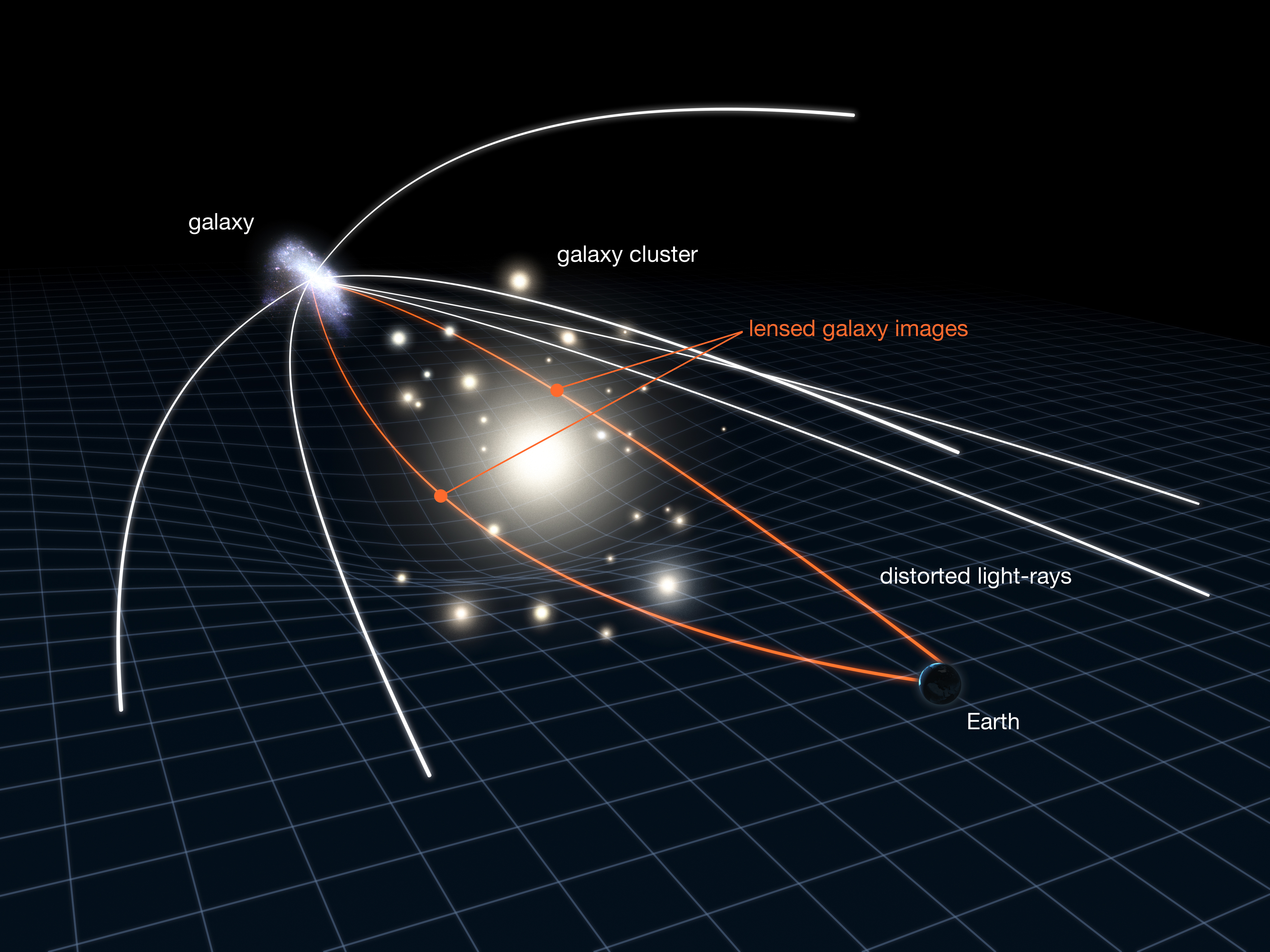
For the trajectories of particles that move close to the speed of light, or to obtain very accurate predictions for the orbit of Mercury (the Solar System’s closest and fastest planet), or to explain the gravitational bending of starlight by the Sun (during an eclipse) or by a large collection of mass (such as in the case of gravitational lensing, above), Einstein’s theory gives predictions that match what we observe and measure, whereas Newton’s older law of universal gravitation fails. In fact, for every observational or experimental test we’ve thrown at general relativity, from gravitational waves to the frame-dragging of space itself, it’s passed with flying colors.
Clearly, this shows that Einstein’s general relativity has more explanatory power, and is a better approximation of reality, than all of the attempts at describing gravitation that came before it. But does that mean that Einstein’s general theory of relativity should be taken as “the scientific truth?”
When you apply it to these specific scenarios, absolutely; it’s true in the sense that wherever we’ve been able to test it, those tests have been consistent with general relativity’s predictions. However, there are scenarios and circumstances we can consider, all of which are not yet sufficiently tested, where we fully expect that general relativity won’t give quantitatively accurate predictions.

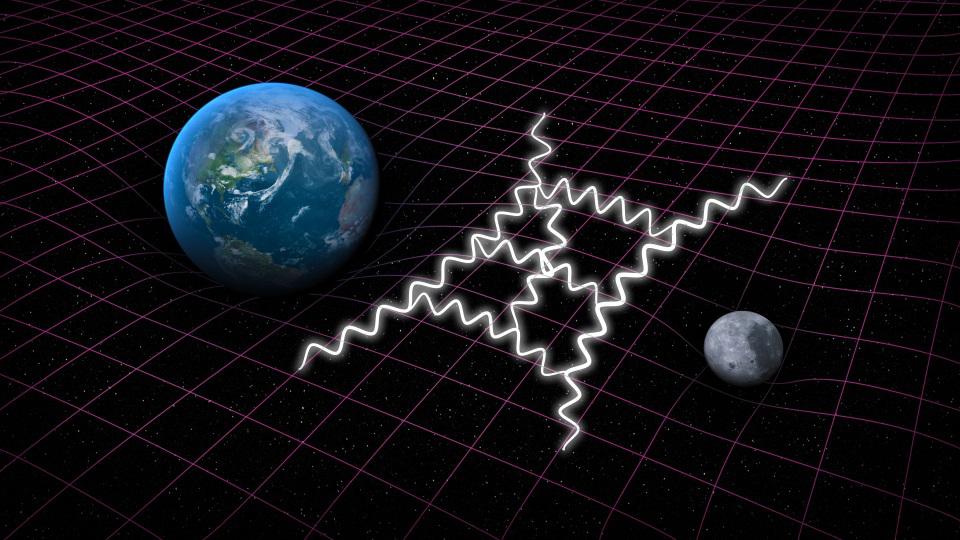
There are many questions we can ask about reality that require us to understand what’s happening where gravity is important or where the curvature of spacetime is extremely strong: just where you’d want to put Einstein’s theory to the critical test. But when the distance scales you’re thinking about are also very small, it isn’t just Einstein (and classical general relativity) that should come into play; you expect quantum effects to be important as well. Under those conditions, general relativity alone shouldn’t be able to explain the full suite of what we anticipate will occur. Some questions that require a knowledge of gravity beyond Einstein’s theory include the following:
- What happens to the gravitational field of an electron when it passes through a double slit?
- What happens to the information of the particles that collapse to form a black hole, if the black hole’s eventual state is to decay into thermal radiation?
- And what is the behavior of a gravitational field/force at and around a singularity?
Einstein’s theory won’t just get these answers wrong; it won’t have any sensible answers to offer at all. In these regimes, we know we require a more advanced theory, such as a valid quantum gravitational theory, to tell us what’s going to happen under these circumstances.
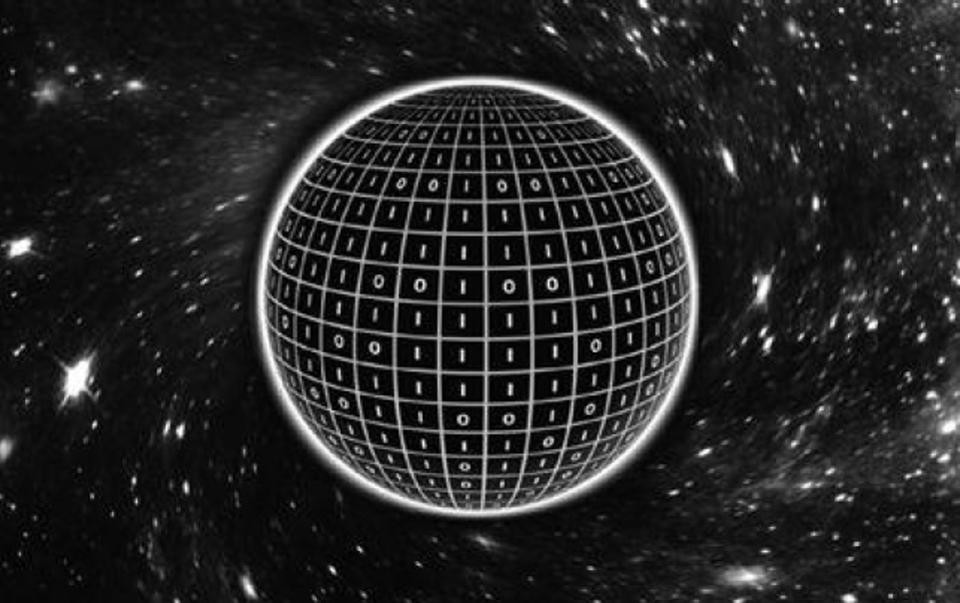
Our understanding of gravitation isn’t complete; we haven’t reached an understanding that’s compatible with notions like “absolute truth” or a fully accurate, comprehensive, and complete picture of reality. Yes, masses at the surface of Earth accelerate downward at 9.8 m/s², but that won’t explain everything. If we ask the right questions or perform the right observations or experiments, we can find where and how this description of reality is no longer a good approximation of the truth, and identify where it breaks down.
Newton’s laws can explain the acceleration due to gravity at Earth’s surface and more, accounting for all the observed phenomena of objects near Earth’s surface as well as many others, but it, too, isn’t complete. We can find observations and experiments that show us where Newton, too, is insufficient.
Even replacing Newton’s laws with Einstein’s general relativity leads to the same story: Einstein’s theory can successfully explain everything that Newton’s can, plus additional phenomena. Some of those phenomena were already known when Einstein was constructing his theory; others had not yet been tested or even thought up. However, we can be certain that even Einstein’s greatest accomplishment will someday be superseded. When it does, we fully expect it will happen in exactly the same way: by probing a regime where general relativity’s predictions don’t match up with what we observe and measure reality to be.
Science is not, despite the claims of many, about finding the absolute truth of the Universe. No matter how much we’d like to know what the fundamental nature of reality is, from the smallest subatomic scales and below to the largest cosmic ones and beyond, this is not something science can deliver. All of our scientific truths are only ever provisional, and we must recognize that they merely represent our best models for currently approximating our observed, shared reality.
Even the most successful scientific theories imaginable will, by their very nature, have a limited range of validity over which they apply. However, we are free to theorize whatever we like, and to let our imaginations run wild when it comes to concocting potential scenarios for a scientific revolution. After all, whenever a new theory meets the following three criteria:
- it achieves all of the successes of the prevailing, pre-existing theory,
- it succeeds where the current theory is known to fail or be insufficient,
- and it makes novel predictions for up-to-that-point unmeasured phenomena, distinct from the prior theory, that then wind up passing the critical observational or experimental tests,
it will supersede the current one as our best approximation of a scientific truth. When all three of these conditions are met, a scientific revolution is all but inevitable.

All of our currently held “scientific truths,” from the Standard Model of elementary particles to the Big Bang to dark matter and dark energy to cosmic inflation and beyond, are only provisional. They are hailed as truths today because they describe the Universe extremely accurately, succeeding even in regimes where all prior frameworks have failed. Yet, they all have limitations to how far we can take their implications before we arrive at a place where their predictions are no longer sensible, or will wind up no longer describing reality. What we might call a “scientific truth” is not an absolute truth, but rather only an approximate, provisional one, albeit the best one for describing reality at the current time.
Moreover, there is no such thing as an experiment that can ever prove that a scientific theory is true; that’s not how science works. We can only demonstrate that a theory’s range of validity either can be extended to cover previously untested ground, or that it fails to extend into whatever regime we’re newly testing it in. The failure of a theory to give predictions that match observations is actually the ultimate scientific success: an opportunity to find an even better scientific truth to approximate reality. As legendary physicist Enrico Fermi put it,
“There are two possible outcomes: If the result confirms the hypothesis, then you’ve made a measurement. If the result is contrary to the hypothesis, then you’ve made a discovery.”
Whenever we discover that our current understanding is insufficient to explain all that’s out there, yes, it means that science was wrong. That’s not a failure of science, however, it’s being wrong in the best way imaginable: in a way that can only lead to a superior scientific framework, and a better answer to the scientific question of the truths of our shared physical reality.
This article was first published in August of 2022. It was updated in December of 2025.

The Energy Transition