




















Search
Astrophysics

Many facts are well-known to professionals, but are unappreciated or even rejected outright by the public. "How stars work" takes the cake.

The famous framework ranks civilizations by energy use — but ignores a critical factor that can halt their progress.

On cosmic scales, only dark matter (or something equivalent) gives us the Universe we observe. Now, the Sunyaev-Zel'dovich effect agrees.

Although a star's "birth" is well-defined, it doesn't correspond to an ignition event in its core. Here's how stars are actually born.

One parameter, alone, sets the dividing line between rocky planets, gas giants, brown dwarfs, stars, and much more. Here's why mass matters.

By looking at a giant, remarkable, edge-on protoplanetary system, astronomers have found a proto-protoplanet for the first time.

Human beings have now traveled farther from Earth than ever before with Artemis II's flyby of the lunar far side. Here's how it happened.

Known as the "past hypothesis" problem, the Universe's initially low entropy has long puzzled scientists. Now, cosmic inflation solves it.

The 1st generation of stars formed, lived, and died very early on. But 2nd generation stars could still persist today. Did we just find one?

As humanity journeys to the Moon for the first time since 1972, can we rediscover our shared responsibilities: to the world and each other?
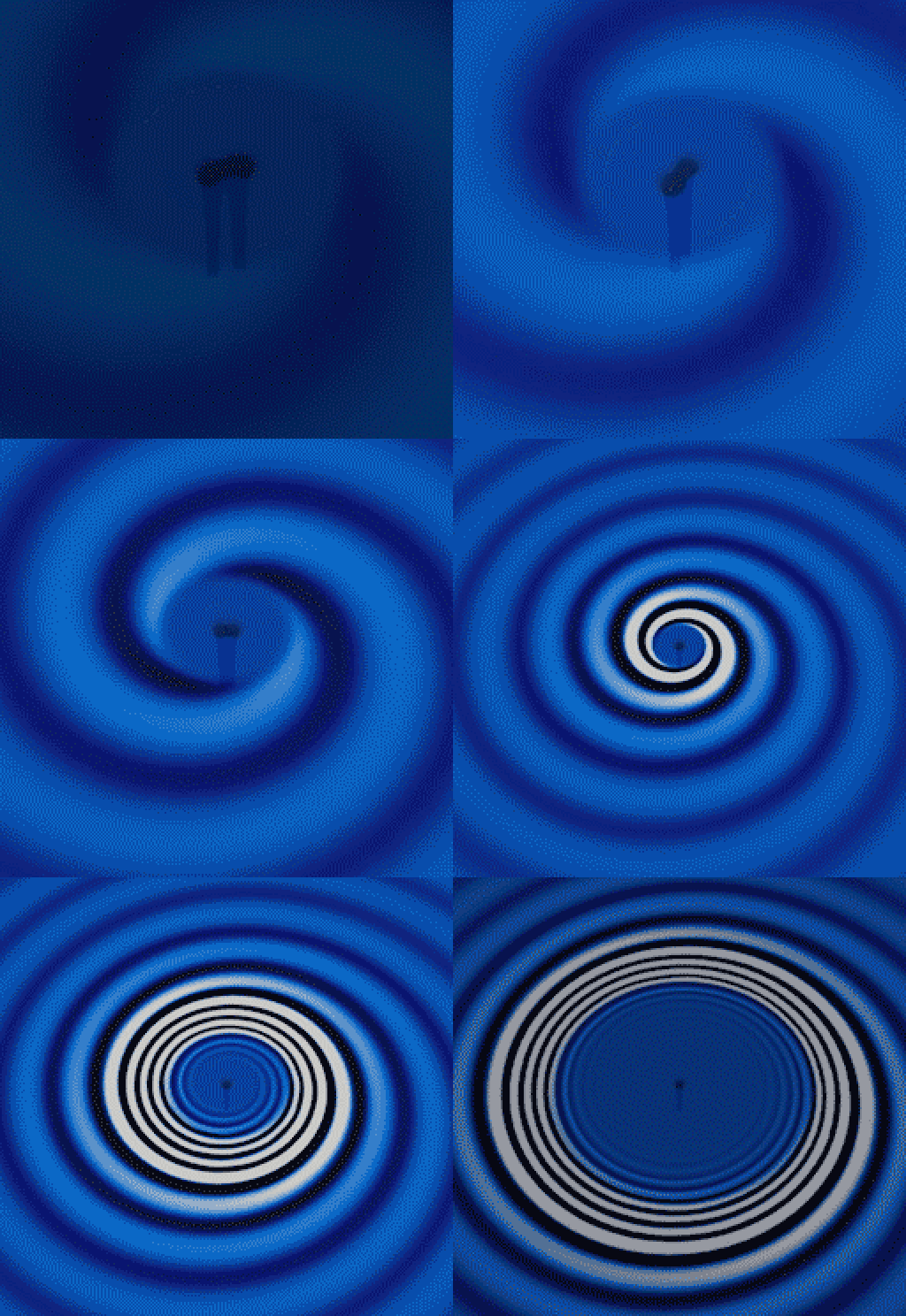
As light travels across the Universe, it's subject to cosmic expansion, changing fields, and relative motion. How about gravitational waves?

Even though no human has stepped foot on the Moon's surface in 50 years, the evidence of our presence there remains unambiguous.

In a 13.8 billion year old Universe, a few seconds hardly seems like it matters. But these minuscule changes sure do add up over time.

Most massive galaxies are spiral or elliptical shaped. But peculiar galaxies showcase the beautiful violence that helps explain our cosmos.

Early on, the Universe needed near-perfect flatness, or atoms, stars, and galaxies couldn't form. What happens once dark energy takes over?
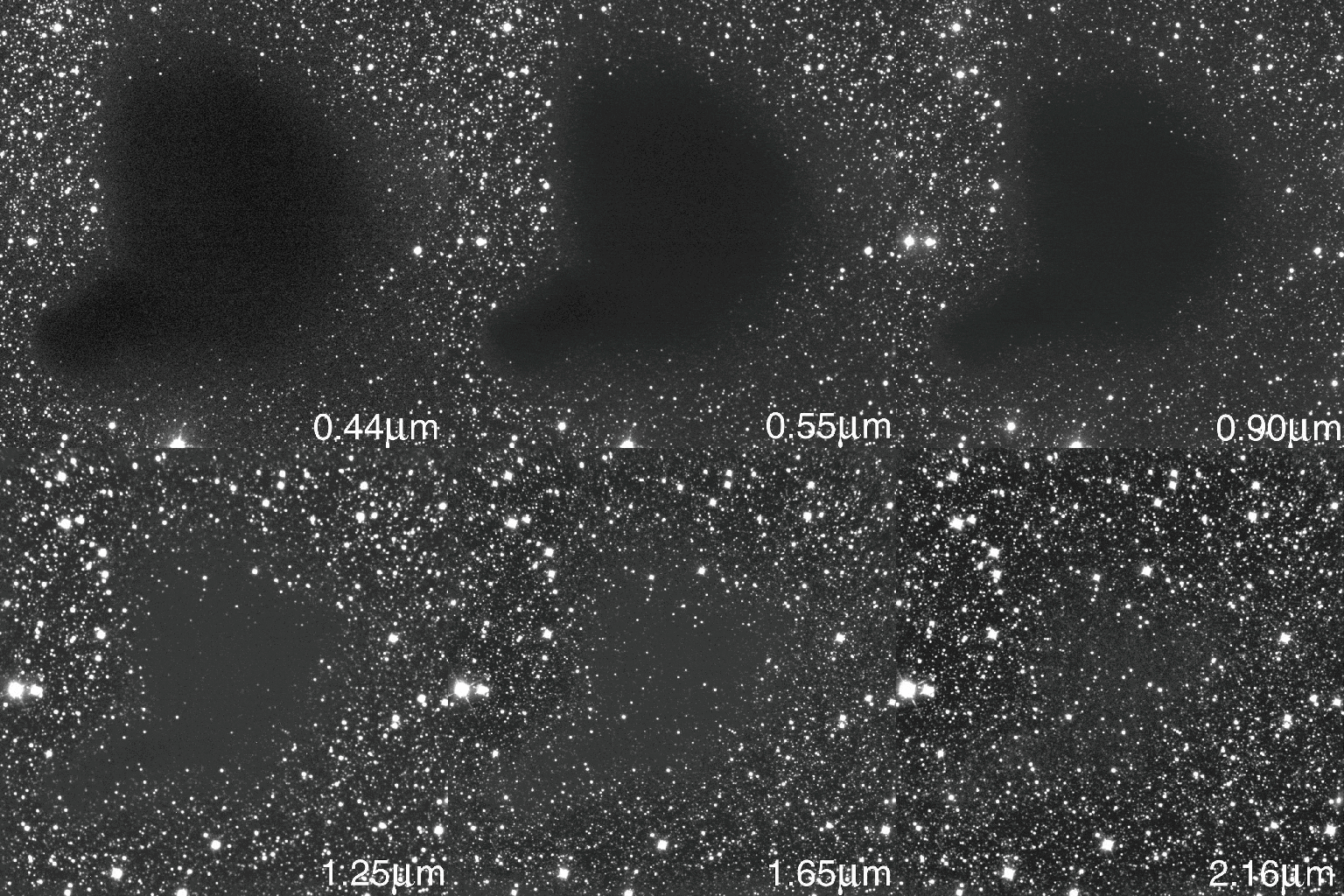
The image you're seeing isn't a hole in the Universe, and the cosmic voids that do exist aren't hole-like at all.

1hr 16mins
NASA astronomer Michelle Thaller makes the case that quantum entanglement may be the underlying fabric from which spacetime itself emerges.

Looking up at the night sky gives us a glimpse of the Universe beyond our terrestrial concerns. Here's the science of what's out there.

No matter what physical system we consider, nature always obeys the same fundamental laws. Must it be this way, and if so, why?

When what we predict and what we measure don't add up, that's a sign there's something new to learn. Could it be a new fundamental force?

In theory, the fabric of space could have been curved in any way imaginable. So why is the Universe flat when we measure it?

Binary black holes eventually inspiral and merge. That's why the OJ 287 system is destined for the most energetic event in history.

Over billions of years, fewer stars form, galaxies mutually recede, and the Universe becomes ever darker. Here's how fast it all happens.

Nothing lives forever, at least, not in the known Universe. But relativity allows us to get closer than ever: from a physics perspective.

The path to exploring the high-energy Universe was clear and compelling. Here's how 2025's cuts are still causing NASA casualties in 2026.

Resembling a cosmic brain, the Exposed Cranium Nebula instead shows a dying, massive star, as JWST reveals. Its fate remains uncertain.

In traveling through the expanding Universe, particles slow down while light and gravitational waves redshift. What degrades and what won't?

The discovery of CDG-2, a galaxy that's more than 99.9% dark matter, could reveal a new population of ultra-faint galaxies. But is it real?

No human has ever left the Solar System, and only six already-launched spacecraft will ever exit it. Will Voyager 1 remain the most distant?

Quantum entanglement links information between particles across space and time. So what happens when one of them falls into a black hole?