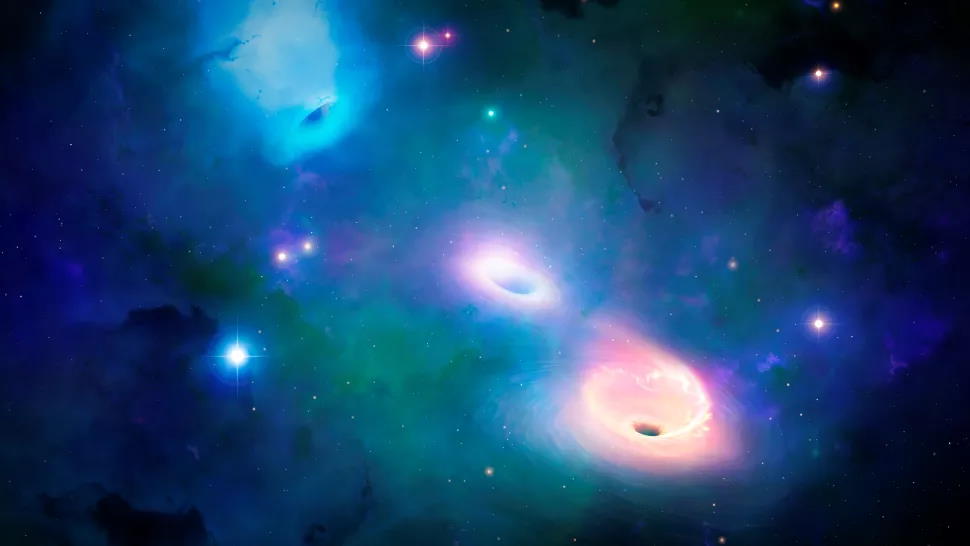
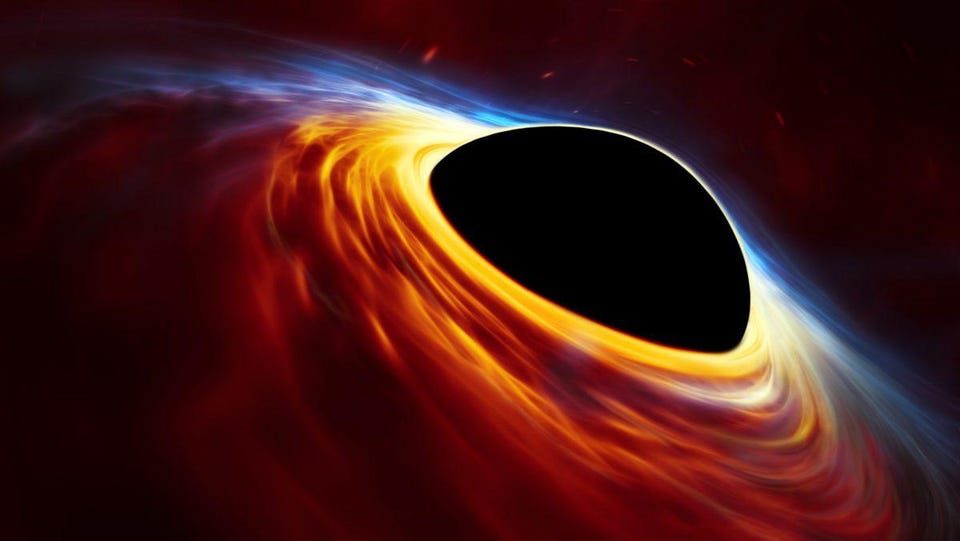
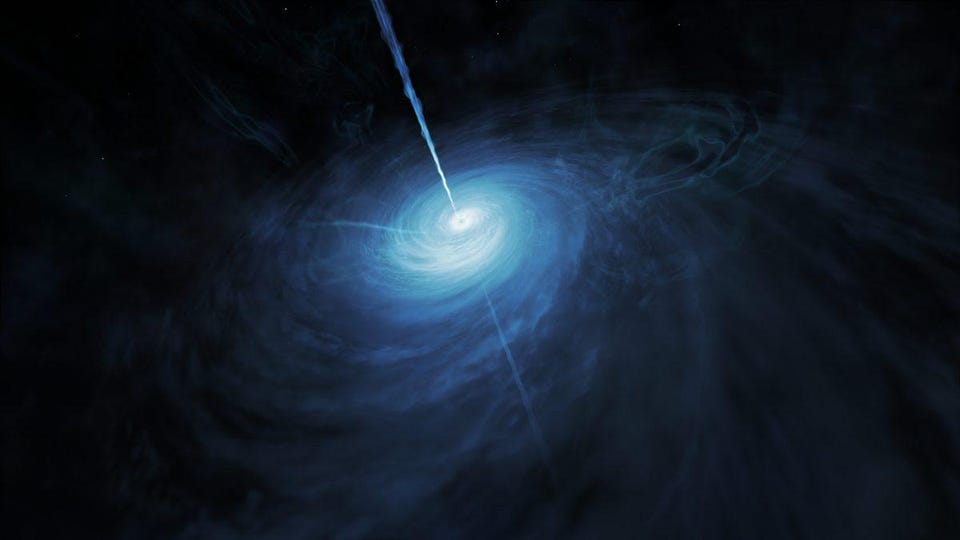
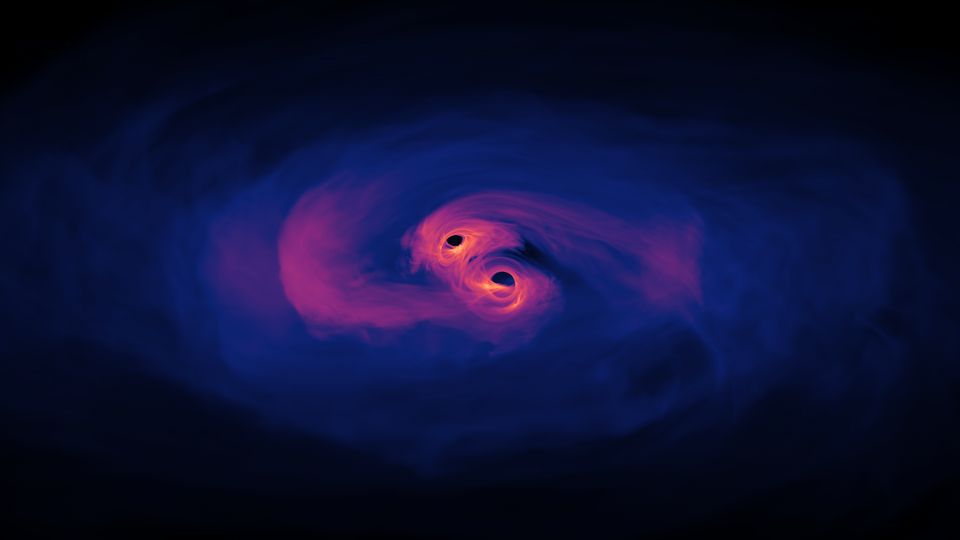
Although most galaxies have only a single supermassive black hole at their centers, some galaxies have two: a binary supermassive black hole. When these black holes inspiral and merge, they represent the most energetic events to occur in our cosmos since the Big Bang, and can outshine all the stars in the sky, combined, by a factor of many millions.
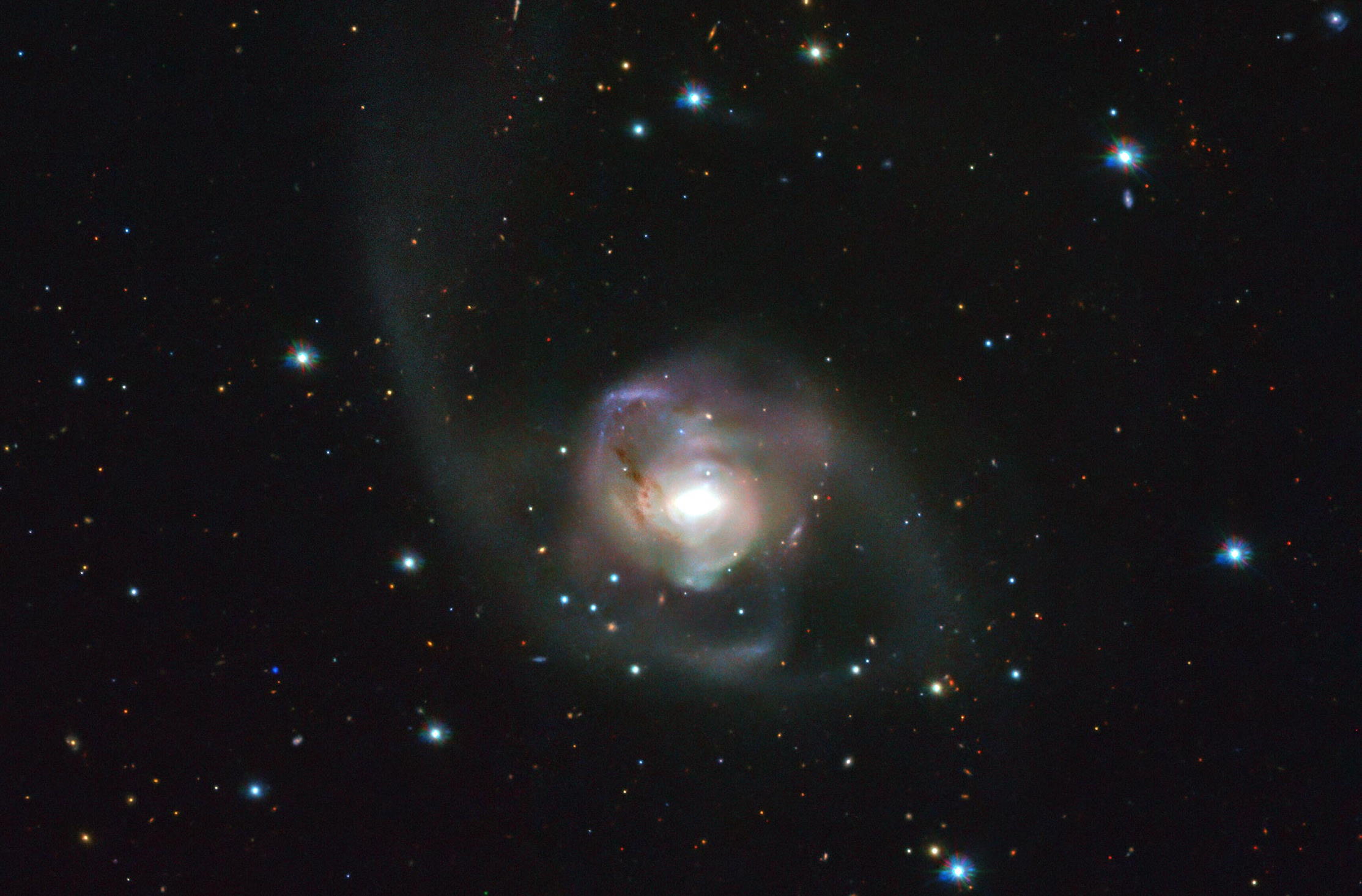
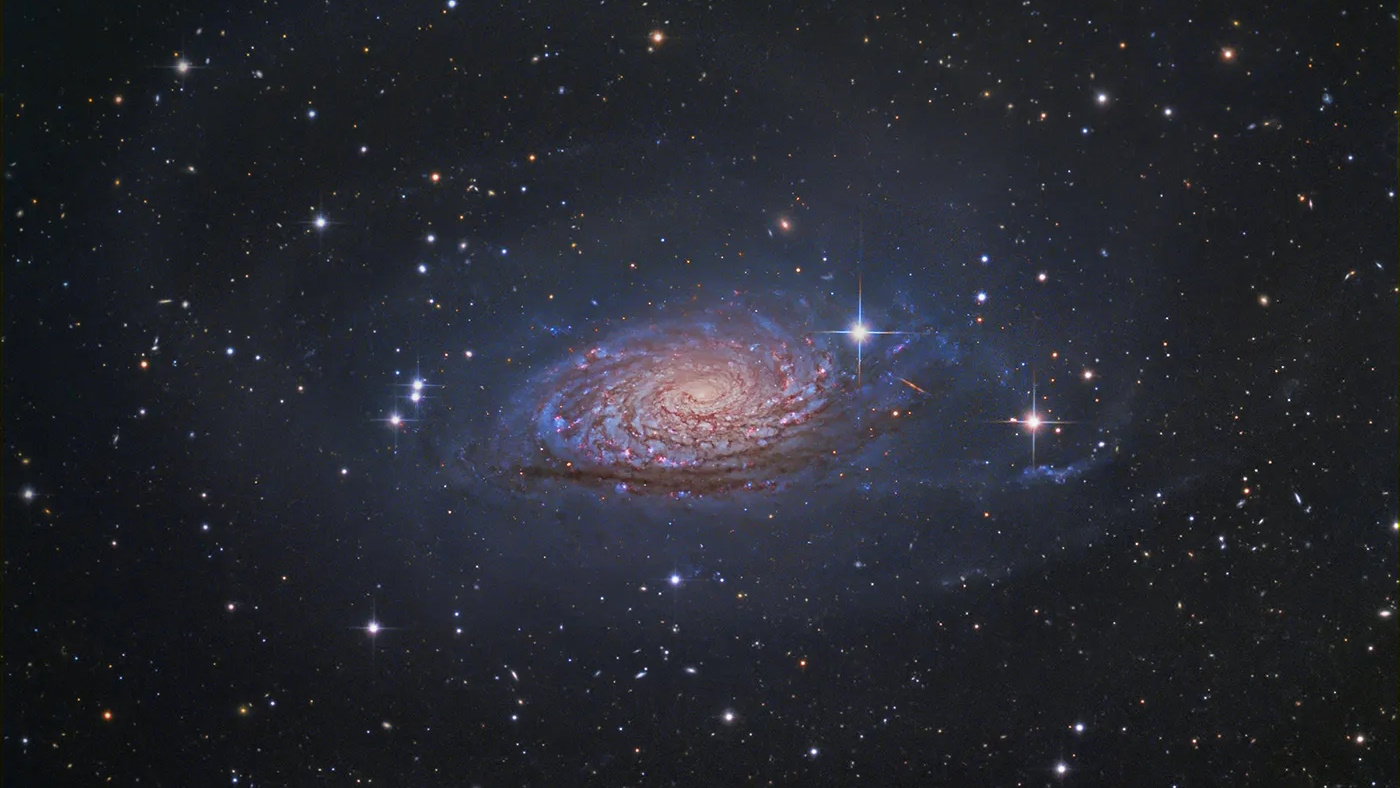
The galaxy NGC 7727 shows extended spiral arms: likely the aftermath of a recent major merger between two comparably massive galaxies. The presence of two supermassive black holes inside this galaxy, as well as the extended streams of gas and stars, show one possible outcome of a major merger of two similar-mass, initially gas-rich galaxies.
Credit: ESO/VST ATLAS team. Acknowledgment: Durham University/CASU/WFAU
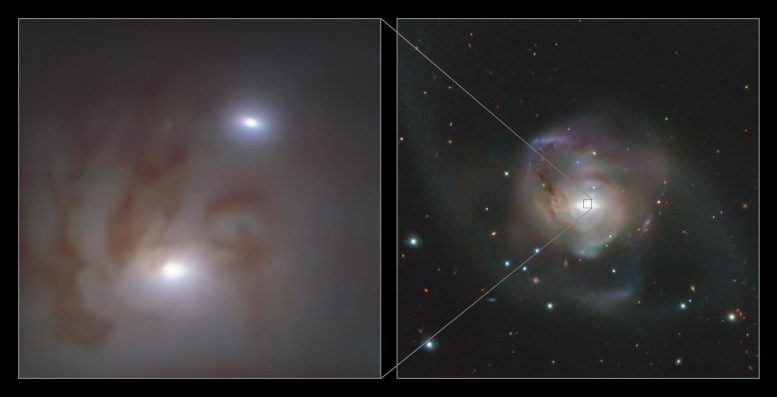
Just 89 million light-years away, these 154,000,000- and 6,300,000-solar-mass black holes are just 1,600 light-years apart.
A close-up (left) and wider-field (right) view of the central nucleus of the nearby galaxy NGC 7727. Just 89 million light-years away, it houses the closest pair of binary supermassive black holes known, with a separation of 1,600 light-years. While friction with the environment can lead supermassive black holes to closely approach one another, the final stages of an inspiral and merger should come due to gravitational wave emission. Binary supermassive black holes are fairly common at the centers of galaxies, representing about 1-in-1000 galactic systems.
Credit: ESO/Voggel et al.; ESO/VST ATLAS team. Acknowledgment: Durham University/CASU/WFAU
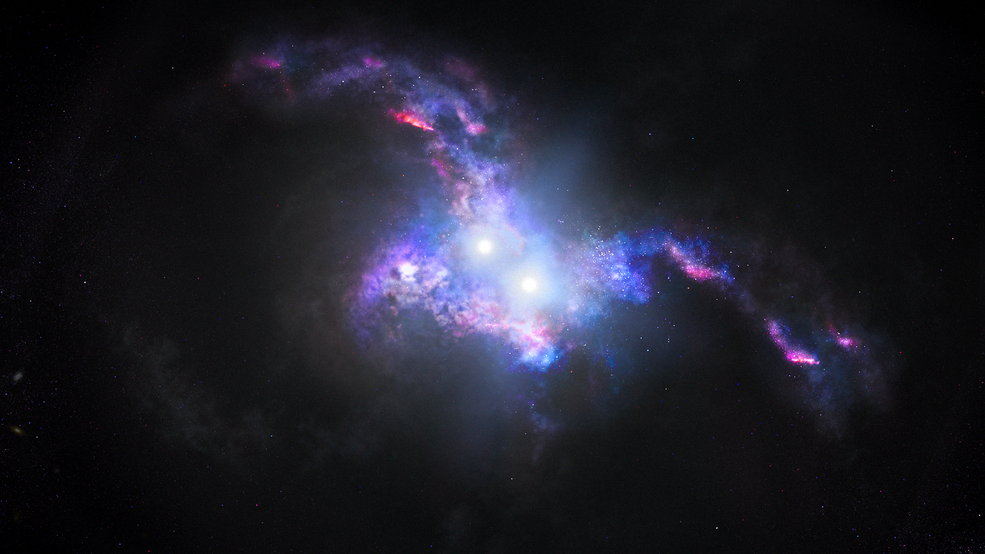
We’ve also discovered pairs of “double quasars,” with two supermassive black holes each.
These two quasar pairs don’t possess a single supermassive black hole at the core of each, but rather two supermassive black holes separated by about 10,000 light-years apiece. The multiwavelength emission properties of these objects are required for unveiling the physical processes occurring inside. The merger timescale for black holes was calculated to be under one billion years, even for such a large initial separation.
Credit: NASA, ESA, H. Hwang and N. Zakamska (Johns Hopkins University), and Y. Shen (University of Illinois, Urbana-Champaign)
Approximately 0.1% of young quasars are expected to be doubles, with typical separations of ~10,000 light-years.
This artist’s conception shows the brilliant light of two quasars residing in the cores of two galaxies that are in the chaotic process of merging. Although most galaxies possess only a single supermassive black hole, binaries may be present in a substantial fraction of galaxies, particularly young, early galaxies.
This simulation shows the radiation emitted from a binary black hole system. Although we’ve detected many pairs of black holes through gravitational waves, they’re all restricted to black holes of ~200 solar masses or below. The supermassive ones remain out of reach until a longer baseline gravitational wave detector is established.
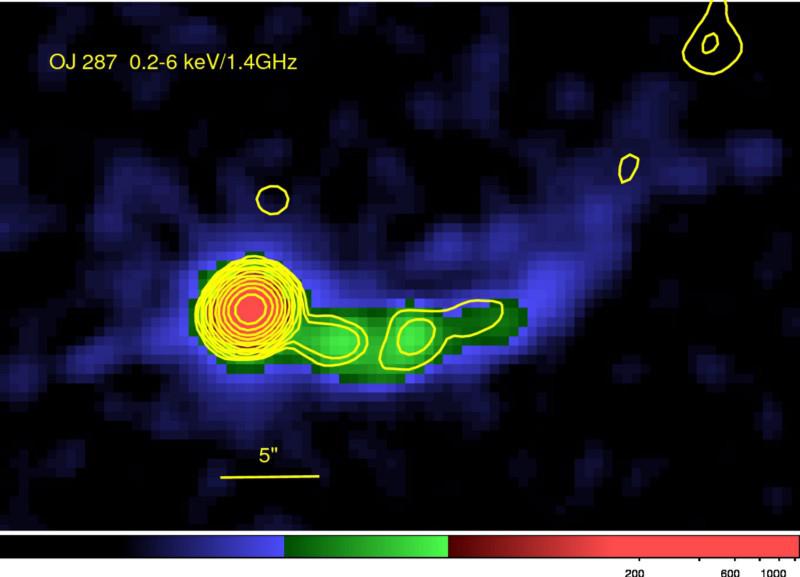
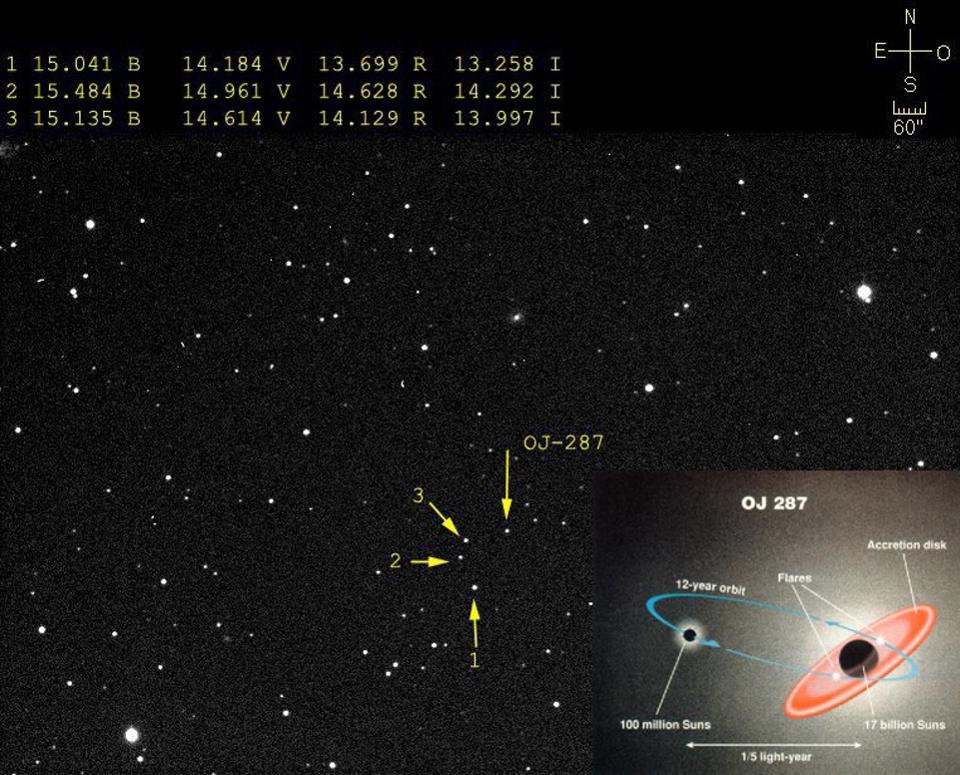
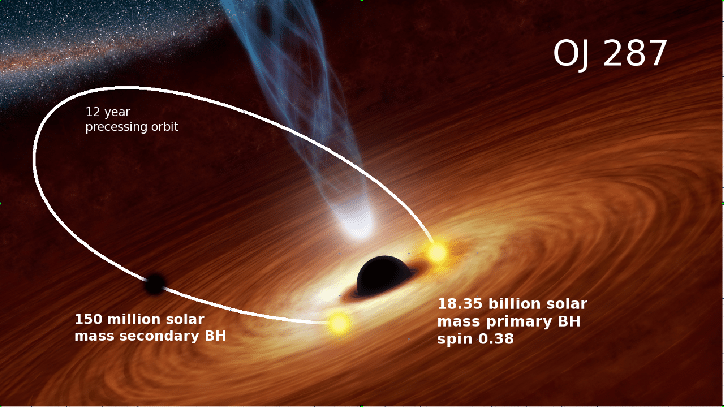
That’s OJ 287: still the most extreme supermassive binary, 3.5 billion light-years away.
An X-ray and radio composite of OJ 287 during one of its flaring phases. The ‘orbital trail’ that you see in both views is a hint of the secondary black hole’s motion. This system is a binary supermassive system, where one component is approximately 18 billion solar masses and the other is 150 million solar masses. When they merge, they may emit as much energy, albeit in the form of gravitational waves, as was found in the most energetically-injected galaxy cluster.
Credit: A.P. Marscher & S. G. Jorstad, ApJ, 2011; NASA/Chandra and Very Large Array
First spotted in 1887, it flares with a double burst every 12 years.
The most massive pair of black holes in the known Universe is OJ 287, whose gravitational waves will be so long in wavelength that they’ll even be out of reach of LISA. A longer-baseline gravitational wave observatory could see it, as could, potentially, a sufficiently precise pulsar timing array. Although OJ 287 was first imaged in 1887, its nature and distance were not determined until the 1960s.
Its main black hole is enormous: 18.35 billion solar masses.
We typically measure black holes in solar masses, for stellar mass black holes, or in millions of solar masses, for supermassive ones. Only a few intermediate, or having in-between masses, black holes are known. Some black holes, like OJ 287, extend into the tens of billions of solar masses, making them the most massive individual objects found within our Universe.
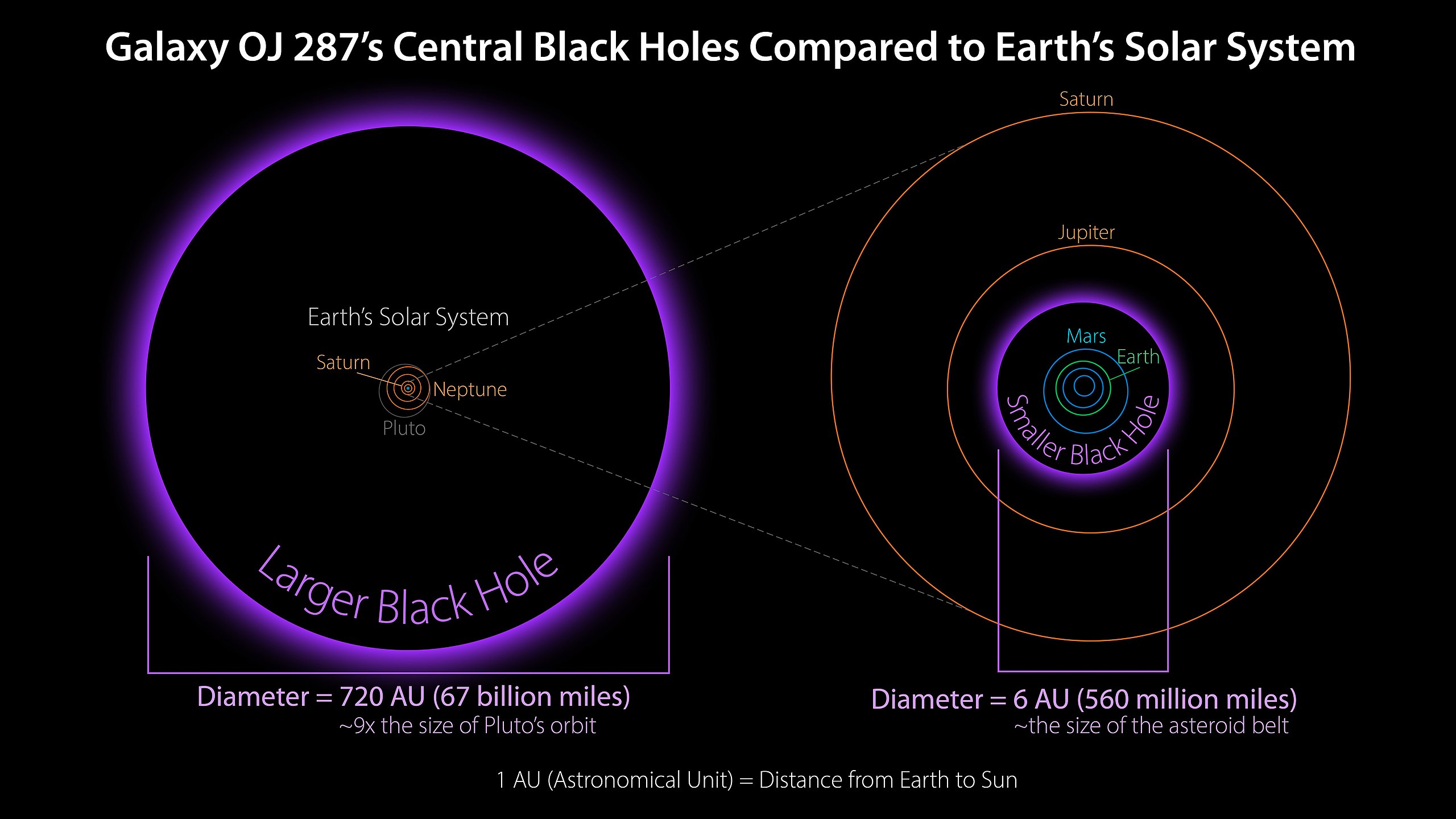
This diagram shows the relative sizes of the event horizons of the two supermassive black holes orbiting one another in the OJ 287 system. The larger one, of ~18 billion solar masses, is 12 times the size of Neptune’s orbit; the smaller, of 150 million solar masses, is about the size of the asteroid Ceres’s orbit around the Sun. The heaviest known black hole is only a few times more massive (and hence, a few times larger in radius) than OJ 287’s primary.
It also has a companion black hole of “merely” 150,000,000 solar masses.
When multiple black holes appear in the same vicinity as one another, they will interact with their environment via dynamical friction. As the matter gets either swallowed or expelled, the black holes become more tightly gravitationally bound. If the black holes are of unequal masses, the smaller one will lose more orbital energy than the larger one, and when they approach each other closely enough, their orbits will decay via the emission of gravitational waves before ultimately leading to a merger.
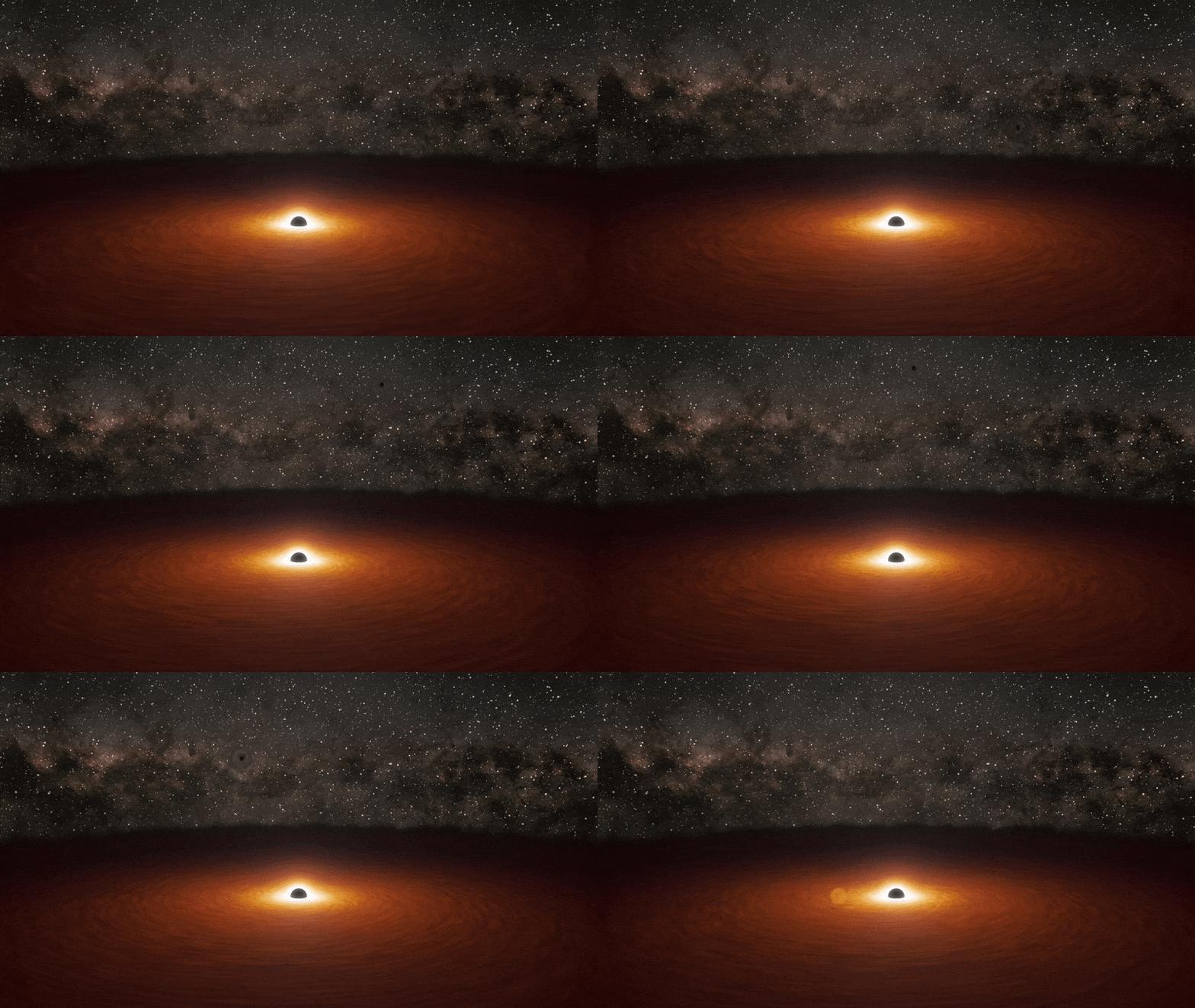
The periodic double burst arises when the smaller black hole punches through the larger’s accretion disk.
This animation shows a lower-mass black hole punching through the accretion disk generated around a larger supermassive black hole. When the smaller black hole crosses through the disk, a flare emerges. Over long enough timescales, these black holes will inspiral and merge, generating a tremendous gravitational wave signal in the process. This bursting “double flare” system is a prominent characteristic of OJ 287.
With a 12-year orbit, it varies from 0.05 to 0.28 light-years away from the primary.
The double peaks of the flare seen from OJ 287 is consistent with the smaller black hole punching through the larger’s accretion disk twice per orbit. The rate of the flaring, plus time-based changes in the flare’s orientation, are thoroughly predictable with Einstein’s general relativity alone.
Credit: L. Dey et al., Astrophysical Journal, 2018
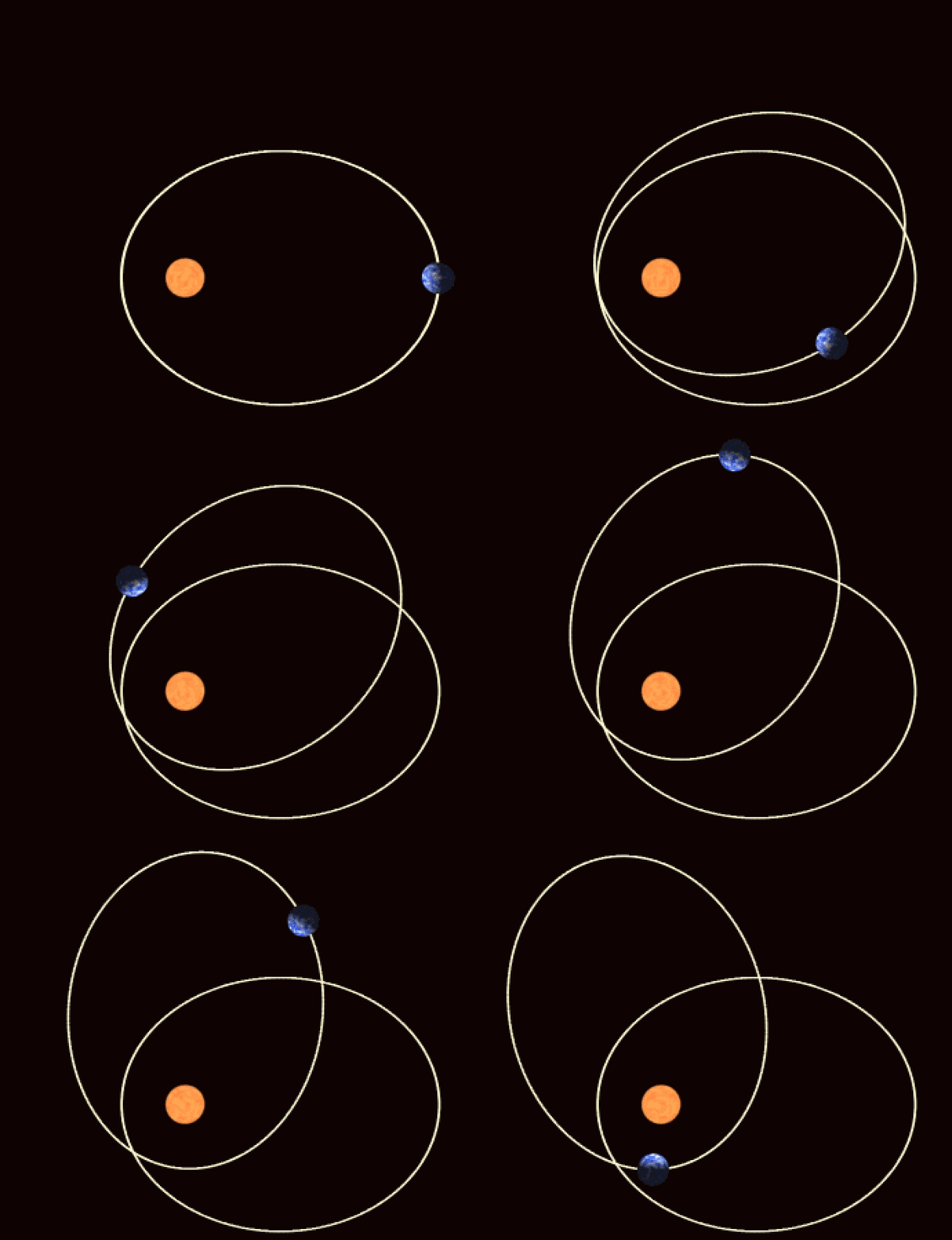
The secondary black hole precesses 39° with every orbit: a fantastic confirmation of general relativity’s predictions.
This illustration shows the precession of a planet’s orbit around the Sun. A very small amount of precession is due to general relativity in our Solar System; Mercury precesses by 43 arc-seconds per century, the greatest value of all our planets. OJ 287’s secondary black hole precesses by 39 degrees per orbit: the most severely precessing system known so far.
In only ~10,000 years, these behemoths should merge.
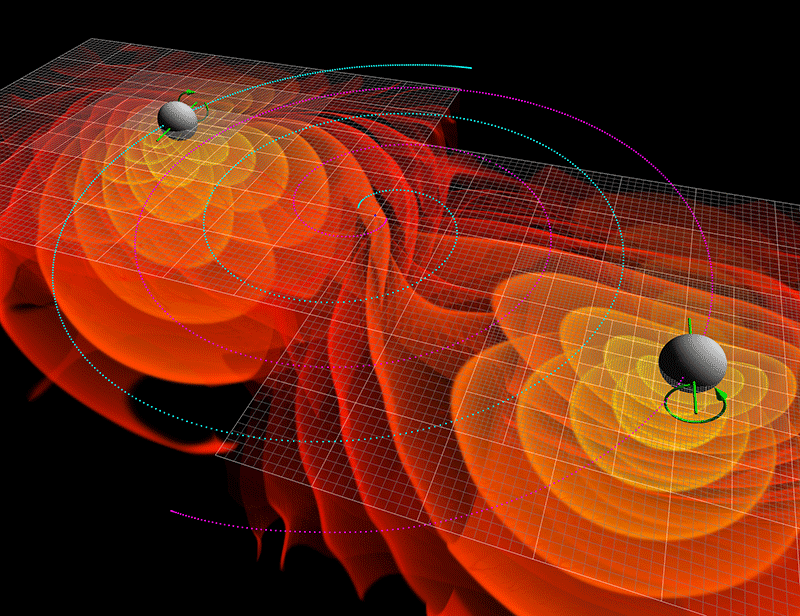
Numerical simulations of the gravitational waves emitted by the inspiral and merger of two black holes. The colored contours around each black hole represent the amplitude of the gravitational radiation; the blue lines represent the orbits of the black holes and the green arrows represent their spins. The physics of binary black hole mergers is mass-independent, with only the ratios of mass-to-distance mattering.
Hopefully, humanity will be watching when it happens.
With three equally spaced detectors in space connected by laser arms, periodic changes in their separation distance can reveal the passing of gravitational waves of appropriate wavelengths. LISA will be humanity’s first detector capable of detecting spacetime ripples from supermassive black holes, but only if it is completed, built, and launched: a scenario that’s in jeopardy here in 2026.
Credit: NASA/JPL-Caltech/NASAEA/ESA/CXC/STScl/GSFCSVS/S.Barke (CC BY 4.0)
Mostly Mute Monday tells an astronomical story in images, visuals, and no more than 200 words.This article was first published in December of 2021. It was updated in March of 2026.