




















Search
Astronomy

At the end of July, hundreds of scientists convened to plan NASA's upcoming astrophysics flagship mission. Will the US allow it to happen?

Two supermassive black holes on an inevitable death spiral push the limits of Einstein's relativity. New observations reveal even more.

Somewhere, at some point in the history of our Universe, life arose. We're evidence of that here on Earth, but many big puzzles remain.

Even just by examining the Moon with the unaided eye, we can learn an incredible amount about the Moon, Earth, and more.

When the Hubble Space Telescope first launched in 1990, there was so much we didn't know. Here's how far we've come.
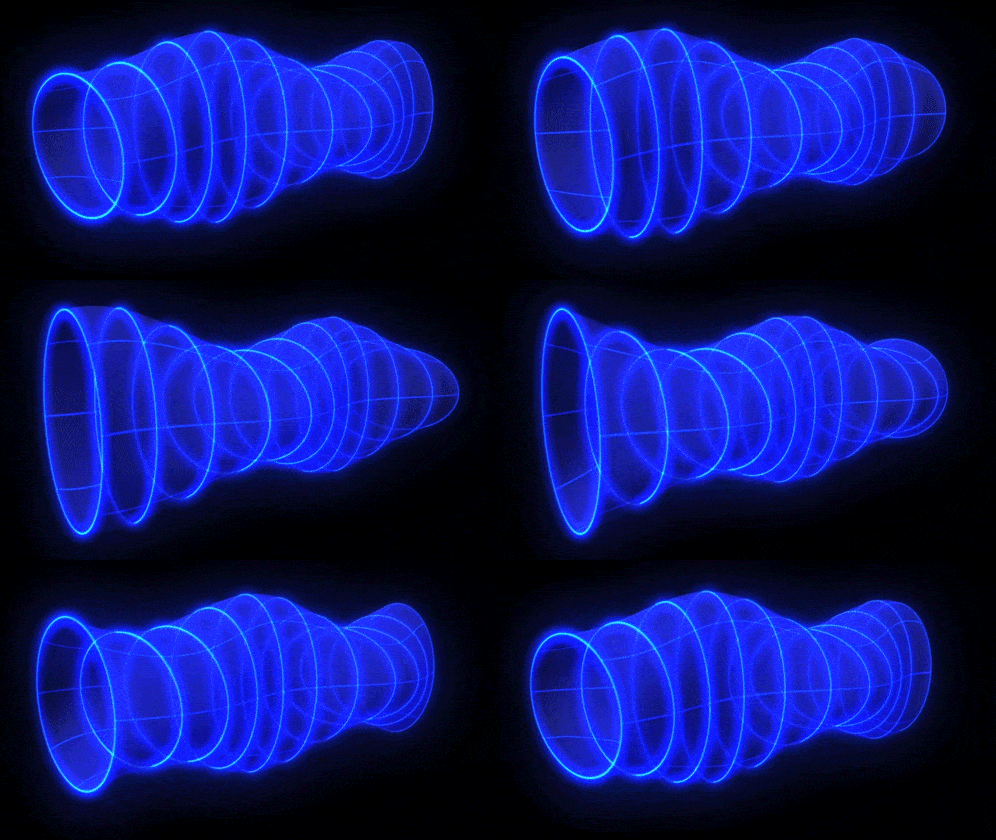
With over 300 high-significance gravitational wave detections, we now have a huge unsolved puzzle. Will we invest in finding the solution?

13mins
"We've sent out one or two little messages, but we certainly aren't investing billions of dollars shouting out into the cosmos saying, "Hey, we are here. Come say hi.""

65 million years ago, a massive asteroid struck Earth. Not only did Jupiter not stop it, but it most likely caused the impact itself.

First 'Oumuamua, then Borisov, and now ATLAS have shown us that interstellar interlopers are real. Here's what the newest one teaches us.

Our nearby Ring Nebula, with JWST's eyes, shows evidence for planet formation. Will the Sun eventually destroy, and then replace, the Earth?

The relic signal that first proved the Big Bang has been known and analyzed for 60 years. Join us at the frontiers of modern cosmology!

Once every 12 years, Earth, Jupiter, Uranus, and Neptune all line up, opening a window for a joint mission. Our next chance arrives in 2034.

Over the first half of 2025, the US has cut science as never before. This disaster for American science may be a gift to the rest of the world.

Originally, the abundance of bright, early galaxies shocked astronomers. After 3 years of JWST, we now know what's really going on.

Looking at a dark, night sky has filled humans with a sense of awe and wonder since prehistoric times. But appearances can be deceiving.

In just its first 10 hours of observations, the Vera Rubin observatory discovered more than 2000 new asteroids. What else will it teach us?

For hundreds of millions of years, a cosmic fog blocked all signs of starlight. At last, JWST found the galaxies that cleared that fog away.

As the closest icy ocean world to
Earth, Ceres may be a promising candidate in the search for signs of ancient life.

Is the Universe's expansion rate 67 km/s/Mpc, 73 km/s/Mpc, or somewhere in between? The Hubble tension is real and not so easy to resolve.

Different methods of measuring the Universe's expansion rate yield high-precision, incompatible answers. But is the problem robustly real?
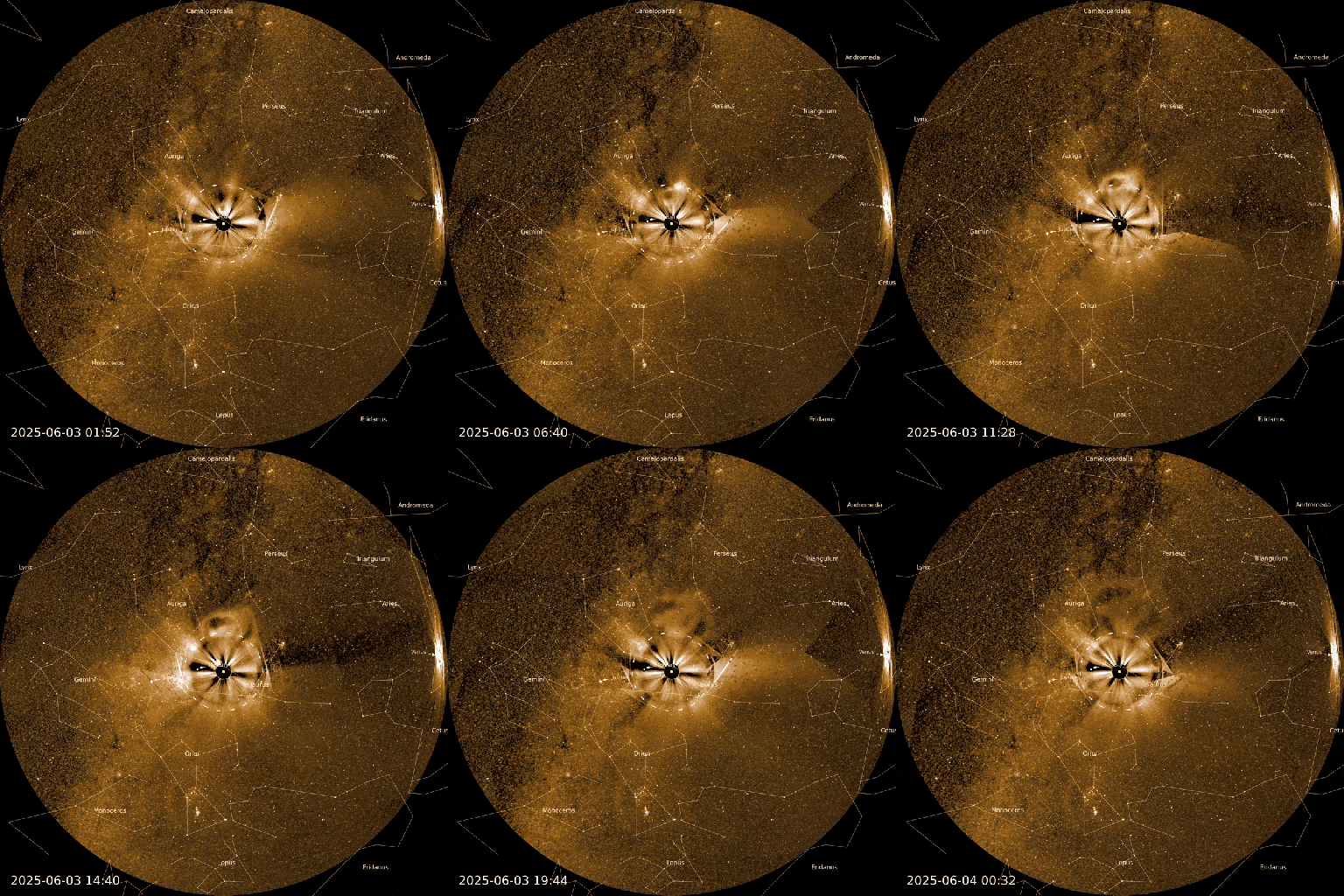
Launched in March, the PUNCH mission has viewed two incredible coronal mass ejections, tracking them farther from the Sun than ever before.

The tiniest galaxies of all are the most severely dominated by dark matter. Could black holes be the cause of the extra gravity instead?

Viewing Uranus's largest moons with Hubble, astronomers hoped to find darkening on the trailing side. They found the exact opposite instead.

On Earth, our particle accelerators can reach tera-electron-volt (TeV) energies. Particles from space are thousands of times as energetic.

The first galaxies were irregular blobs of gas and stars. But modern features, like spiral arms and bars, appeared earlier than expected.

The hunt for extraterrestrial life begins with planets like Earth. But our inhabited Earth once looked very different than Earth does today.

The COSMOS-Web has just finalized their release of their full field: larger and deeper than any other JWST program. Here's what's inside.

The Vera C. Rubin Observatory in Chile will image the southern sky using the largest digital camera ever built.

For decades, astronomers have claimed the Milky Way will merge with Andromeda in ~4 billion years. Here's why, in 2025, that seems unlikely.

"The stars made our minds, and now our minds look back."