




















Search
Astronomy

Astronomer Adam Frank asks: With so many extraordinary claims, why can't anybody produce the proof?

When we see pictures from Hubble or JWST, they show the Universe in a series of brilliant colors. But what do those colors really tell us?

The last naked-eye Milky Way supernova happened way back in 1604. With today's detectors, the next one could solve the dark matter mystery.

How did life on Earth begin? Is there life on other worlds? An answer to either question will reflect heavily on the other.
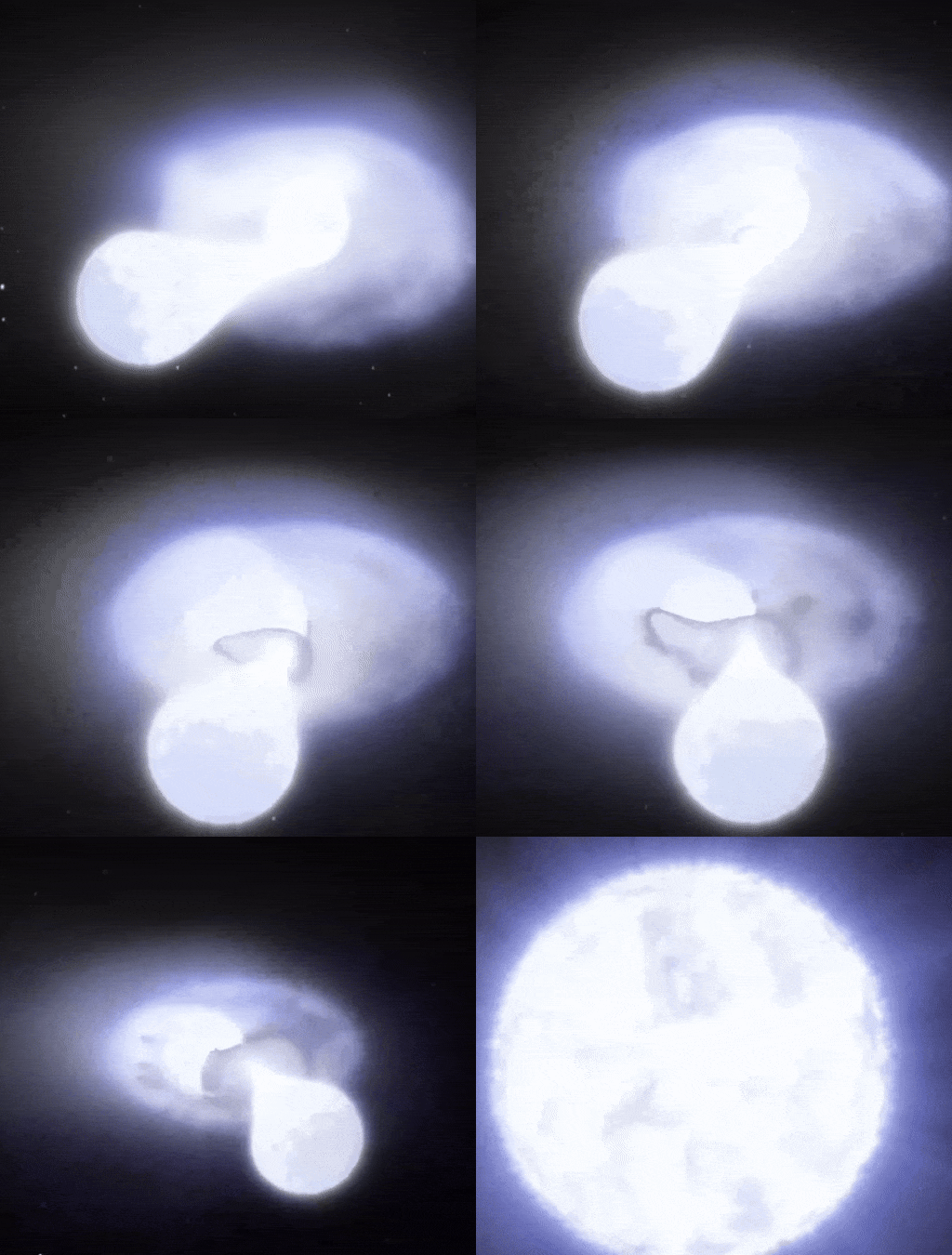
Since 1930, type Ia supernovae have been thought to arise from white dwarfs exceeding the Chandrasekhar mass limit. Here's why that's wrong.

The race to find dark matter could grow more complex with high-energy neutrino interference.

In astronomy, a star's initial mass determines its ultimate outcome in life. Unless, that is, a stellar companion alters the deal.

All the stars, stellar corpses, planets, and other large, massive objects take on spherical or spheroidal shapes. Why is that universal?

Why hasn’t matter fallen apart over billions of years? The mystery might start with protons.

The 5th brightest star in our night sky is young, blue, and apparently devoid of massive planets. New JWST observations deepen the mystery.

Mars and Earth were sister planets in many ways, with early similar conditions. Why did Mars die? The leading explanation isn't universal.

NASA's space telescopes and observatories bring humanity unrivaled science images and scientific discoveries. Here's what should be next.

In the year 1181, a "guest star" was recorded in the constellation of Cassiopeia. Its modern supernova remnant is weirder than we imagined.

What are dark matter and dark energy? The large-scale structure of the cosmos encodes them both, with ESA's Euclid mission leading the way.

The most common visual depictions of the history of the Universe show the Big Bang as a growing tube with an "ignition" point. Why is that?

Could life be widespread throughout the cosmos, in the subsurface oceans of ice-covered worlds? NASA's Europa Clipper mission investigates.

Caption:“At this time in Mars’ history, we think CO2 is everywhere, in every nook and cranny, and water percolating through the rocks is full of CO2 too,” Joshua Murray says.

An in-depth interview with astronomer Kelsey Johnson, whose new book, Into the Unknown, explores what remains unknown about the Universe.

There are a number of factors to consider when choosing where to build a telescope. These 3 locations, on their merits, surpass all others.

National Geographic's first James Webb Space Telescope book shows us the cosmos like never before.

The earliest Milky Way-like galaxy, REBELS-25, was spotted rotating about its axis. It's only 700 million years old: 5% of our present age.

Interferometry gave us a black hole's event horizon, but that was in the radio. What can we accomplish with a new optical interferometer?

Today, the deepest depths of intergalactic space aren't at absolute zero, but at a chill 2.73 K. How does that temperature change over time?

Physicists recently created Coordinated Lunar Time, a time zone for our Moon.
The Universe has been creating stars for nearly all 13.8 billion years of its history. But those photons can't match the Big Bang's light.

Comet A3, also known as Comet Tsuchinshan-ATLAS, has sprung to life since 2024's last equinox. Here's how to catch the show for yourself.

Scientists might be looking for Martian life in the wrong place.

The Parker Solar Probe is about to undergo its seventh encounter with Venus on its journey toward the Sun. Here's how fast it'll go.

Despite many ultra-distant galaxy candidates found with JWST, we still haven't seen anything from the Universe's first 250 million years.

Just 460 light-years away, the closest newborn protostars are forming in the Taurus molecular cloud. Here are JWST's astonishing insights.