
















Astrophysics

Astrophysics

Two glowing spheres, one red and one green, face each other in space with a wavy line of light—like a particle physics collision—connecting them against a speckled dark background reminiscent of the last collider’s discoveries.
Will we build a successor collider to the LHC? Someday, we'll reach the true limit of what experiments can probe. But that won't be the end.
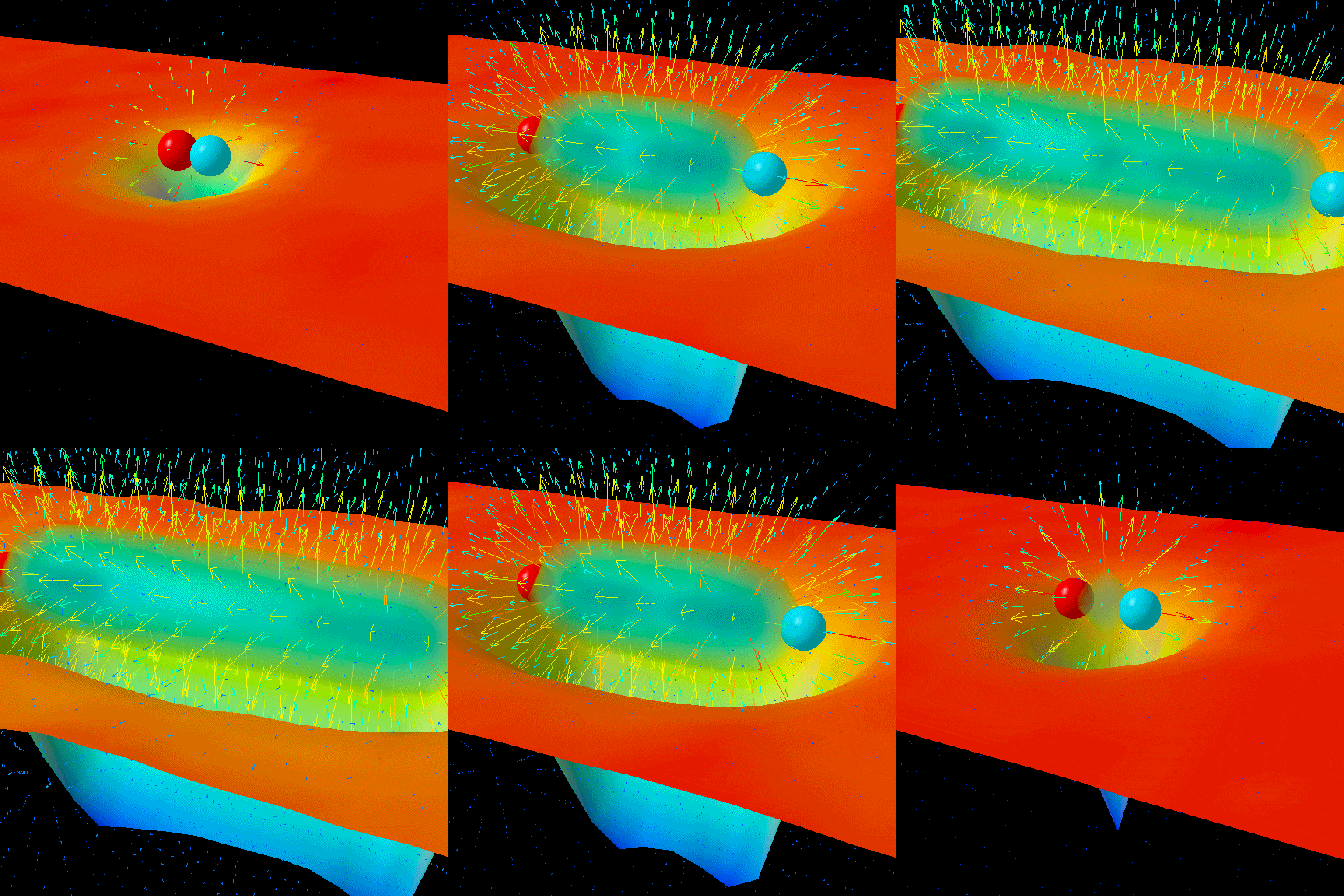
A visual simulation of two objects orbiting and merging, distorting a red-orange grid representing spacetime—illustrating gravitational waves once thought to be the worst prediction in science.
The measured value of the cosmological constant is 120 orders of magnitude smaller than what's predicted. How can this paradox be resolved?
comet collide with earth
65 million years ago, a massive asteroid struck Earth. Not only did Jupiter not stop it, but it most likely caused the impact itself.
Black and white image of a star field with one bright object in the center, indicated by a red arrow, believed to be the third interstellar object detected passing through our solar system.
First 'Oumuamua, then Borisov, and now ATLAS have shown us that interstellar interlopers are real. Here's what the newest one teaches us.
Side-by-side images of the Ring Nebula show its structure in different colors, each with a white dotted oval highlighting the central region.
Our nearby Ring Nebula, with JWST's eyes, shows evidence for planet formation. Will the Sun eventually destroy, and then replace, the Earth?
A crane lifts a large metal structure onto a white building at a construction site in a mountainous, arid area under clear blue sky.
The relic signal that first proved the Big Bang has been known and analyzed for 60 years. Join us at the frontiers of modern cosmology!
The CMB has long been considered the Big Bang's "smoking gun" evidence. But after what JWST saw, might it come from early galaxies instead?
Images show the planet Uranus. The left image highlights its bright rings, while the right image, captured by the James Webb Space Telescope, depicts surprising details of glowing rings and a cloudy atmosphere. Discover more wonders in our solar system with these stunning visuals.
Once every 12 years, Earth, Jupiter, Uranus, and Neptune all line up, opening a window for a joint mission. Our next chance arrives in 2034.
Infographic displays spacecraft names and missions around the Sun, planets, and moons, illustrating the current and planned science fleet exploring the Solar System.
Over the first half of 2025, the US has cut science as never before. This disaster for American science may be a gift to the rest of the world.
A dense field of distant galaxies and bright stars against a black background, as captured in a JWST early galaxies deep space telescope image.
Originally, the abundance of bright, early galaxies shocked astronomers. After 3 years of JWST, we now know what's really going on.
the night sky with stars and trees in the foreground.
Looking at a dark, night sky has filled humans with a sense of awe and wonder since prehistoric times. But appearances can be deceiving.
The Vera Rubin Observatory is situated on a rocky hilltop under a clear, star-filled night sky, with distant mountains and a bright planet visible on the horizon, inspiring astronomers to solve puzzles of the universe.
In just its first 10 hours of observations, the Vera Rubin observatory discovered more than 2000 new asteroids. What else will it teach us?
An image of a sphere with stars in it.
For over 50 years, it’s been the scientifically accepted theory describing the origin of the Universe. It’s time we all learned its truths.
A dense star field and distant galaxies with bright galaxy clusters and several white squares highlighting specific points in the image.
For hundreds of millions of years, a cosmic fog blocked all signs of starlight. At last, JWST found the galaxies that cleared that fog away.
A cratered, spherical celestial body with a bright spot on its surface floats in dark outer space dotted with stars.
As the closest icy ocean world to Earth, Ceres may be a promising candidate in the search for signs of ancient life.
Two side-by-side images of a galaxy cluster in space, captured by JWST, showcase numerous bright galaxies and stars on a dark background—highlighting one of the most extreme gravitational lens effects ever observed.
Massive galaxy cluster Abell S1063, 4.5 billion light-years away, bends and distorts the space nearby. Here's what a JWST deep field shows.
Infographic illustrating three steps to measure the Hubble Constant, showing Cepheid variable stars, supernovae, and galaxies at increasing distances with redshifted light—highlighting how these methods reveal that the hubble tension is real.
Is the Universe's expansion rate 67 km/s/Mpc, 73 km/s/Mpc, or somewhere in between? The Hubble tension is real and not so easy to resolve.
parallel universe
The ANITA experiment found cosmic rays shooting out of Antarctica. One interpretation claims "parallel Universes," but is that right?
A composite image showing a galaxy with red circles marking stars on the left and multicolored expanding rings with Earth on the right, all set against a grid background, illustrating concepts like Hubble tension studied by Wendy Freedman.
Different methods of measuring the Universe's expansion rate yield high-precision, incompatible answers. But is the problem robustly real?
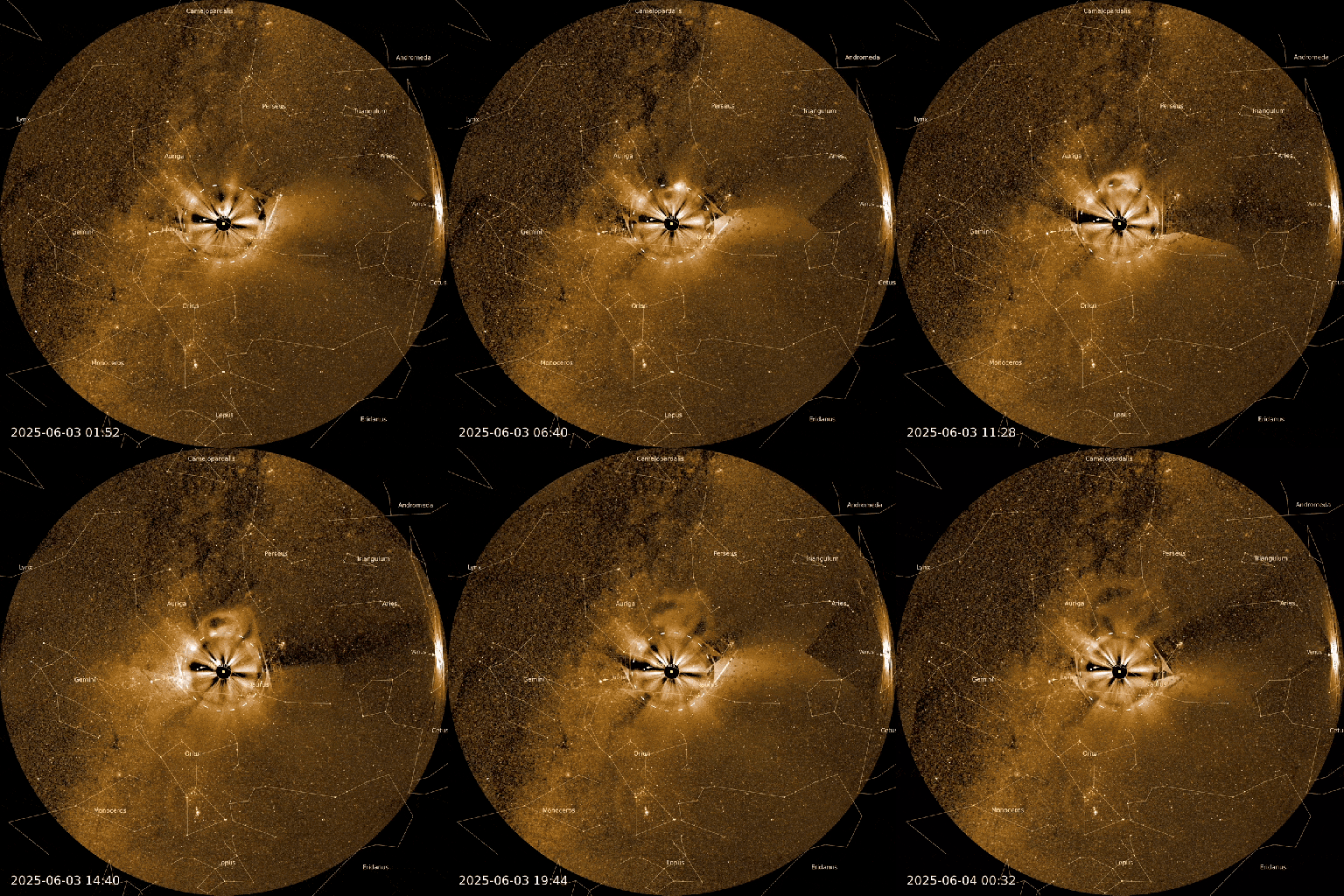
Circular astronomical image showing constellations and celestial objects labeled against a dark sky, reminiscent of a NASA PUNCH video sun corona visualization, with a timestamp of 2025-06-03 01:52 at the bottom left.
Launched in March, the PUNCH mission has viewed two incredible coronal mass ejections, tracking them farther from the Sun than ever before.
The tiniest galaxies of all are the most severely dominated by dark matter. Could black holes be the cause of the extra gravity instead?
A digital illustration showing a glowing blue particle on the left, evoking cosmic inflation, transitioning into a geometric, grid-like structure on a purple background on the right.
A few physical quantities, in all laboratory experiments, are always conserved: including energy. But for the entire Universe? Not so much.
Timeline of the universe from the Big Bang, as described in cosmology, showing inflation, formation of atoms, stars, galaxies, and expansion to the present day over 13.8 billion years.
If you want to understand the Universe, cosmologically, you just can't do it without the Friedmann equation. With it, the cosmos is yours.
A blue planet with visible rings and several small, bright Uranus moons is set against a darkened black background.
Viewing Uranus's largest moons with Hubble, astronomers hoped to find darkening on the trailing side. They found the exact opposite instead.
An illustration shows a cosmic ray entering Earth’s atmosphere, creating a cascade of secondary particles—some of the highest energy particles astronomers study—detected by an array of sensors on the ground.
On Earth, our particle accelerators can reach tera-electron-volt (TeV) energies. Particles from space are thousands of times as energetic.
Image of two large elliptical galaxies surrounded by several smaller, colorful galaxies and stars against a dark background in space.
The first galaxies were irregular blobs of gas and stars. But modern features, like spiral arms and bars, appeared earlier than expected.
A grey, icy planet or moon with surface cracks is shown against a backdrop of stars and the Milky Way galaxy.
The hunt for extraterrestrial life begins with planets like Earth. But our inhabited Earth once looked very different than Earth does today.
An artist's impression of a cluster of stars.
If the Universe is 13.8 billion years old today, but different ages the farther we look back, what does it mean for a star to be the first?
A split image shows a star field on the left and a COSMOS-Web survey area diagram on the right, with labeled NIRCam and MIRI footprints alongside the moon for scale, highlighting galaxies explored by JWST science.
The COSMOS-Web has just finalized their release of their full field: larger and deeper than any other JWST program. Here's what's inside.
Interior view of a large observatory telescope in operation at night, with orange light trails and a starry sky visible through the open roof.
The Vera C. Rubin Observatory in Chile will image the southern sky using the largest digital camera ever built.