
















Business

Business

Two scenes: Top shows climbers on an ice-covered terrain, embodying fun and success. Bottom captures an airplane in flight against a clear sky.
Fun in business is no laughing matter — it can create a golden strategic advantage and bring serious success in the long term.
A black and white portrait of a smiling man in a gray sweater is centered against a vibrant, abstract digital background with blue, purple, and green sections, evoking the essence of humanity striking back.
Mike Bechtel, chief futurist with Deloitte Consulting LLP, joins Big Think for a wide-ranging look at what’s next — and why.
Aerial view of a car parking with proximity sensors activated, showing red and green signals indicating object detection around the vehicle.
Why the road to self-driving vehicles is paved with smarter “dumb” cars.
A close-up of gloved hands handling a cryogenic storage device with straw container tubes inside, emitting visible vapor.
How technology could change everything we thought we knew about reproduction.
A labeled diagram of a human head's profile showcases areas of the brain related to career, self-esteem, conscientiousness, integrity, ambition, and more personality traits that help individuals work happy.
We spend over a third of our lives at work, yet the global workplace is often not a happy place. The solution may lie with our feelings of attachment.
A book open to a black and white photo of a steaming mug on the left page and a detailed, artistic portrait of an elderly person on the right page, capturing a sense of rival camaraderie through the contrasting images.
Why Bob Stiller — founder and former CEO of billion-dollar beverage company Green Mountain Coffee Roasters — believes shared learnings are a win-win.
Collage featuring a surfer, hands holding a Rubik's cube, and text "The Nightcrawler." Abstract elements include graphs, car parts, and a cityscape interwoven with life lessons.
Welcome to The Nightcrawler — a weekly newsletter from Eric Markowitz covering tech, innovation, and long-term thinking.
A pole with numerous traffic lights mounted in different directions creates an illusion of control against a clear sky background.
How to find the right balance between controlling teams and allowing them the agency to make mistakes — and learn from them.
Top image: Close-up of hands slicing a piece of raw meat with a knife, emphasizing precision akin to the longevity sought in business immortality. Bottom image: Close-up of two Zildjian cymbals of different sizes on a grid pattern background.
In a world of distractions, several remarkable companies show why focus is the ultimate strategy for endurance.
Open book with an image of a brain on the left page and a pencil eraser unlearning old marks on the right page.
By unlearning old leadership mindsets, cultures, and assumptions we can move from Industrial Age thinking to Intelligence Age thinking.
Film strip collage of abstract images—including faces with X marks, colorful patterns, and nature elements—evokes the vibrant allure of "Crazy Rich Asians.
"No matter how long you’ve been doing a job or how good people say you are, you need to care as if you’ve never done it before."
A group of vintage uniformed men, some wearing helmets, appear startled or curious while standing in what seems to be an office setting. The man on the left is speaking into a telephone, possibly exemplifying the Peter Principle as he manages the unexpected situation.
Why would someone who has spent their entire career following orders become a great leader overnight?
Collage with baseball trading cards and photos of people, overlaid with a line graph and titled "The Nightcrawler." The piece seems to be in founder mode, capturing the essence of pioneering moments. Background features a grid pattern.
Welcome to The Nightcrawler — a weekly newsletter from Eric Markowitz covering tech, innovation, and long-term thinking.
A collage of clock faces—one depicting cavemen, another showing hands typing on a laptop, and a blank clock—symbolizes the hyperefficient evolution of work over time.
These practical strategies can help you conquer burnout and achieve a state of calm and focused productivity.
A high-rise office building at night with one illuminated corner office visible amidst the darkened windows, a lone workaholic burning the midnight oil.
In a major shift, psychologists now view an out-of-control compulsion to work as an addiction with its own set of risk factors and consequences.
A close-up view of a computer graphics card featuring an array of components, including capacitors, resistors, and a central processing chip, all mounted on a black circuit board.
Just eight of Etched’s Sohu chips could replace 160 Nvidia GPUs.
A montage of famous philosophers’ portraits next to a large question mark on the right, intersected by a horizontal arrow.
Philosophy cures no disease and invents nothing new. What's even the point?
A hand holds a tablet displaying a fluctuating green stock market graph, capturing the attention of day traders with its dynamic curves and axis lines in the background.
Gary Vaynerchuk, CEO of VaynerMedia, explains how to find branding success by making "boulders" out of "pebbles."
A silhouette of a person using a metal detector merges seamlessly with a large, centered image of JFK's face against a gradient blue background, symbolizing leadership and discovery.
Most leaders get the psychology of human motivation all wrong — here’s how a presidential encounter with a leaf-sweeper puts it right.
Abstract image featuring a blue-toned sphere with grid patterns above an orange-toned depiction of a cyclist amidst technical drawings, evoking the principle of golden marginal gains.
For extraordinary long-term success in business we can look to insights from British Olympic cycling, Roger Federer and neuroeconomics.
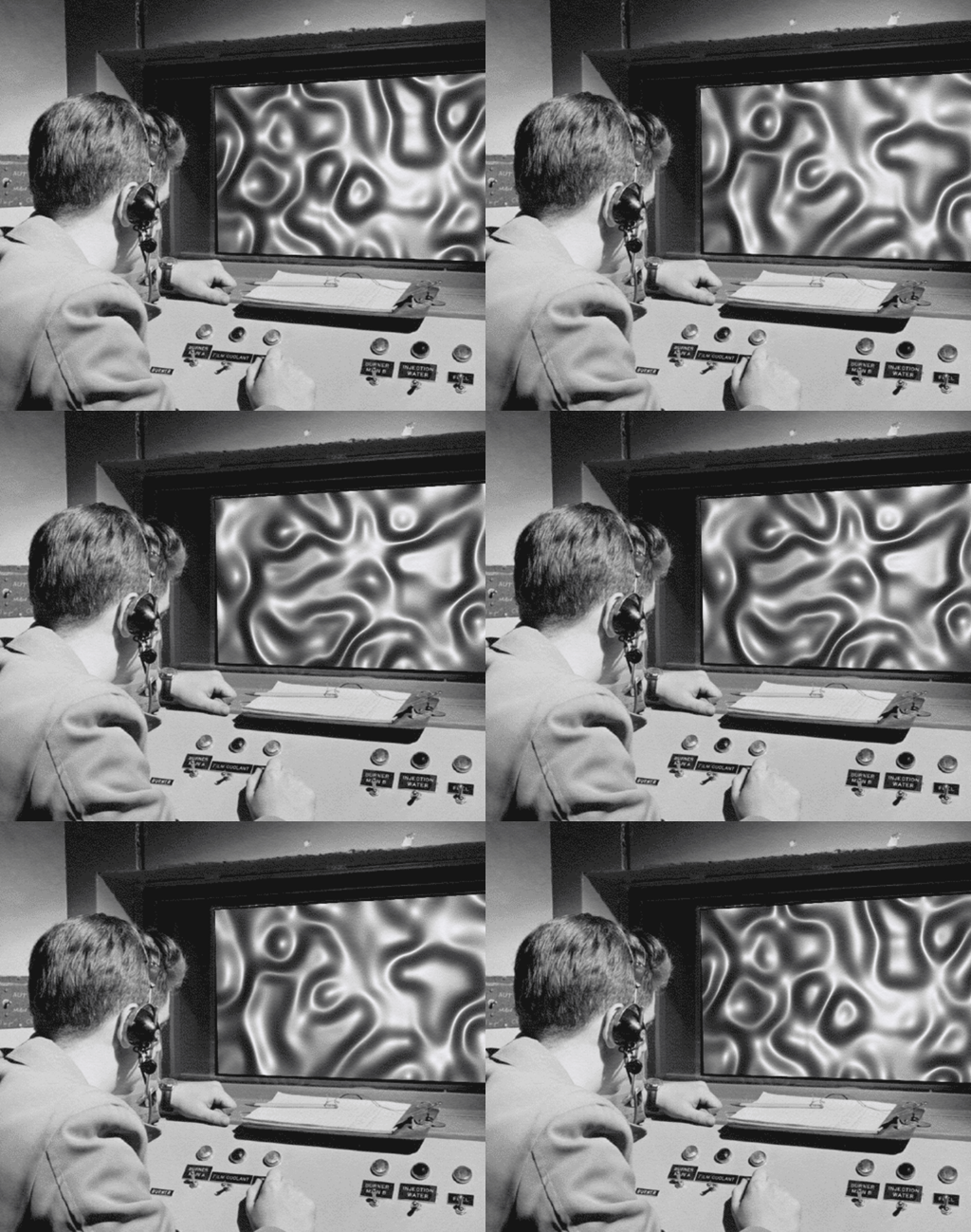
A man sits at a control panel with knobs and buttons, wearing a headset, looking at a screen displaying abstract, distorted wavy patterns—the antidote for leaders in navigating complex data.
We can address the misalignment between the current leadership reality and traditional leadership practices with a simple formula.
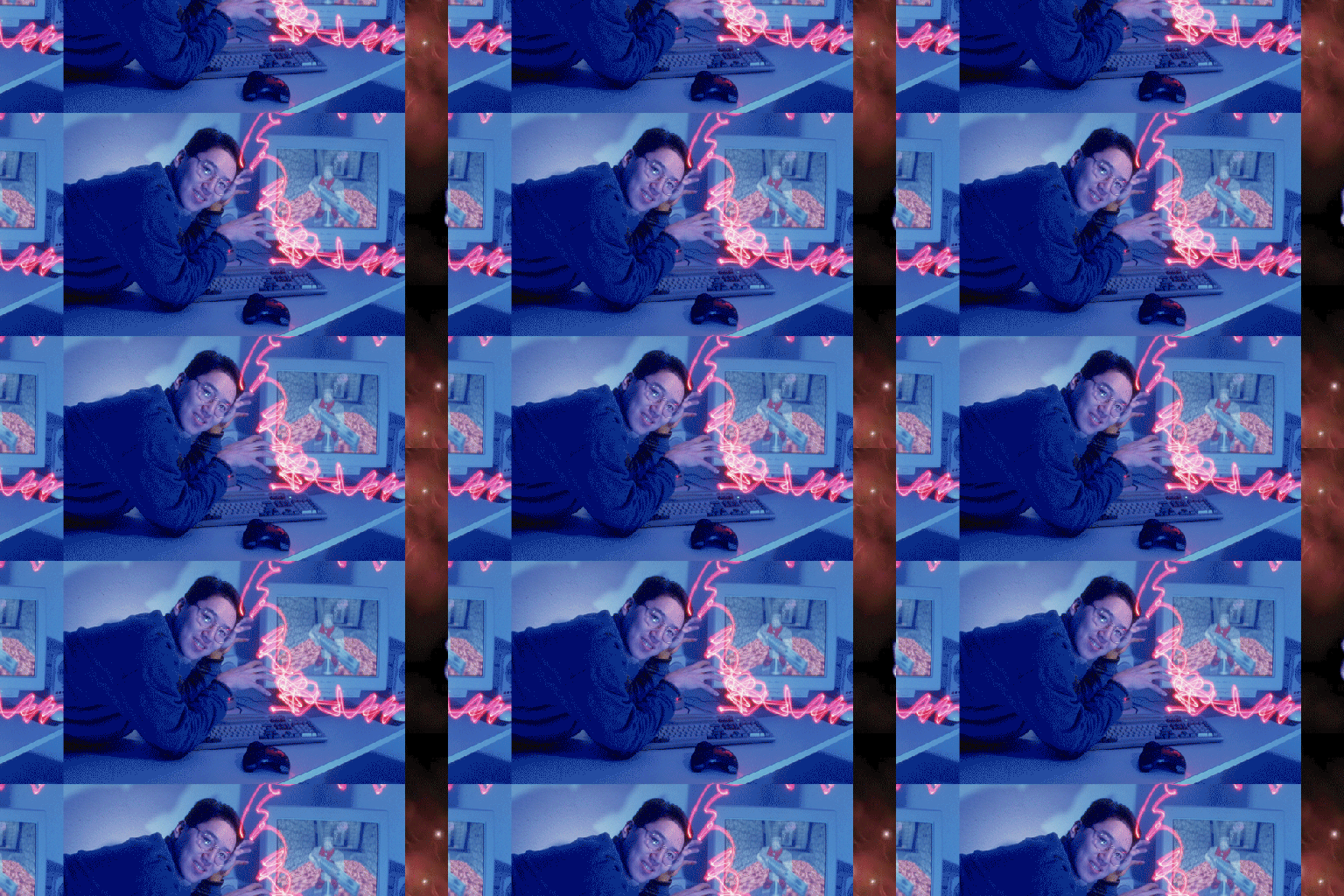
A person in glasses using a computer is repeated four times on the left, showcasing the intensity of the first pro gamer, while two video game screenshots are featured on the right side of the image. Pink neon lines are superimposed over the scenes.
Dennis “Thresh” Fong talks to us about battling Elon Musk in Quake in the ‘90s, his undefeated record as a pro gamer, and using AI to detoxify gaming.
A stainless steel razor blade in the shape of an open book against a blue background. The razor's edges form the outline of the book's pages.
Some news is slow, some news is fast — and there are two simple techniques to help you filter both.
Image with a split view: the left half shows a black-and-white image of Earth, the right half depicts a grayscale crowd scene. Text overlay: "More Humans Are Better," with the number "3" in the top right corner.
In a world of rising cynicism, a celebration of our capacity to create, adapt, and thrive.
New research from Big Think+ shows that leaders crave more feedback on their leadership and management skills.
A silhouette of an archer centaur stands poised over a background of binary code, symbolizing the rise of more AI jobs.
Evidence shows that “centaurs” — human–AI teaming — produce better performance than either people or software can achieve alone.
Black-and-white photo of a smiling man in a suit superimposed on a collage with abstract shapes, an office scene, and a map highlighting Santiago, Chile, capturing an emotional connection to the city's vibrant spirit.
Jeremy Johnson — co-founder of the talent network Andela — reflects on leadership in the age of remote work and AI.
Collage of graphical elements includes a plant, a salt shaker, and abstract designs with the text "THE NIGHTCRAWLER" and a small "resilient investing" logo in the corner.
Welcome to The Nightcrawler — a weekly newsletter from Eric Markowitz covering tech, innovation, and long-term thinking.
A white ladder leans against a white wall, leading up to a circular opening revealing a blue sky with scattered clouds.
A simple semantic device — invented by a forgotten senator — can help us break “the curse of knowledge.”