




















Search
Cosmic Inflation

There was a lot of hype and a lot of nonsense, but also some profoundly major advances. Here are the biggest ones you may have missed.

From a hot, dense, uniform state in its earliest moments, our entire known Universe arose. These unavoidable steps made it all possible.

It was barely a century ago that we thought the Milky Way encompassed the entirety of the Universe. Now? We're not even a special galaxy.

Since the mid-1960s, the CMB has been identified with the Big Bang's leftover glow. Could any alternative explanations still work?
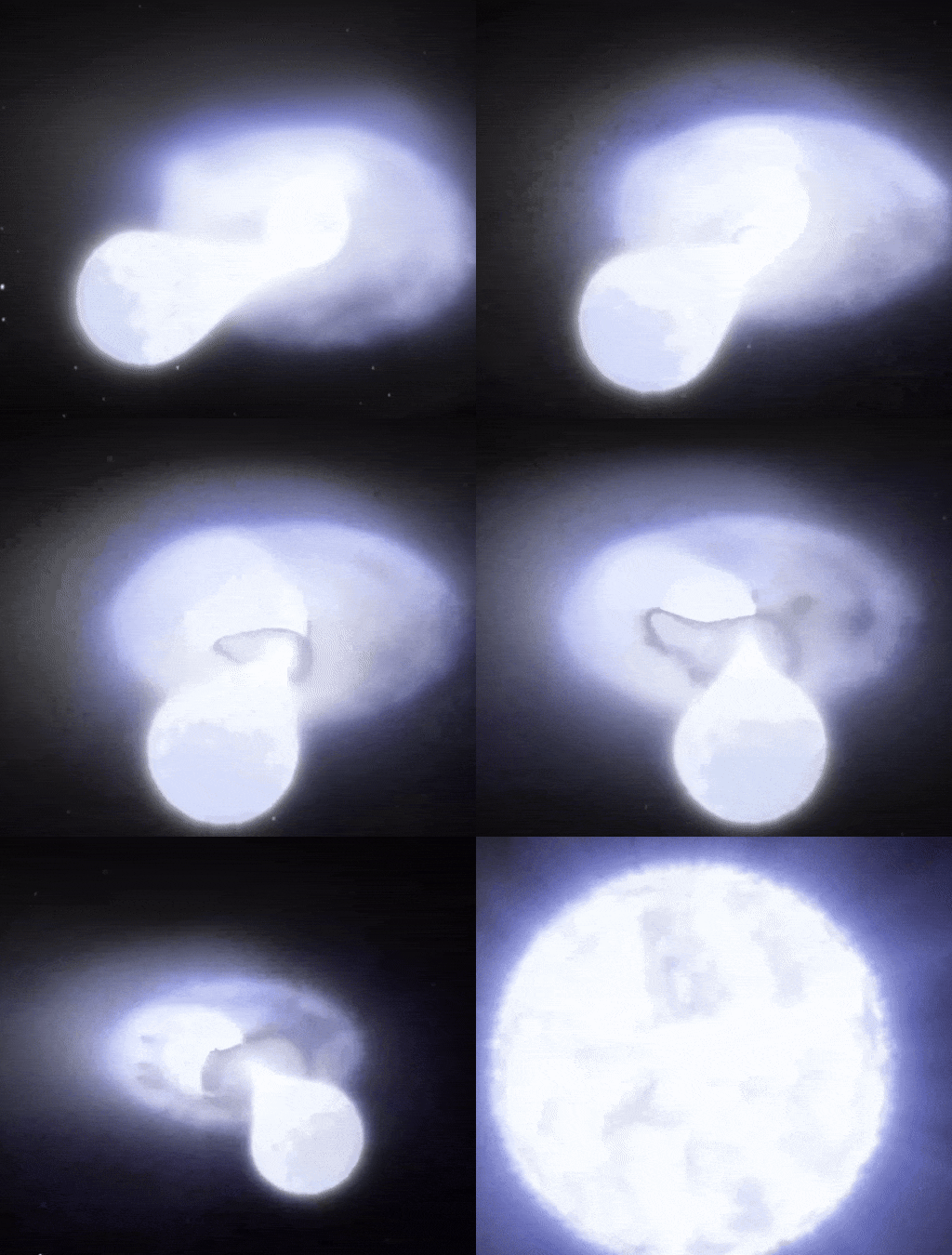
Since 1930, type Ia supernovae have been thought to arise from white dwarfs exceeding the Chandrasekhar mass limit. Here's why that's wrong.

Black holes are the most massive individual objects, spanning up to a light-day across. So how do they make jets that affect the cosmic web?

Almost everyone asserts that the Big Bang was the beginning of everything, followed by inflation. Has everyone gotten the order wrong?

The most common visual depictions of the history of the Universe show the Big Bang as a growing tube with an "ignition" point. Why is that?

The Universe changes remarkably over time, with some entities surviving and others simply decaying away. Is this cosmic evolution at work?

In all directions, at great distances, the Universe looks younger, more uniform, and less evolved. Does that mean Earth must be the center?

With the discovery of Porphyrion, we've now seen black hole jets spanning 24 million light-years: the scale of the cosmic web.

The Lyman-α emission line has never been seen earlier than 550 million years after the Big Bang. So why does JADES-GS-z13-1-LA have one?

The Universe isn't just expansion, but the expansion itself is accelerating. So why can't we feel it in any measurable way?

Life arose on Earth early on, eventually giving rise to us: intelligent and technologically advanced. "First contact" still remains elusive.

If you think of the Big Bang as an explosion, we can trace it back to a single point-of-origin. But what if it happened everywhere at once?

3mins
What drives the universe's expansion? Chemist Lee Cronin explains the theories linking time, space, and selection, providing a fresh perspective on this cosmic mystery.

The Universe is 13.8 billion years old, going back to the hot Big Bang. But was that truly the beginning, and is that truly its age?
Many contrarians dispute that cosmic inflation occurred. The evidence says otherwise.

The largest particle accelerator and collider ever built is the Large Hadron Collider at CERN. Why not go much, much bigger?

Even in the very early Universe, there were heavy, supermassive black holes at the centers of galaxies. How did they get so big so fast?

The Universe's history, from cosmic inflation to the Big Bang to the present, is known. But whether it's infinite or not is still a mystery.

There are two different ways to measure the expansion rate of the Universe, and they don't agree. And no, new measurements don't help.

A new all-time record! JWST's discovery of JADES-GS-z14-0 pushes the earliest galaxy ever seen to just 290 million years after the Big Bang.

If you bring too much mass or energy together in one location, you'll inevitably create a black hole. So why didn't the Big Bang become one?

Predicted way back in the 1960s, the discovery of the Higgs boson in 2012 completed the Standard Model. Here's why it remains fascinating.

In general relativity, white holes are just as mathematically plausible as black holes. Black holes are real; what about white holes?

From the earliest stages of the hot Big Bang (and even before) to our dark energy-dominated present, how and when did the Universe grow up?

For some reason, when we talk about the age of stars, galaxies, and the Universe, we use "years" to measure time. Can we do better?

The Universe is 13.8 billion years old, going back to the hot Big Bang. But was that truly the beginning, and is that truly its age?
The "first cause" problem may forever remain unsolved, as it doesn’t fit with the way we do science.