




















Search
Cosmic Inflation

With ~400 billion stars in the Milky Way and 6-20 trillion galaxies overall, that makes for a lot of stars. But not as many as you'd think.

How fast is the Universe expanding? Two major methods disagree. New JWST data, just released, strengthens this Hubble tension even further.

There are two types of missing, or "dark" matter: baryonic (made of normal matter) and non-baryonic. Have we finally found the normal stuff?

Today, our observable Universe extends for 46 billion light-years in all directions. But early on in our history, things were much smaller.

In a distant galaxy, a cosmic dance between two supermassive black holes emits periodic flashes of light.
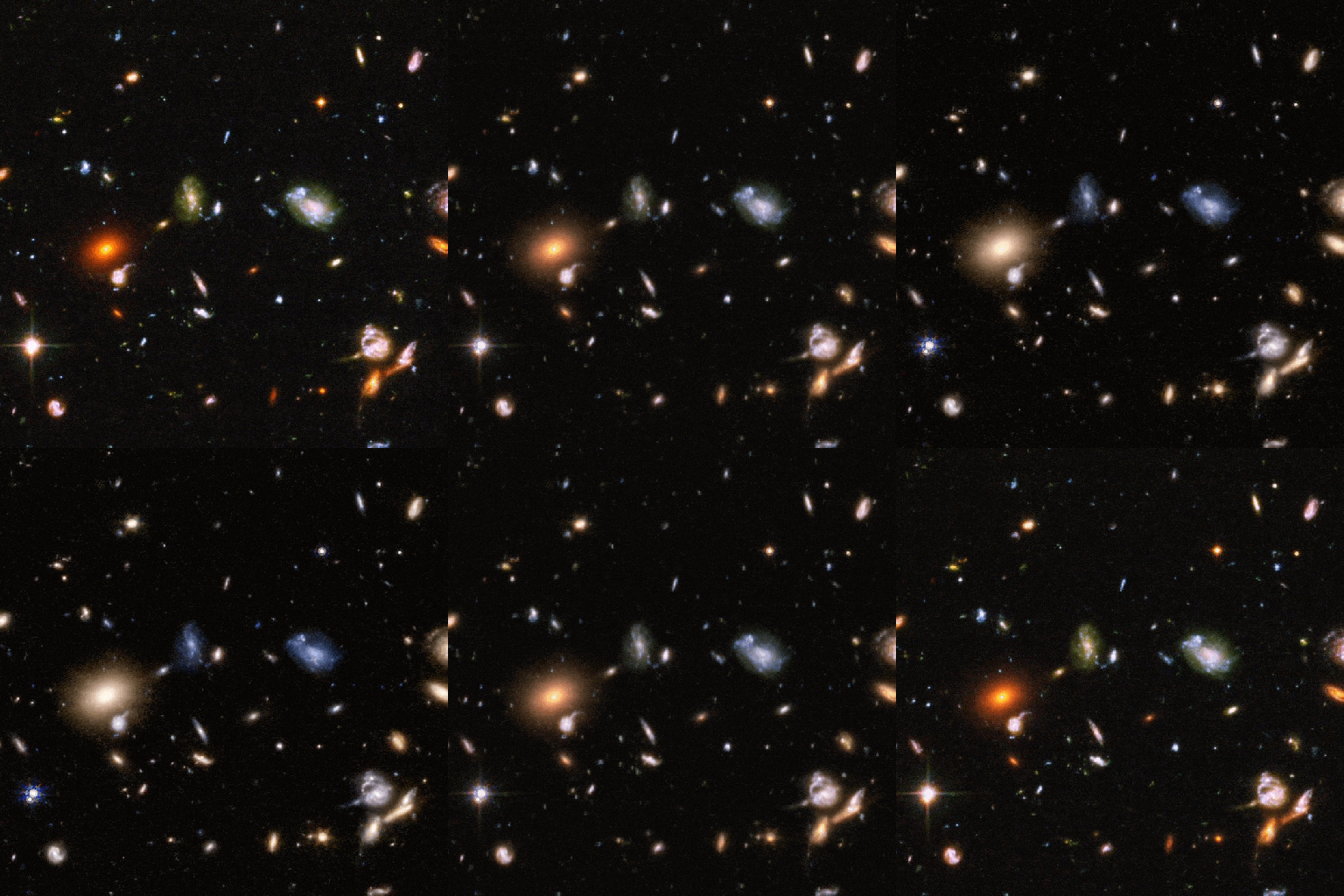
The farther away they get, the smaller distant galaxies look. But only up to a point, and beyond that, they appear larger again. Here’s how.

It's been 100 years since we discovered that the Universe was expanding. But if it's expanding, then what is it expanding into?

If our Universe were born a little differently, there wouldn't have been any planets, stars, galaxies, or chemically interesting reactions.

We can reasonably say that we understand the history of the Universe within one-trillionth of a second after the Big Bang. That's not good enough.

A new, unexpected brightening, just 3 years after a massive dimming event, has astronomers watching Betelgeuse. Is a supernova imminent?

Before there were planets, stars, and galaxies, before even neutral atoms or stable protons, there was the Big Bang. How did we prove it?

Cosmologists are largely still in the dark about the forces that drive the Universe.

It may be time for a cosmological paradigm shift.

When white dwarfs explode, they create a type Ia supernovae. After decades of following the leading theory, here's the complete overhaul!

With a finite 13.8 billion years having passed since the Big Bang, there's an edge to what we can see: the cosmic horizon. What's it like?

What do we mean by a black hole's size? A photon sphere? The minimal stable orbit? The event horizon? The singularity? Which one is right?

Nobel Laureate Roger Penrose, famed for his work on black holes, claims we've seen evidence from a prior Universe. Only, we haven't.

The glorious sights that JWST keeps revealing are less than a millionth of the whole Universe. Just imagine what else is out there.

From the Big Bang to dark energy, knowledge of the cosmos has sped up in the past century — but big questions linger.

The secret ingredient is violence, and it just might indicate that "moonmoons" aren't as uncommon as most astronomers think.

From the earliest stages of the hot Big Bang (and even before) to our dark energy-dominated present, how and when did the Universe grow up?

In general relativity, white holes are just as mathematically plausible as black holes. Black holes are real; what about white holes?

The Universe isn't as "clumpy" as we think it should be.

The Universe certainly formed stars, at one point, for the very first time. But we haven't found them yet. Here's what everyone should know.

One study suggested that the "Methuselah Star" is older than the Universe itself.

JWST just found its first transiting exoplanet, and it's 99% the size of Earth. But with no atmosphere seen, perhaps air is truly rare.

All the things that surround and compose us didn't always exist. But describing their origin depends on what 'nothing' means.

You can lead an overconfident chatbot to expert knowledge, but can it actually learn and assimilate new information?

The very dust that blocks our view of the distant, luminous objects in the Universe is responsible for our entire existence.
We thought the Big Bang started it all. Then we realized that something else came before, and it erased everything that existed prior.