




















Search
Cosmology

Such massive, early supermassive black holes have puzzled astronomers for decades. At last, we've finally figured out how they form.

Every observation out into deep space is also a look back in time.

From white holes to dark stars and multiverses, James Riordon explores the bizarre exhibits of general relativity's "cryptozoo."

Wavelengths stretch, distances grow, and temperatures cool as the Universe expands with time. How are the various cosmic parameters related?

Weird-looking galaxies, with tentacle-like tails or prominent dual streams, appear like jellyfish or bunny ears. But that’s just the start.

Dark matter, dark energy, and the Big Bang are all part of a solid scientific foundation. Here's why popular media often claims otherwise.

Planets grow from protostellar material in disks, leading to full-grown planetary systems in time. At last, the final gap has been filled.

Until the late 20th century, there wasn't a truly universal standard. Under our current definition, everyone agrees on what "one meter" is.

Stellar streams are faint trails of stars that appear to "stream" out of galaxies. A new one, escaping galaxy M61, may point to many others.

When dying, Sun-like stars have binary companions, spectacular sights arise from the ionization. JWST spots the Red Spider Nebula in action!

There's some, but not overwhelming, evidence that dark energy is evolving. What would it take for a "Big Crunch" to be our cosmic fate?

Scientists are notoriously resistant to new ideas. Are they falling prey to groupthink? Or are our current theories just that successful?

The planet, the Solar System, and the galaxy aren't expanding. But the whole Universe is. So where does the dividing line begin?

For 13.8 billion years, the Universe has been expanding. But that couldn't have been the case for an eternity, and science has proven it.

Dark matter has never been directly detected, but the astronomical evidence for its existence is overwhelming. Here's what to know.

We've long known we can't go back to infinite temperatures and densities. But the hottest part of the hot Big Bang remains a cosmic mystery.

Red dwarfs are the Universe's most common star type. Their flaring now makes potentially Earth-like worlds uninhabitable, but just you wait.

Found by Hubble before JWST's launch, GNz7q looked like a mix of a galaxy and a quasar. Was it actually our first known "little red dot"?

24mins
“Deep down the natural endpoint of this whole goal of looking for planets is to answer the question: are we alone?”

Observations with the Hubble space telescope helped cement dark energy and reveal the Hubble tension. How are these two things so different?

The whole isn't greater than the sum of its parts; that's a flaw in our thinking. Non-reductionism requires magic, not merely science.

Inflation's two main criticisms, that it can predict anything and that the "measure problem" remains unsolved, can't erase its successes.

To learn how our Universe grew up, we have to look at large numbers of galaxies at all distances to find out. Good thing we have JWST!

Our Sun only arose after 9.2 billion years of cosmic history: with many stars living and dying first. How many prior generations were there?

Since the time of Galileo, Saturn's rings have remained an unexplained mystery. A new idea may have finally solved the longstanding puzzle.

By deeply imaging a large volume of space, COSMOS-Web provides JWST's widest cosmic views. Its gravitational lenses reveal a big surprise.

As the Universe ages, it continues to gravitate, form stars, and expand. And yet, all this will someday end. Do we finally understand how?
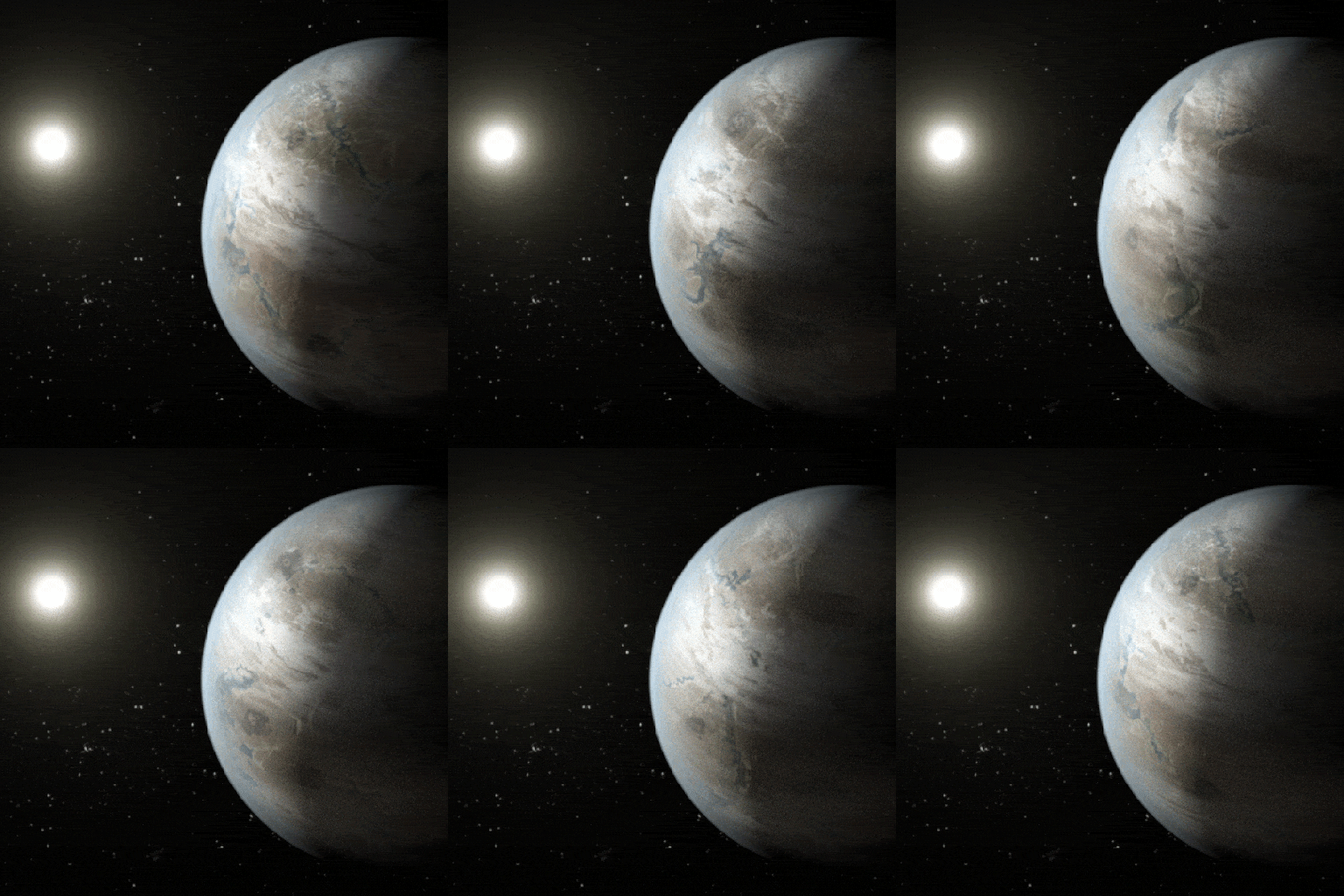
From here on Earth, looking farther away in space means looking farther back in time. So what are distant Earth-watchers seeing right now?

Proposed over 2000 years ago by Democritus, the word atom literally means uncuttable. Revived in 1803, today's "atoms" can indeed be split.

From the Big Bang to a prior period of cosmic inflation, our cosmic origins are clearer than ever. Yet these 5 big mysteries still remain.