




















Search
Cosmology

On cosmic scales, only dark matter (or something equivalent) gives us the Universe we observe. Now, the Sunyaev-Zel'dovich effect agrees.

"Color" with respect to the strong force is just an analogy. Here's how to understand it without colors, group theory, or any advanced math.

One parameter, alone, sets the dividing line between rocky planets, gas giants, brown dwarfs, stars, and much more. Here's why mass matters.

The distance ladder and the CMB give incompatible values for the expansion rate. A new study shows just how robust the Hubble tension is.
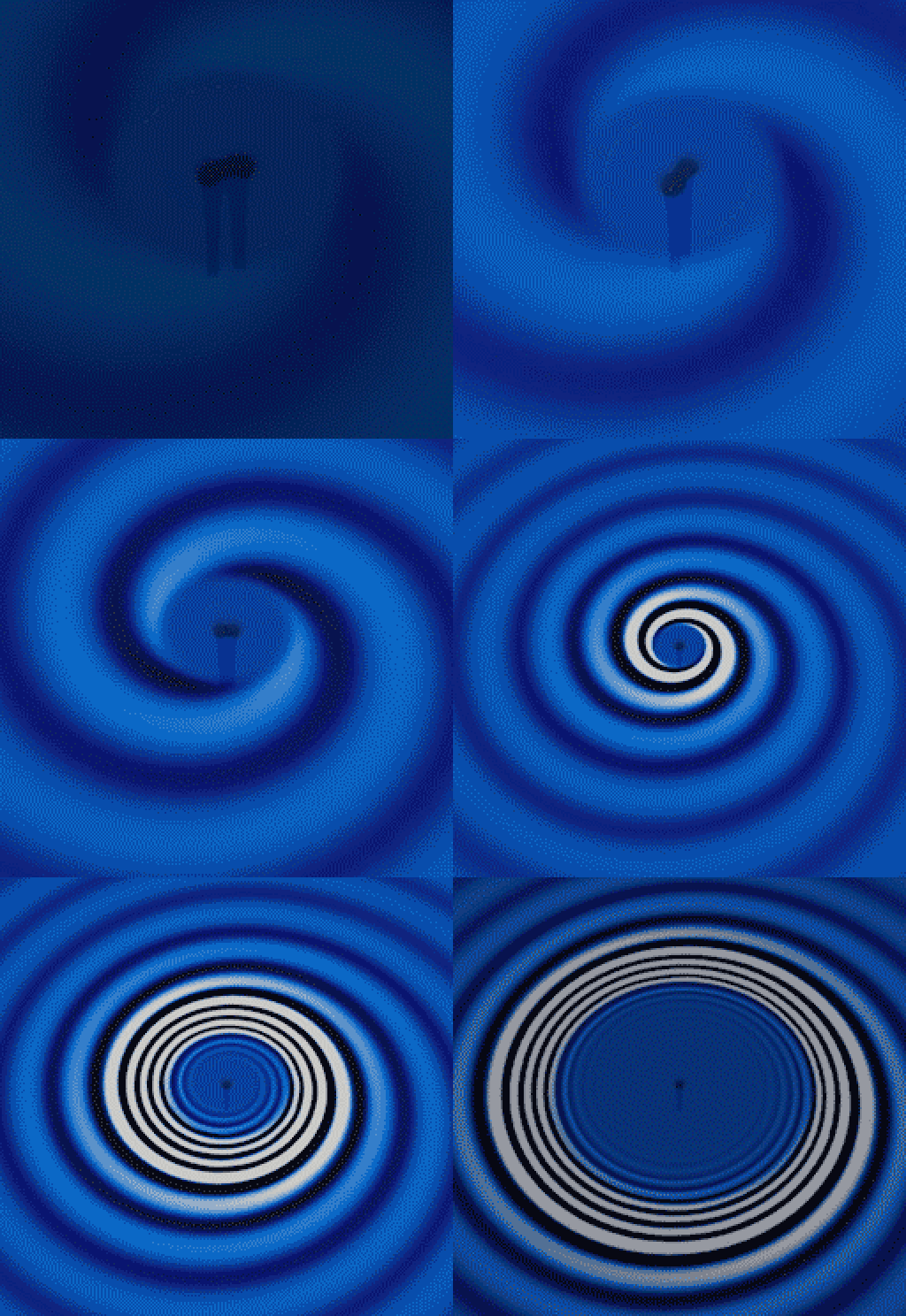
As light travels across the Universe, it's subject to cosmic expansion, changing fields, and relative motion. How about gravitational waves?

Is dark energy evolving with at least 99.99% confidence? Despite the quality of recent data, scientists have every reason to be skeptical.

In a 13.8 billion year old Universe, a few seconds hardly seems like it matters. But these minuscule changes sure do add up over time.

Most massive galaxies are spiral or elliptical shaped. But peculiar galaxies showcase the beautiful violence that helps explain our cosmos.

Early on, the Universe needed near-perfect flatness, or atoms, stars, and galaxies couldn't form. What happens once dark energy takes over?
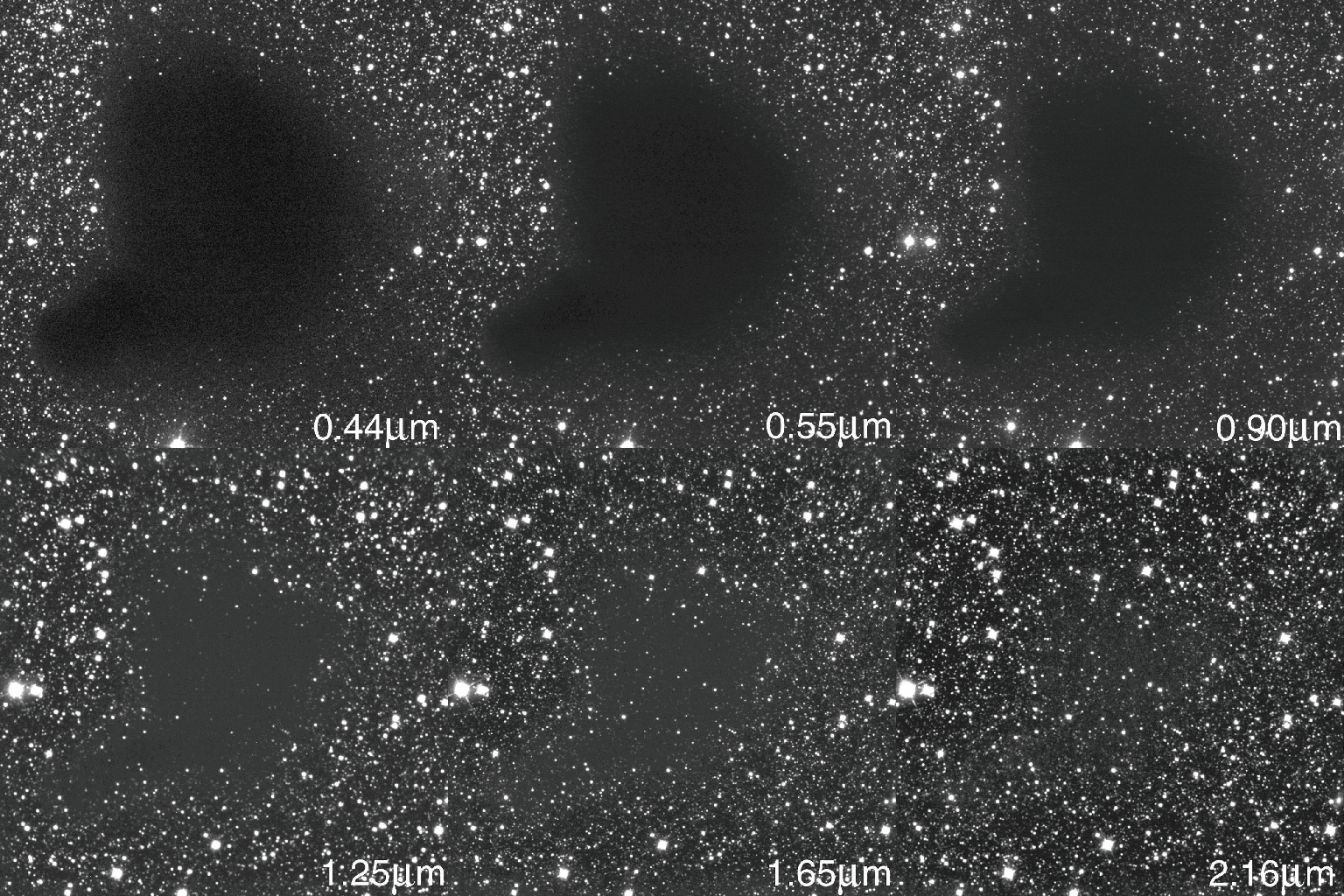
The image you're seeing isn't a hole in the Universe, and the cosmic voids that do exist aren't hole-like at all.

1hr 16mins
NASA astronomer Michelle Thaller makes the case that quantum entanglement may be the underlying fabric from which spacetime itself emerges.

We have two descriptions of the Universe that work perfectly well: general relativity and quantum physics. Too bad they don't work together.

No matter what physical system we consider, nature always obeys the same fundamental laws. Must it be this way, and if so, why?

When what we predict and what we measure don't add up, that's a sign there's something new to learn. Could it be a new fundamental force?

Over billions of years, fewer stars form, galaxies mutually recede, and the Universe becomes ever darker. Here's how fast it all happens.

Not everyone accepts the scientific consensus; some even make careers out of challenging it. But only a select few do it the right way.

Resembling a cosmic brain, the Exposed Cranium Nebula instead shows a dying, massive star, as JWST reveals. Its fate remains uncertain.

In traveling through the expanding Universe, particles slow down while light and gravitational waves redshift. What degrades and what won't?

1hr 19mins
Theoretical physicist Jim Al-Khalili explores why our sense of time may be incredibly misleading, including the idea that past, present, and future might all exist at once.

The discovery of CDG-2, a galaxy that's more than 99.9% dark matter, could reveal a new population of ultra-faint galaxies. But is it real?

Quantum entanglement links information between particles across space and time. So what happens when one of them falls into a black hole?

Forget about the terawatt lasers we're making on Earth. The Universe makes natural ones thousands of times more powerful than the Sun.

The fundamental building blocks of reality are indivisible: quanta that cannot be split or divided. Our understanding remains incomplete.

Long after the last star burns out, the Universe will experience its end state: a heat death. Will everything prior then be meaningless?

Before we formed stars, atoms, elements, or even got rid of our antimatter, the Big Bang made neutrinos. And we finally found them.

The Universe is expanding, the expansion is accelerating, and some galaxies even recede faster-than-light. Can we see a change in real time?

Before Sun-like stars die, they transition from AGB red giants into preplanetary nebulae. Here's how Hubble sees the famous Egg Nebula.

1hr 3mins
Astronomer Jill Tarter explains why SETI is really about technology, patience, and learning how to tell alien signals from our own.

Many collaborations have used JWST to take deep-field images: some wider and some deeper than others. Here's how it can surpass them all.

The Universe formed stars, galaxies, and even galaxy clusters extremely early on in our cosmos. This new marvel is one more JWST surprise.