




















Search
Cosmology

Taught in every introductory physics class for centuries, the parabola is only an imperfect approximation for the true path of a projectile.

Inflation, dark matter, and string theory are all proposed extensions to the prior consensus picture. But what does the evidence say?

The observation that everything we know is made out of matter and not antimatter is one of nature's greatest puzzles. Will we ever solve it?

The mass that gravitates and the mass that resists motion are, somehow, the same mass. But even Einstein didn't know why this is so.

Scientific surprises, driven by experiment, are often how science advances. But more often than not, they’re just bad science.
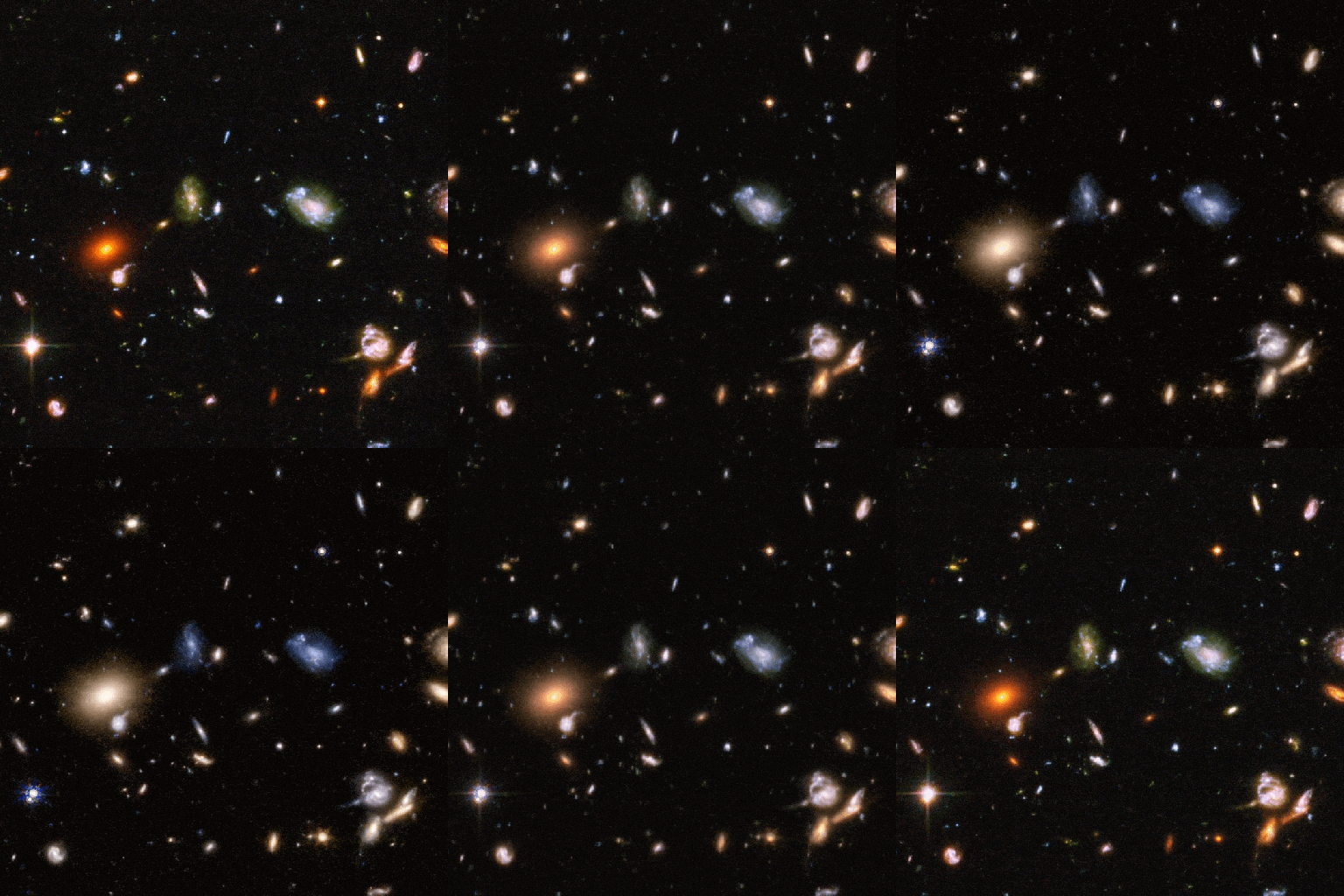
The "little red dots" were touted as being too massive, too early, for cosmology to explain. With new knowledge, everything adds up.

The Universe isn't just expansion, but the expansion itself is accelerating. So why can't we feel it in any measurable way?

No matter how good our measurement devices get, certain quantum properties always possess an inherent uncertainty. Can we figure out why?

If you think of the Big Bang as an explosion, we can trace it back to a single point-of-origin. But what if it happened everywhere at once?

DUNE is designed to detect the Universe's most antisocial particle: the neutrino.

3mins
What drives the universe's expansion? Chemist Lee Cronin explains the theories linking time, space, and selection, providing a fresh perspective on this cosmic mystery.

The Universe is 13.8 billion years old, going back to the hot Big Bang. But was that truly the beginning, and is that truly its age?
Many contrarians dispute that cosmic inflation occurred. The evidence says otherwise.

In all the Universe, only a few particles are eternally stable. The photon, the quantum of light, has an infinite lifetime. Or does it?

The big question isn't whether the Universe is expanding at 67 or 73 km/s/Mpc. It's why different methods yield such different answers.

Most stars in the Universe are located in big, massive, Milky Way-like galaxies. But most galaxies aren't like ours at all.

More than any other equation in physics, E = mc² is recognizable and profound. But what do we actually learn about reality from it?

For centuries, Newton's inverse square law of gravity worked beautifully, but no one knew why. Here's how Einstein finally explained it.

From size to mass to density and more, each world in our Solar System is unique. When we compare them, the results are truly shocking.

Dark matter's hallmark is that it gravitates, but shows no sign of interacting under any other force. Does that mean we'll never detect it?

Straddling the bounds of science and religion, Newton wondered who set the planets in motion. Astrophysics reveals the answer.

How do normal matter and dark matter separate by so much when galaxy clusters collide? Astronomers find the surprising, unexpected answer.

Even in the very early Universe, there were heavy, supermassive black holes at the centers of galaxies. How did they get so big so fast?

The passage of time is something we all experience, as it takes us from one moment to the next. But could it all just be an illusion?
From inside our Solar System, zodiacal light prevents us from seeing true darkness. From billions of miles away, New Horizons finally can.

For its 2-year science anniversary, JWST has revealed unprecedented details in "the Penguin and the Egg." Here are the surprises inside.

Just 13.8 billion years after the hot Big Bang, we can see objects up to 46.1 billion light-years away. No, this doesn't violate relativity.

We know of stellar mass and supermassive black holes, but intermediate mass ones have long proved elusive. Until now.

The Bullet Cluster has, for nearly 20 years, been hailed as an empirical "proof" of dark matter. Can their detractors explain it away?

On a cosmic scale, our existence seems insignificant and inconsequential. But from another perspective, humans are completely remarkable.