




















Search
Cultural Evolution

How drugs, demons, and the search for immortality gave us words we use everyday.

Just as human beings diversified so that people in Asia look different from people in Europe, so too did their microbiomes.

Our inaugural special issue is focused on progress — the search for, the study of, and the project towards a better world.

An interview with filmmaker Jason Sussberg about his new film about Stewart Brand and the importance of culture in achieving progress.

Advances in ancient DNA analysis gave researchers a new way to trace the movements of peoples across Eurasia.

The Industrial Revolution changed music forever, thanks to a combination of technological advances and clever entrepreneurs.

Anything, good or bad, about Henry Ford can be contradicted — except his ambition and his work.

Time will tell what the reign of Charles III will look like, but one thing is for sure: the “new Elizabethan age” is long gone.


The Greeks were among the first to move beyond “primitive money” and establish an official currency, transforming their trade, government, and even philosophy.
Million Stories

When justice isn’t tempered by something such as mercy, forgiveness, or nonviolence, efforts to make society more equitable often backfire.
John Templeton Foundation

Horses pranced around the western hemisphere until they went extinct in the late Holocene. They were reintroduced by European colonists — though where, when, and how has remained unclear.

8mins
The history of music from bone flutes to Beyoncé.

A second Enlightenment would have a far bigger task: Saving civilization itself.

Using data collected from ancient civilizations across the world, researchers identified the most significant factors in human development. War came out on top.

4mins
Rituals come as much from religion as they do from the way Earth spins around the Sun.

It is little more than a fancy excuse for escapist fantasizing.

According to author and entrepreneur Steven Kotler, at some point this century, we will confront the prospect of immortality.
John Templeton Foundation

Research shows that octopuses are sentient, emotional creatures.

Every timekeeping device works via a version of a pendulum — even the atomic clocks that are accurate to nanoseconds.

Moments of social anxiety around truth tend to be accompanied by similar “fool the eye” pop culture phenomena.
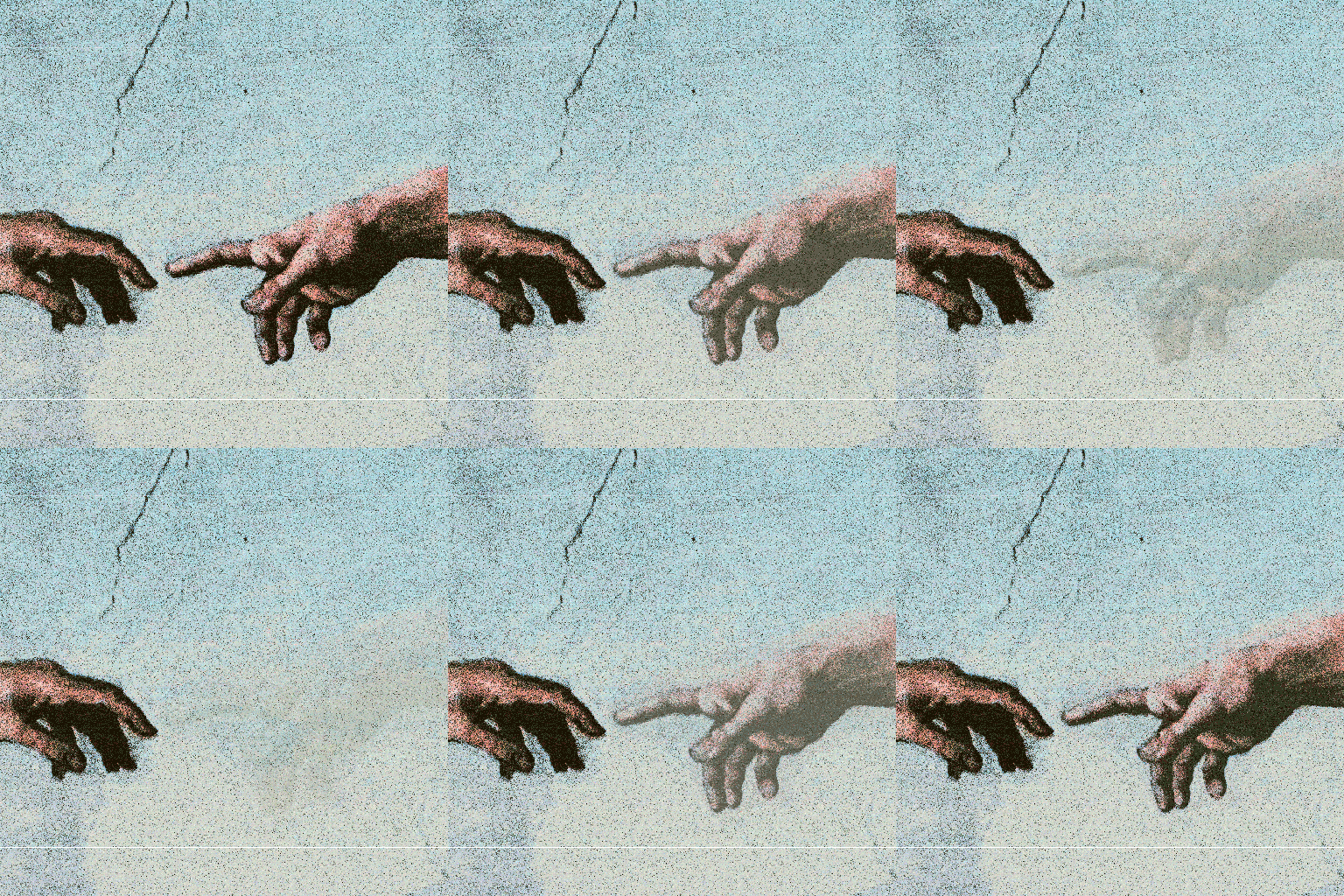
Many atheists think of themselves as intellectually gifted individuals, guiding humanity on the path of reason. Scientific data shows otherwise.
John Templeton Foundation

This representation of the Bamum kingdom is a rare example of early 20th-century indigenous African cartography.

Time for a status check before watching "Moon Knight."

Awe is a powerful force, a fact that is both exciting and terrifying.
John Templeton Foundation

1mins
From trust and conformity to aspiration, this new series, hosted by Todd Rose, explores and decodes the world's greatest Collective Illusions.
Stand Together

One particular revolution was so important, that at least one historian thinks the 20th century officially began in 1914 and ended in 1991.

After it became clear that the world wasn't 6,000 years old, some proposed that northern peoples had emerged independently from others.

We are generally taught that there is an arc of history — an inevitable path of progress that leads to modern society. Maybe it isn't true.

Many key inventions were unique: one-offs.