
















Earth Science

Earth Science

A group of people stands and plays cricket in an urban park at dusk, with city buildings, trees, and illuminated streetlights in the background.
The ozone hole was going to destroy life as we know it, but an unprecedented global effort fixed the problem.
logarithmic history of universe
In a 13.8 billion year old Universe, a few seconds hardly seems like it matters. But these minuscule changes sure do add up over time.
A woman in a red dress is gracefully ice skating on a frozen lake.
While ice itself is slick, slippery, and difficult to navigate across under most circumstances, skaters easily glide across the ice.
Top-down view of assorted wild mushrooms arranged in a circle with beige and orange cutout shapes on a black background.
Well before plants and animals, there were fungi.
a diagram of the ocean floor.
About six million years ago, the Mediterranean was sealed off from the Atlantic, and over centuries it ran dry. One megaflood reversed that.
A man in a suit sits in front of a large NASA logo sign, symbolizing the determination to defy charter limits and push the boundaries of space exploration.
NASA's 1958 charter's top priority was, "the expansion of human knowledge of phenomena in the atmosphere and space." Is this how it ends?
Map showing Copenhagen, Denmark’s projected 2080 climate as similar to Demigny, France today, with a red arrow connecting the two cities and climate details listed in pop-up boxes.
“Climate analog mapping” finds the place that is currently as warm as your city might be in 60 years.
Full moon over a city skyline at night, high-rise buildings aglow and lights reflecting on the calm water—a scene that inspires 5 science lessons about the moon's impact on our world.
Even just by examining the Moon with the unaided eye, we can learn an incredible amount about the Moon, Earth, and more.
A grey, icy planet or moon with surface cracks is shown against a backdrop of stars and the Milky Way galaxy.
The hunt for extraterrestrial life begins with planets like Earth. But our inhabited Earth once looked very different than Earth does today.
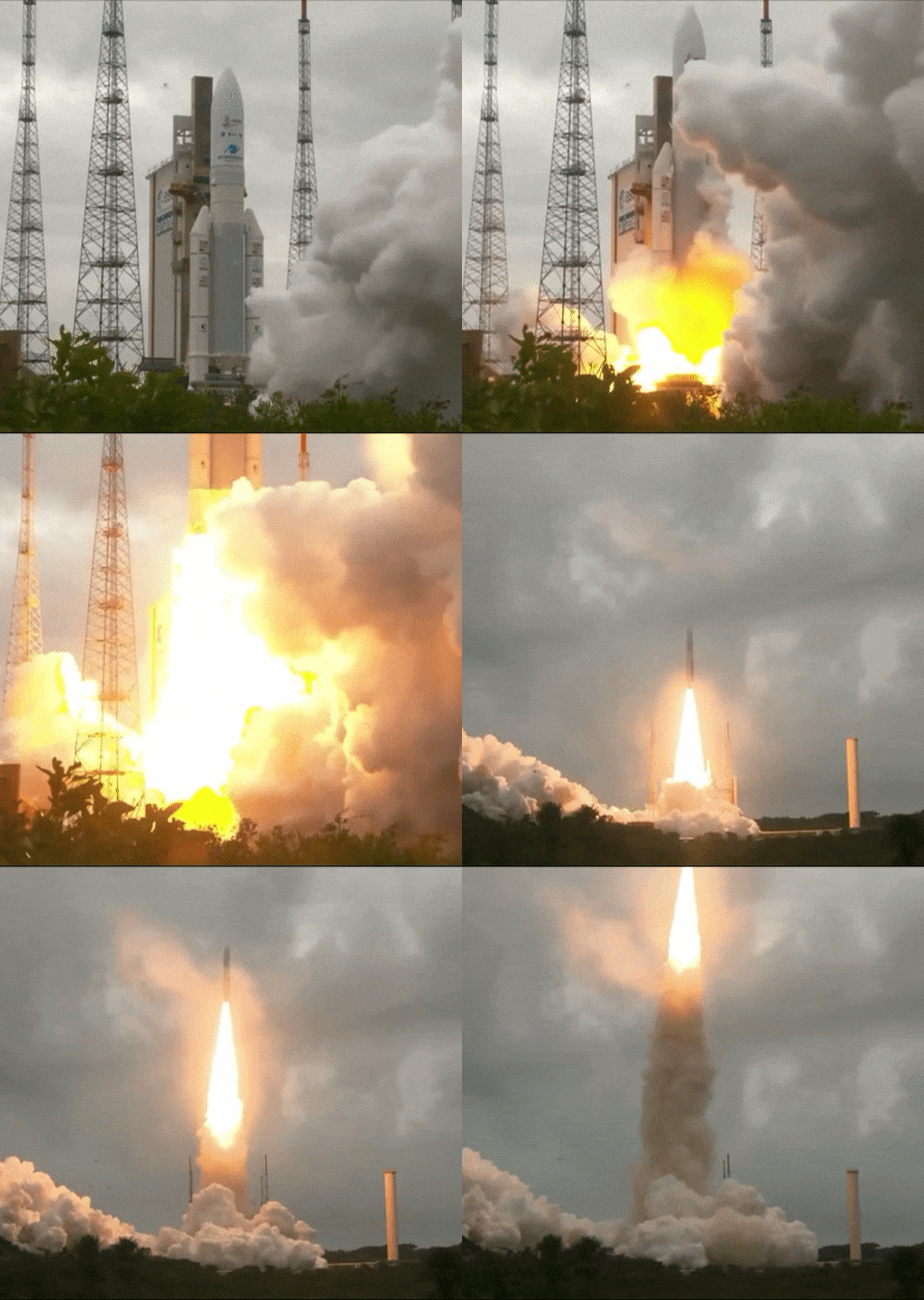
launch James Webb
As US science faces record cuts to funding, jobs, and facilities, these 10 quotes help remind us how science brings value to us all.
Book cover of "Target Earth" by Govert Schilling, featuring a meteor streaking toward Earth—a striking visual of cosmic catastrophe—set against space, clouds below, and an orange background.
If an asteroid hadn't killed off the dinosaurs, humans would almost certainly have never walked the Earth.
From a vantage point reminiscent of Carl Zimmer's explorations, an aerial view captures a massive swirling cloud formation over Earth, resembling a hurricane or cyclone against the infinite darkness of space.
In his new book, the popular science writer tells the story of how scientists discovered the “gaseous ocean” we all swim in — and the trillions of invisible life forms we share it with.
Gloved hands hold an open book titled "The Origin of Species by Means of Natural Selection" by Charles Darwin, a seminal work exploring the origin of life, published in London by John Murray, 1859.
These books helped build the empirical case that life's origins differ from those described in myths and legends.
World map showing temperature changes from 1880 to 2024, with warmer regions in red and cooler areas in blue. A timeline runs from 1880 to 2024 at the bottom.
The primary causes of global climate change are all due to human activity. Adding aerosols to our atmosphere only exacerbates the problem.
Chemical structures over an image of a planet with a dark background, resembling a scientific illustration of molecular compounds in space exploration.
Life might be more common across the Universe than the "Hard Steps Model" suggests.
Map showing tidal ranges in northern Europe. Notable locations include Severn Estuary, Mont Saint Michel Bay, and Gibraltar. Depths indicated in meters and feet.
Great tidal ranges are relatively rare on a global scale — and can be very deadly to the unsuspecting foreshore walker.
Rocky, reddish Martian landscape with scattered boulders and a hazy sky.
Caption:“At this time in Mars’ history, we think CO2 is everywhere, in every nook and cranny, and water percolating through the rocks is full of CO2 too,” Joshua Murray says.
A visual representation of the hole in the ozone over Antarctica, depicted in varying colors to indicate different ozone concentration levels, against a black background.
A scientist’s first-hand account shows the world can tackle a global environmental crisis.
Satellite image showing a dense cloud mass over the southeastern United States and the Gulf of Mexico, with an inset graph from NOAA depicting hurricane frequency peaking around mid-August to late September, a trend exacerbated by global warming.
The laws of physics aren't changing. But the Earth's conditions are different than what they used to be, and so are hurricanes as a result.
A world map displays global climate zones with colors representing varying levels of temperature and precipitation: green for temperate, yellow for arid, orange and red for hotter regions, and blue for wet zones.
The salinity of the oceans is not just a matter of taste. Saltier water behaves differently, too.
This graph shows the highest recorded temperatures in five Middle Eastern cities from 2010 to 2020. The temperatures range from 49.9°C to 53°C. An inset map highlights the locations of the cities.
You could call this rectangle covering parts of Iran, Iraq, and the Arabian Peninsula the “Oven Window.”
View of Earth from space showing a partially illuminated hemisphere with detailed ocean and cloud patterns against a backdrop of stars.
In the 1970s, James Lovelock proposed that the biosphere was not just green scruff quivering on Earth's surface. Instead, it managed to take over the geospheres.
Voyager 1
On a cosmic scale, our existence seems insignificant and inconsequential. But from another perspective, humans are completely remarkable.
Map of the world showing tropical cyclone tracks from 1985 to 2005. Paths are marked with lines indicating storm movement over time. Dense clusters appear in the North Pacific, North Atlantic, and the Indian Ocean.
Thanks to the Coriolis force, hurricanes never cross the equator.
Black and white image of the moon's surface covered with numerous craters of varying sizes under a stark black sky.
The Moon is the most likely place for evidence from the dawn of life on Earth to be preserved in cold storage.
A vibrant solar flare erupts from the Sun's surface, showcasing sun activity in 2024 and emitting bright ultraviolet light in this detailed astrophotograph.
Northern lights in the American South, clusters of huge geomagnetic storms—the Sun is throwing a tantrum right on schedule.
A composite image shows the sun's path in the sky at different times of the year over a grassy landscape, with three arches of sun positions represented by dots, illustrating the earliest solstice.
On June 20, 2024, the summer solstice occurs at its earliest moment since 1796: when George Washington was President of the USA. Here's why.
A sailboat is silhouetted against a vibrant sunset over a calm sea, with other boats and their reflections visible in the background. The sky and water have a golden hue.
Ancient currents seemed to move in concert with a 2.4 million-year dance between the Red Planet and Earth.
A realistic illustration of earth in space, bathed in sunlight with a visible blue glow from the GaiaSignatures atmosphere.
"I hope we take a mindset where we are willing to look for weird life in weird places."