




















Search
Evolutionary Biology

"For many people, the idea that consciousness is a set of tricks is offensive," the late philosopher told Big Think in 2012. "I think that's a prime mistake."

Our Earthbound definitions of life could leave us blind to the Universe’s strangest forms.

At the center of Hubble's famous "cosmic horseshoe," a very heavy supermassive black hole has been robustly measured. How is it possible?

Somewhere, at some point in the history of our Universe, life arose. We're evidence of that here on Earth, but many big puzzles remain.

In "The Headache," Tom Zeller Jr. explores one of the human brain's most enduring, and painful, enigmas.

After more than a million years of separation, two branches of humanity reunited around 300,000 years ago, suggests new research.
2mins
The ocean is evolving, and it’s not based on the ‘survival of the fittest.’ Astrobiologist Betül Kaçar explains how it’s not competition that has kept the ocean alive, but collaboration.

Evolution may have built our brains, but it didn't build them to find truth.
Why do we fall in love with one person over another? The late biological anthropologist Dr. Helen Fisher unpacks the evolutionary roots of romantic love, sex, and attachment. Using research […]

In "The Shortest History of the Dinosaurs," Riley Black reveals the bold mammals that thrived in the Age of Reptiles.

43mins
"If we're related to every living thing on the planet, do we not have a special responsibility for every living thing on this planet? They are really all our relatives."

1hr 11mins
“It's a remarkable series of events that were required for us to be here, and that so many things could have happened in a different way that we wouldn't be here at all, both individually, and as a species.”

Dreams of resurrecting lost species didn’t start in Hollywood or Silicon Valley.

If an asteroid hadn't killed off the dinosaurs, humans would almost certainly have never walked the Earth.

Welcome to The Nightcrawler — a weekly newsletter from Eric Markowitz covering tech, innovation, and long-term thinking.

Science writer Matt Ridley joins us to discuss how “Darwin’s strangest idea” makes us all a bit feather-brained (in a good way).

A fresh view of intelligence — spanning living systems from bacteria to human civilization — challenges the idea that it’s merely problem-solving.

These books helped build the empirical case that life's origins differ from those described in myths and legends.

Memory takes effort, and our brains know it.
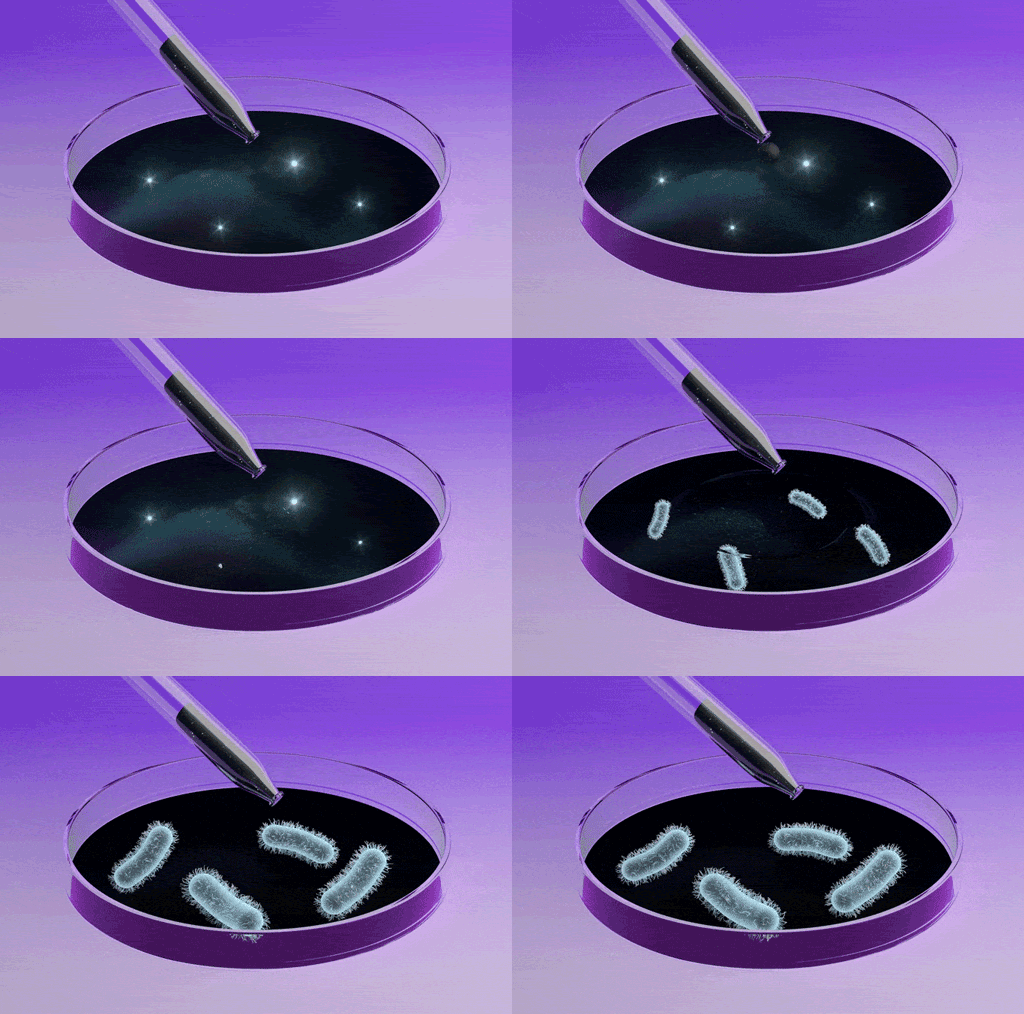
“I want to change the way we think about the past altogether,” says Dr. Betül Kaçar, an astrobiologist who studies the origin of life.

New research challenges old assumptions about the evolution of the human brain.

Life may have arisen far earlier — and more rapidly — than previously thought.

Life might be more common across the Universe than the "Hard Steps Model" suggests.

“Could you create a god?” Nietzsche's titular character asks in "Thus Spoke Zarathustra."

Could studying the Oriental hornet lead to a treatment for people with alcohol use disorder?

We need a "theory that explains the evolution of evolution," argues theoretical physicist Sara Imari Walker.

13mins
What can you do to support your health during menopause? “If exercise were a drug, that would be the one thing that we would be giving to everybody.”

Scientists have created a magnificent portrait of every connection among neurons in a fruit fly’s brain.

Here's the dark side of first contact.

The Universe changes remarkably over time, with some entities surviving and others simply decaying away. Is this cosmic evolution at work?